
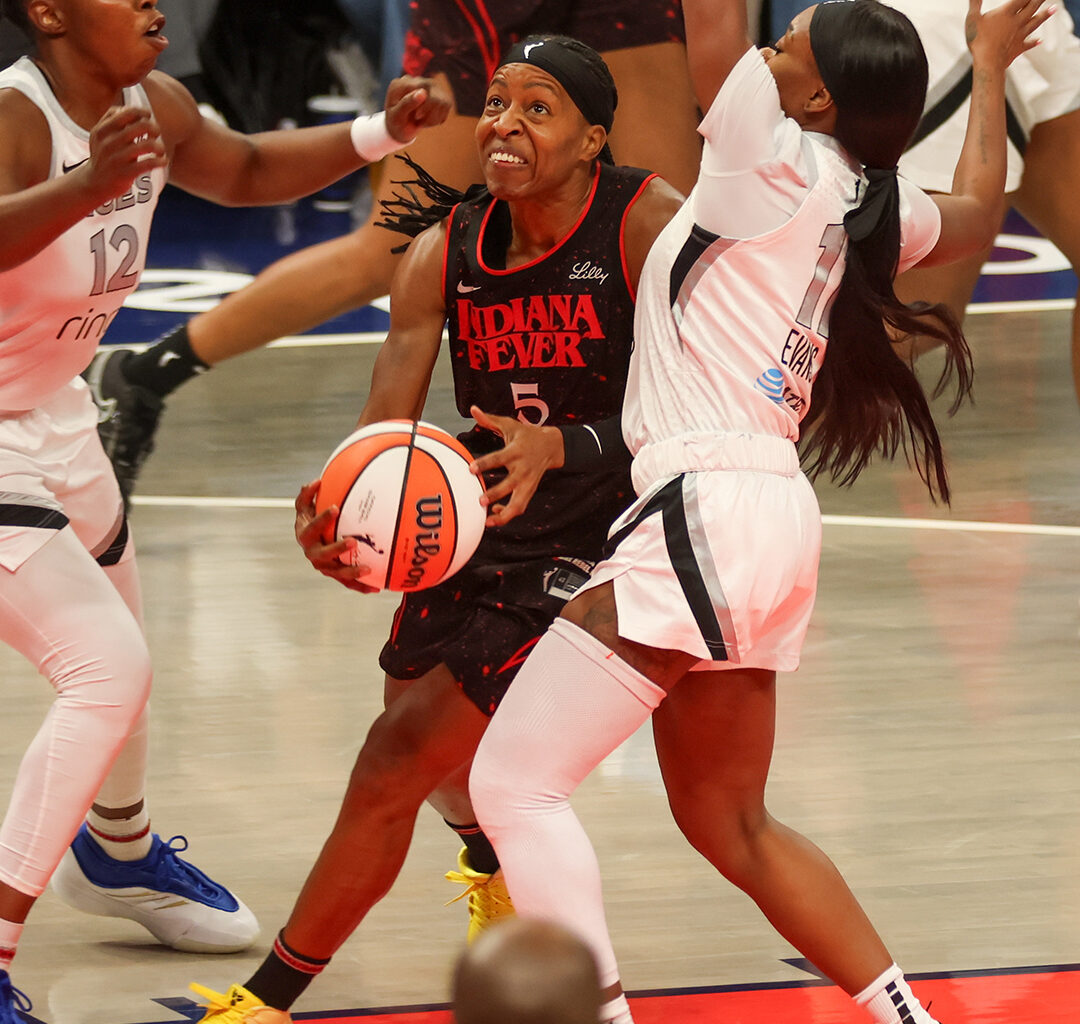
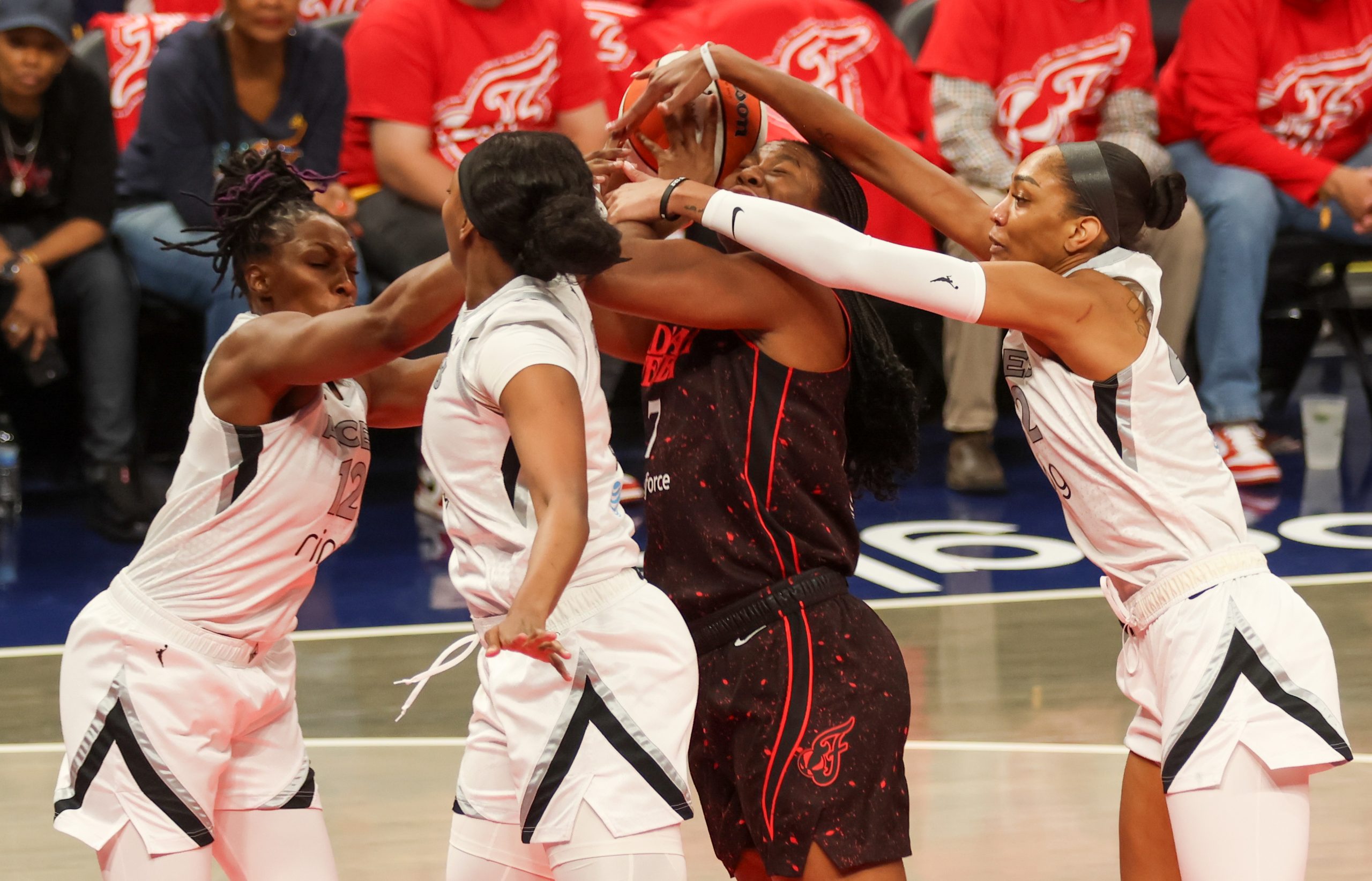
 Aliyah Boston is fouled on an attempt at the rim during the semifinal matchup against the Las Vegas Aces. Photo by Clay Maxfield
JUST A DAY removed from their decisive Game 5 semifinal loss in Las Vegas, the Indiana Fever’s Kelsey Mitchell released a statement on Instagram describing an injury she sustained in the second half as the moment she played until her “wheels fell off.”
Mitchell exited the 107-98 loss with a condition termed rhabdomyolysis, a rare injury where a muscle breaks down and releases harmful substances into the bloodstream. While she is expected to make a full recovery, her grit along with her setback reflect Indiana’s season as a whole.
Heading into the playoffs, the Fever were without six players, two of whom began the season in the starting five. While few picked them to advance past the first round against the Atlanta Dream, they won the series in a 2-1 final.
From there, they put the Las Vegas Aces on notice by winning Game 1, 89-73, not only bringing home court advantage back to Indiana but also giving themselves the fuel to continue their improbable run.
Indiana dropped the following two games, including Game 3 at home, 84-72, before pushing Vegas to the brink with a 7-point win at Gainbridge just two nights later and forcing a winner-takes-all contest on the road.
Ultimately, they lost in overtime on the road, 107-98. In a game where Mitchell pushed her body to the brink, she represented a microcosm of a team that continued to leave it all on the floor only to be halted by injury time and time again.
“Not a lot of people expected us to be here,” Mitchell says during exit interviews. “That within itself is a lot to be proud about with this group. We handled a lot of adversity. … People had to adjust and transform their game a little bit. I think with the injuries, the team camaraderie that we had to keep and bringing people in often, it was really big for us.”
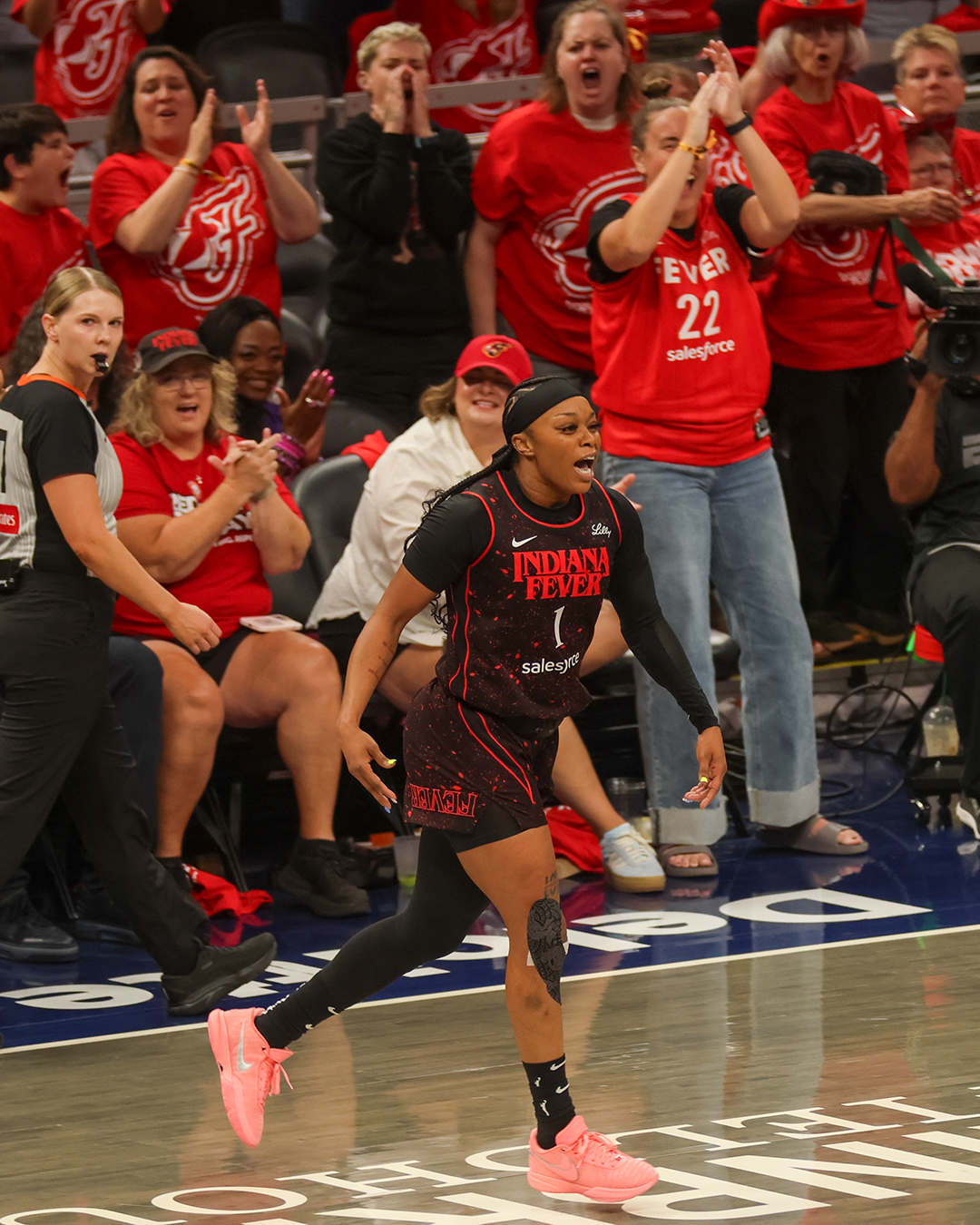 Odyssey Sims celebrates following a made basket during game four of the WNBA semifinals against the Las Vegas Aces. Photo by Clay MaxfieldThe WNBA’s Future
With the postseason in their wake, the Indiana Fever and the WNBA head into the offseason in a state of uncertainty as the terms of the newest collective bargaining agreement between the WNBA Players Association and the WNBA have yet to be agreed upon.
Both sides have until October 31 to agree on a new deal, and with contention throughout the WNBPA and the league, the chances of getting anything set in stone by the end of the month are beginning to look bleak.
Should both sides be unable to come to an agreement, the league will go into a work stoppage that will bar players from team facilities and delay contract negotiations between teams and players, as well as increase the chance of missing games in the 2026 regular season.
What are players asking for in negotiations?
Throughout the season, issues such as better investment by team owners, including improved practice facilities; a higher priority on health, wellness, and recovery among players; better officiating; and a better revenue share have all been some of the players’ most prevalent demands.
Players in the WNBA currently receive 9.3 percent of the revenue share, a far lower number than their NBA counterparts, who bring in a 50-percent share. An important and often misunderstood clarification of this demand is that players are seeking a more fair and equitable revenue share, similar to players in the NBA—they are not seeking the same type of salary as players in the NBA.
And with the introduction of players such as Caitlin Clark, Angel Reese, and Paige Bueckers increasing the league’s star power, alongside the addition of five new expansion teams by 2030, the profitability of the W is only increasing.
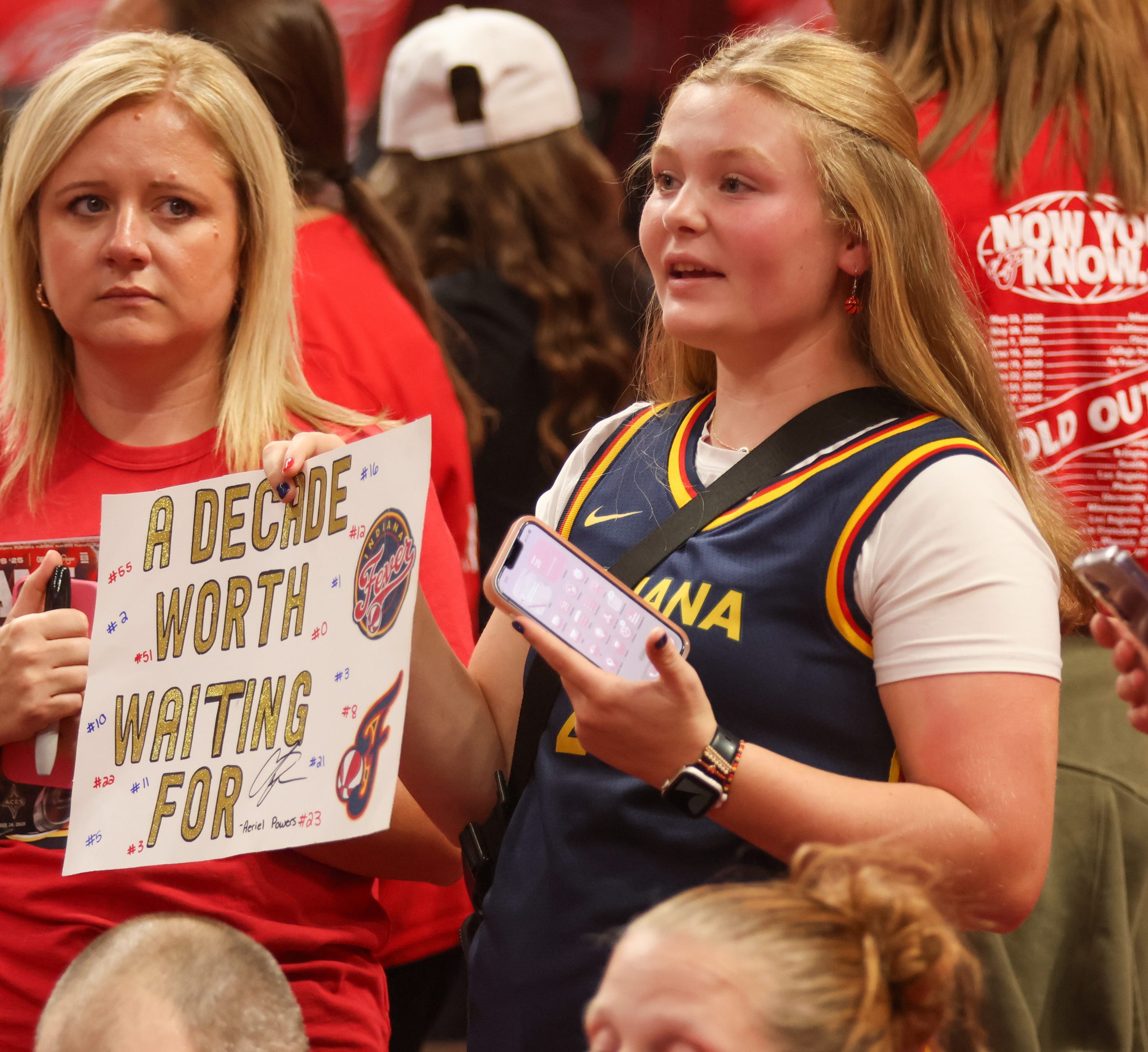 An Indiana Fever fan holds up a sign before Game 4 of the WNBA semifinals. Photo by Clay MaxfieldHow does this affect the Fever?
Labor negotiations aside, this upcoming year is going to be arguably the most transformative to date as over half of the league heads into the offseason as free agents.
Among the notable Indiana players still on contract are Caitlin Clark and Aliyah Boston, a recent selection for the WNBA All-Defense Second Team, while Lexie Hull heads into the offseason as a restricted free agent. The restricted status gives the Fever the first refusal if she decides to sign with another team.
Others like Mitchell, Sophie Cunningham, Natasha Howard, and Odyssey Sims will all be unrestricted free agents and have the ability to sign with any other team of their choosing.
While the season didn’t end as many throughout the organization had hoped, general manager Amber Cox recently noted that the run Indiana had this season will pay dividends in the future.
“I think as we step away from this season, we’ll take a lot of pride in it, and I think the most important thing is the foundation it builds,” Cox says. “When you look at Aliyah, Kelsey, and Lexie, who have been with this organization, and this is the furthest they’ve gone, and to get a taste of that? The motivation and excitement that it provides for next season? That’s where the juice is.”