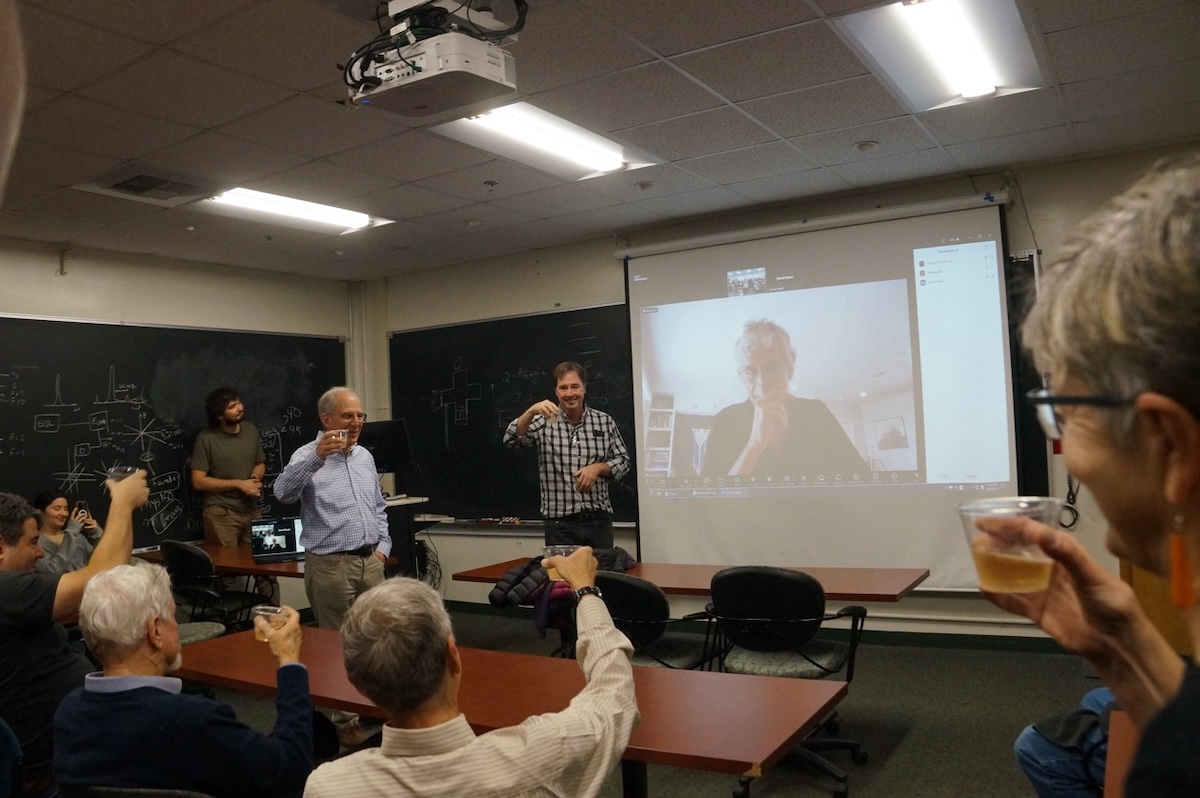
It’s not every Tuesday morning that UCSB wakes up to a pair of new Nobel laureates. But that’s exactly what happened this week, when physicists John M. Martinis and Michel H. Devoret were awarded the 2025 Nobel Prize in Physics, sharing the honor with longtime collaborator John Clarke of UC Berkeley.
The Royal Swedish Academy of Sciences recognized the trio “for the discovery of macroscopic quantum mechanical tunneling and energy quantization in an electric circuit” — a mouthful that, translated, means they managed to make quantum mechanics visible on a scale big enough to hold in your hand.
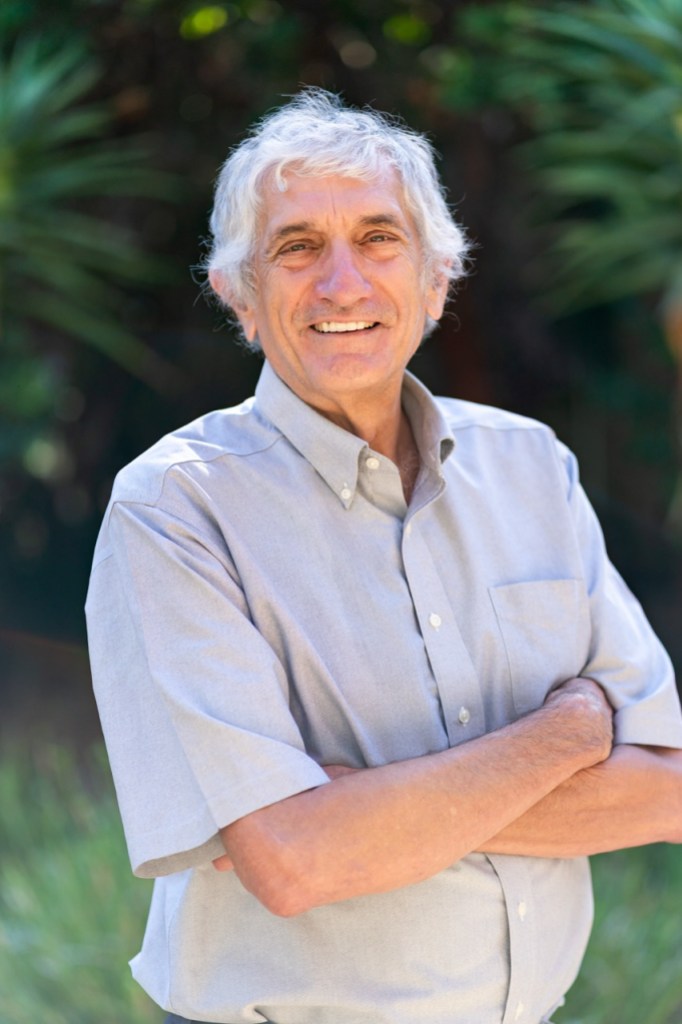 John Martinis | Credit: UC Santa Barbara, Jeff Liang
Their 1980s experiment, conducted in Berkeley’s physics labs, proved that electric circuits made from superconductors could behave like a single quantum particle — showing the bizarre tunneling and quantized energy jumps that, until then, had been confined to the subatomic world (think Ant-Man). Those findings paved the way for quantum computers, quantum sensors, and even some of the technologies behind the smartphone.
At a press conference Wednesday morning, UCSB’s Executive Vice Chancellor and Provost David Marshall read a statement from UCSB’s new chancellor, Dennis Assanis, who called it “a proud day for UC Santa Barbara and the UC community.”
“The impact of your work cannot be overstated,” Assanis wrote. “Your revolutionary work in quantum tunneling has been well known for over three decades. You’ve paved the way for components found in everyday devices and major advancements in communication, computing, and sensing.”
After the congratulations came a message with more political edge — a quote Marshall said the chancellor borrowed from George Washington: “A flourishing state of the arts and sciences contributes to national prosperity. Publicly financed institutions are very cheap instruments of immense national benefit that serve to assist a spirit of discovery.”
It was a gentle but pointed reminder. Just last month, UCSB researchers warned that federal budget cuts under the Trump administration could “cripple” long-term science, especially at public universities that rely on grants from the National Science Foundation and National Institute of Health.
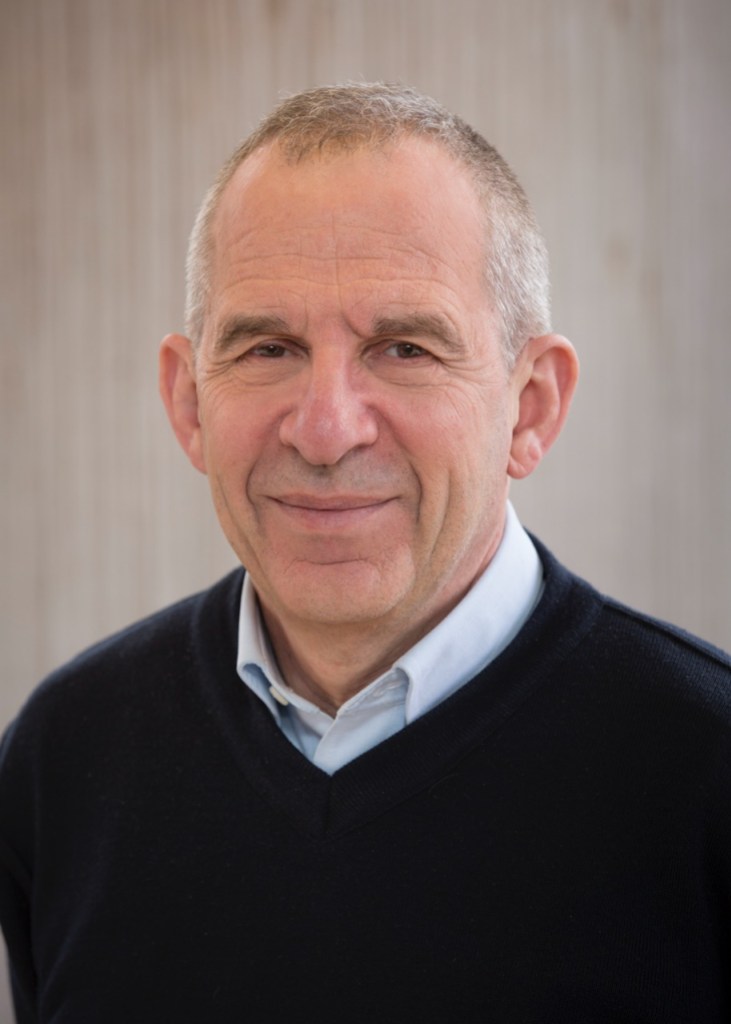 Michel Devoret | Credit: Harold Shapiro
Despite this uncertainty, UCSB has long been known as a powerhouse for collaboration — where innovative minds come together to push the boundaries of science. “You are part of a tremendous legacy here at UC Santa Barbara,” Chancellor Assanis said. “A proud culture of interdisciplinary collaboration, innovation, and excellence built over decades.” Joining the ranks of UCSB Nobel laureates, Martinis and Devorets bring the campus total from six to eight since 1998.
In agreement with Assanis, Martinis praised the joint effort, “all these people working together to develop science is what made [winning the Nobel Prize] possible.” Even his wife was part of the effort in receiving the news — staying up late fielding congratulatory calls at 3 a.m. before waking him. “She did the right thing,” he said with a laugh.
After joining UCSB in 2004, Martinis led the university’s Google Quantum AI partnership, where his lab built a 53-qubit processor that achieved “quantum supremacy” — solving a problem no conventional computer could handle. He later co-founded Qolab, a startup advancing the same technology.
“All this basic research that we did for decades made this happen,” Martinis said at the press conference. “Hopefully not too many years in the future we can talk about the useful quantum computer that we have built.”
Devoret’s path took him from Paris to Berkeley and then to Yale, where he helped lead the university’s Quantronics Group. He joined UCSB’s faculty in 2024, continuing his research in superconducting qubits while serving as chief scientist for Google Quantum AI.
At the time of their Nobel-winning experiments, Clarke was Devoret’s postdoctoral advisor and Martinis’s graduate mentor. “I could not imagine accepting the prize without the two of them,” Clarke told the Nobel committee. “To put it mildly, it was the surprise of my life.”
The Nobel Prize, of course, is personal. But in Santa Barbara this week, it felt shared — a moment of pride not just for two physicists, but for a public university system that despite facing shifts in funding, still manages to change the world.