
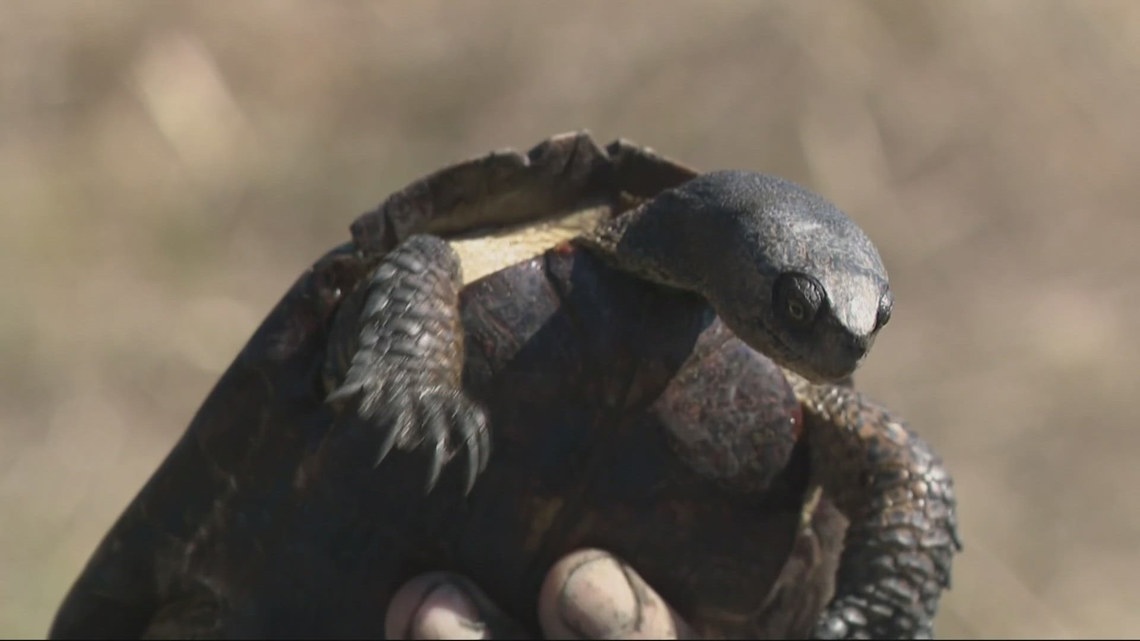
Wildlife conservation biologists are trying to keep the native ‘priority’ species from becoming threatened or endangered, in an Oregon that is worth protecting.
YAMHILL COUNTY, Oregon — Conservationists in Oregon are racing to protect one of the state’s only native freshwater turtle species from becoming endangered.
The Northwestern Pond Turtle, a semiaquatic reptile once common in the region, is now listed as a “species of greatest conservation need” in Oregon’s Wildlife Action Plan. Biologists say habitat loss, invasive predators and illegal collection are threatening its survival.
“This is one of the species that is a priority to Oregon,” said Susan Barnes, a regional wildlife conservation biologist with the Oregon Department of Fish and Wildlife. “If we lose this species, that would be really sad.”
Barnes is monitoring a conservation site in Yamhill County’s Muddy Valley, where more than 500 individual turtles have been identified and tagged. On a recent visit, traps set overnight yielded a significant catch — a positive sign for the local population.
“Oh my gosh, it’s the mother lode!” Barnes exclaimed as she checked the trap.
But despite the healthy count at the site, the turtles remain at risk from invasive species — particularly American bullfrogs, which prey on juvenile turtles.
“We know bullfrogs will eat anything they can get their mouths on,” said Barnes, who is working with conservation partners to solve the bullfrog problem.
The more than 500 acres of land where the pond is located is managed in partnership with the Yamhill Soil and Water Conservation District, which helps preserve the surrounding upland habitat. These areas are crucial for the turtles, especially during the winter when they leave the water to burrow and hibernate under native vegetation — in this case, upland areas that also hold native Oregon White Oaks.
Barnes urged the public to avoid disturbing turtles found in the wild, and if you need to move one, don’t turn it around, because the turtle is on a mission.
“If you find a turtle crossing a road or trail, move it off in the direction it was heading,” she said. “Don’t return it to the water — that could put it in more danger.”
The biologist also warned against keeping native turtles as pets, as well as keeping or releasing non-native species, like illegal red-eared sliders or snapping turtles, into the wild because those invasive species can take over and ruin habitats.
Though the Northwestern Pond Turtle remains at risk and just one step away from reaching threatened or even endangered status, the steady population at this protected site is a hopeful sign. Barnes, who has worked with nongame wildlife for years, says the species is worth fighting for.
“Every turtle has a different personality. They’re intelligent and curious,” she said.
And the native turtle is part of Oregon that is worth protecting.