
On November 1932, Ruth
Dunn, a pretty 26-year-old physical therapist, rode the Pickwick
Stages from Los Angeles to
Humboldt County to assume her
duties as a therapist with the
county. She recalls her excitement coming into the redwood
country and seeing the big sign
announcing the Humboldt County line. Since then her role in the
county has been that of an angel
for many generations of crippled
children who, even in their late
adulthood, still recall her smile
and skillful hands, and many
keep in touch with her, attributing their successful and active
lives to her patience and professional dedication.
It was Tony Costa, one of Ruth’s crippled children and now a grandfather,
who suggested this article be written,
bringing attention to Ruth’s contribution to Humboldt County health care.

Runn Dunn. Photos via the Humboldt Historian.
Ruth, one of a family of six, always
loved children. She was among the first
class to graduate from Highland Hospital in Oakland. A few years later, she
registered in Los Angeles and was called as a private nurse to the Malibu
beach house of George Olsen, a band
leader, and his wife, Ethel Shutta, a follies dancer, to care for their child. She
was driven by their chauffeur when the
child was scheduled to visit his pediatrician.
Life at Malibu was colorful because
the Olsens were involved in making the
movie “Whoopee,” and Ruth’s room was
next door to that of houseguests Eddie
Cantor, the star of the show, and his
wife Ida. She thought them both charming. Weekends she observed the movie
crowds socializing from one house to the
next along the beach. She preferred
playing cards with the chauffeur and
his wife.
The child’s pediatrician,
Rothman, suggested Ruth learn physical therapy and teach posture at a private girls’ school, a job that seemed far
too dull for Ruth. She did, however, go
on to study physical therapy at Children’s Hospital in Hollywood, received
her certificate, and was recommended
for the position in Humboldt.
The need for a therapist was dramatized by the polio epidemics of the late 1920s, 1930s and 1940s. Those of us who were
children then recall summertime meant
polio season. Often the fear in the minds
of parents and children clouded the joyful, sunny days of summer vacation.
Newspapers with big, black headlines
and dramatic stories recorded the epidemics as they spread across the country. The Pathe Newsreels often showed
the feeding of polio patients encased
iron lungs with only their heads protruding. Every class in school had one or
two victims of the crippling disease to
remind us that the mysterious affliction
could strike at home as well, and as soon
as a case was reported locally,
was on the alert.
“Don’t get too tired — perhaps you
shouldn’t go swimming,” was often
heard, for one of the myths was that one
caught it from swimming. Frequently
several in a family would succumb.
Humboldt County’s polio patients, as
well as children with other crippling
diseases, awaited Ruth at the County
Hospital. She checked in with Lantz
Smith, secretary of the Chamber of
Commerce, “…in the Eureka Inn where
the bar is now located.” He was also
chairman of the Crippled Childrens’
Dr. Philip Committee, comprised of active community leaders who were generously supporting the program for crippled children. Whenever a case was brought to
her, she had to clear it with Smith and
the committee at the Eureka Inn. This
was the Depression, and money was
scarce.
“I always came back to the office
smelling like a cigar,” she laughed.
“Whenever they rejected a patient, I
would have the parent take my report to
them, and they would always accept my
recommendation. They were concerned,
big-hearted men.”
The Kiwanis Club was especially active in helping the program, and each
year the committee and doctors took the
children, therapists and volunteers to
Dr. Orris Myers’ summer home near
everyone Miranda for an all-day picnic, an event
many of the children remember as special indeed, for there was great camaraderie among them. They supported
and felt comfort for one another in their
fight to recover the use of their bodies.

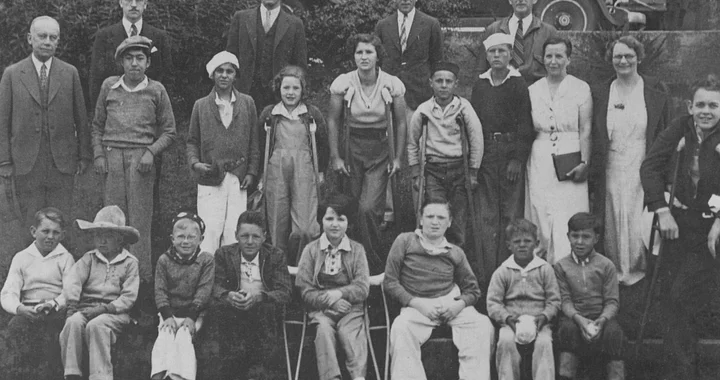
At physically handicapped childrens’ outing held
at “Myers’ Roost” at Miranda. Pictured in this photo taken during July 1935 are, in the first row, left to right: Keith Alexander, William Yardas, Donald Young,
George Elliott, Melba Carlson, Jim McGowan, Ben Lewis, Roby Reese, C.W. Patterson (standing with crutches); in the second
row, left to right: Mayor Sweasey, Frank Machado, Lucy Wilkinson, Alma Hayes, Dorothy Fuller, Donald Sallady, Norman
Fuller, Ruth Beck and Elsa Kuntze; and in the third row, left to right are William Smullin, Don Smith, Carl Gustafson and Dr.
Lawrence Wing.
Tony Costa describes this aspect vividly. Costa was a handsome nine-year-old with curly black hair when he contracted polio on Aug. 5, 1935. He recalls
how a sharp pain ran up his spine at
first; the next day he had a high fever
and lost his ability to use his muscles. It
was a week before a diagnosis was
made, and a quarantine sign was posted
on the front of his home. Dr. Lane Falk
was his doctor, but when it was determined that he had polio, Tony was turned over to Dr. Charles Falk because he
had no children. Doctors feared the disease too.
Tony was placed in the isolation ward
behind the TB School by the County
Hospital on Harrison Avenue for three
weeks. During this time, no one was
allowed to visit him. His poor mother,
devastated by the situation, collapsed.
He is forever grateful to his cousin
Marie Cummins, who came every night
and stood outside until he fell asleep,
and later, with her husband Dave, visited him nightly when he was in the
hospital. His mother continued under
medical care, and when he was released
from the hospital, he went to live with
Dorlinda Rocha.
When his fever subsided at the isolation ward, he could move a little. He was
then taken to a private room at the main
hospital and later to the ward with the
other children, where he stayed for two
years.
Those years were filled with pain,
boredom and loneliness. But the children tried hard to fill the void — and did
with mischief. “We were real devils,”
Tony recalls. “Lots of spitball, water and
pillow fights. My chief regret is losing
two years of education.” Later Sister
Alphonse helped him catch up when he
entered seventh grade at the convent
school.
It was during his hospitalization that
Ruth gave him his life-saving therapy.
Like sunshine she came into the lives of
these children. As Tony describes: “She
was always smiling and joking, but she
was a stern taskmaster and made us do
our exercises, which could be very painful.” It was her massaging that Costa
remembers the most. “She had very
strong, knowing hands that worked our
muscles like dough, and it made us feel
good.”
Beyond the massage and exercise to
stimulate the muscles, Ruth supervised
nurses who applied hot packs on the new
cases of polio. Volunteers, including
Hazel Myers, Dr. Orris Myers’ wife,
helped with this task. There was also a
large tub, called a “Hubbard Tank,”
used for therapy in warm water. This
was later moved to the hospital.
Although Ruth was a dedicated professional, she enjoyed a social life with
the nurses and new friends she made in
Humboldt. She hadn’t been here long
before an energetic young reporter,
Dwight O’Dell, came to interview her
and proceeded to court her. They married in 1934 at the home of Assemblyman Robert Fisher and his wife Bess
near Carlotta. In 1936 the O’Dells had a
son, whom they named Robert, after
their friend. Robert now lives in London, England, with his wife and family.
For several years Ruth, known as
“Mrs. O’Dell” to the children, worked in
the old county building at Sixth and J
streets across from the Sumner Carson
house (now replaced by the Times-Standard newspaper building).
She recalls the county building well:
“As you entered, the therapy office was
on the left, the Agriculture Department
on the right, and the probation offices
were upstairs. At first the children were
brought to me.”
Tony Costa remembers those trips.
Frank Machado, crippled by multiple
sclerosis; Melba Carlson, impaired by a
severe arthritis; and he were driven to
their treatments in a taxi by Cliff Kirkemo, who owned his cab, and was paid
by the county with March of Dimes
funds for the service. The children became close friends.
Frank Machado was always cheerful,
according to Ruth. As a man, after he
had successfully operated his own store
in west Arcata for many years, he traveled to Portugal to visit the village of his
family, where he rode at the head of a
parade the villagers formed to honor
him. When he returned, he visited Ruth, who claims she’ll never forget his joy in
describing this climax to his life.
“I just loved all those children,” she
says, “and it always thrilled me to see
them succeed as so many have.”
A source of pride for Tony Costa, his
wife Joanne, and their family is the
large, attractive home which, in spite of
his handicap, he built largely by himself, “…with a little help,” he grins. “I did
carry the stone and mix the mortar for
the huge fireplace and hearth.”
Ruth’s career as a therapist continued, with two short breaks, until 1957.
The period at the Sixth and J streets
house did not last long. Instead of having
the children come to her, she went to the
children at the hospital.
Polio continued its course until 1955
when the Salk vaccine was finally approved for general use. Other crippling
diseases have not been as effectively attacked. However, as Ruth points out,
therapy and surgical techniques have
improved. It was difficult in the early
days because there was no orthopedic
surgeon in Humboldt. “We depended on
Dr. Howard Markel from San Francisco, who came here to hold clinics and
care for our patients.
“Today,” Ruth continued, “we have
discovered among aging former polio
victims a weakening of the muscles, a
postpolio syndrome.”
Among her patients in the later years
was John Argo, who had a career with
the city schools. He says that he owes
much to Ruth for her patience in treating him after polio. “Therapy is very
tedious and repetitive, but she would
always keep my spirits up.”
Ruth has many happy memories of
successes, but she has tragic memories
too. Young Jim McGowan was a plucky
youngster who eventually was placed in
an iron lung. Ruth had to leave the county for a brief time to follow her husband,
and it broke her heart to leave this little
fellow, for she knew he did not have long
to live.
Her patients were not always children. Ruth was called in to help adult
patients too. During one of the later epidemics, she met Rasmus Beck, born
near Ferndale, grandson of an early
Danish settler. “He was an exceptionally strong man who had loved his work as
a cowboy,” she said, “and seeing him
immobilized with polio was particularly
moving for me.” By then alone, they
each discovered a deep mutual attraction and eventually married. Rasmus,
strong and determined, recovered
enough to earn his living at a new occupation. “He was a wonderful cook and
gardener,” Ruth said, “and we were
happy together until he died in 1972.”
Ruth found children adapted to paralysis more readily than adults, for the
disease seemed to hit older persons
harder. “For children life goes on,” she
said. “What was most painful was mothers being ill and marriages breaking up
under the stress.” Often she volunteered
to nurse older patients because it was
difficult to find nurses willing to help,
especially on weekends. She nursed Dr.
Philip Rummel and his wife when they
were stricken.
Today, at 86, Ruth enjoys her own
home and friends in Eureka, among
them many of her former special children. “I just loved those kids—like my
own,” she said. Undoubtedly her loving
was the underlying secret of her success
and the wellspring of her joyous personality that even now fills any rooms
where she is with sunlight.
###
The story above was originally printed in the September-October 1992 issue of the Humboldt Historian, a journal of the Humboldt County Historical Society. It is reprinted here with permission. The Humboldt County Historical Society is a nonprofit organization devoted to archiving, preserving and sharing Humboldt County’s rich history. You can become a member and receive a year’s worth of new issues of The Humboldt Historian at this link.