
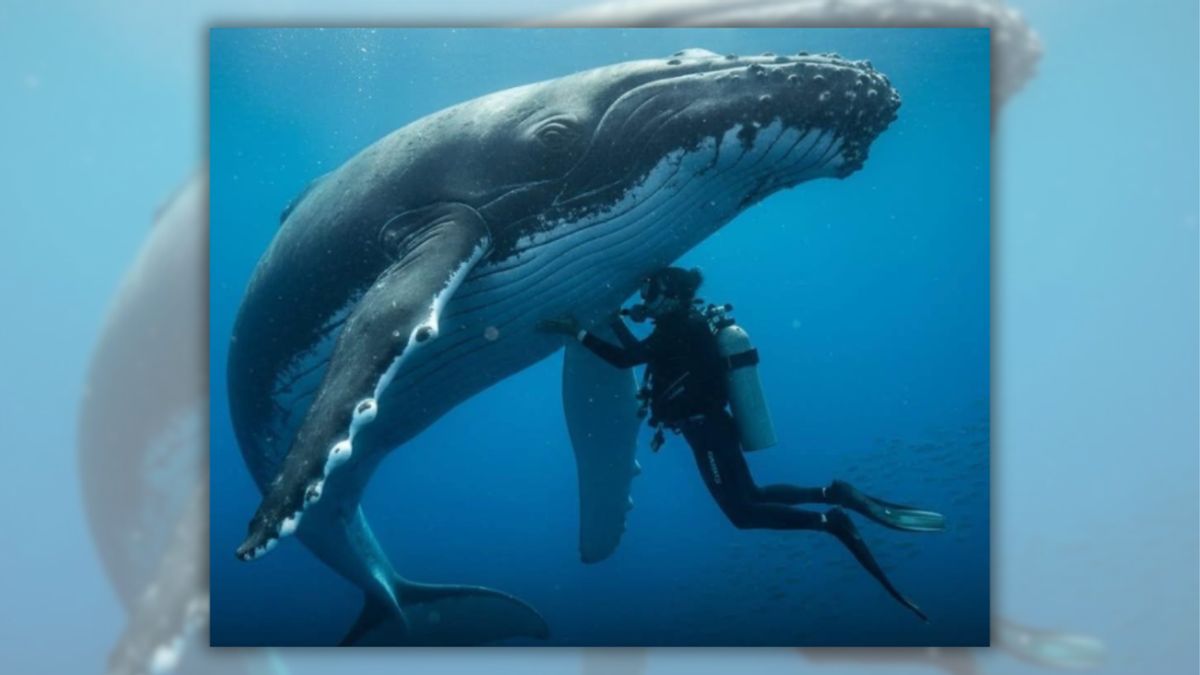
A rumor has circulated online since 2018 claiming that, in 2017, a humpback whale in the Cook Islands used its body to push marine biologist Nan Hauser around while she was underwater, seemingly to protect her from an approaching tiger shark.
Supposed footage of the story appeared on social media platforms such as TikTok (archived) and Reddit (archived), where it received widespread engagement. One Facebook post (archived) included an account of the encounter that read, in part:
Marine scientist Nan Hauser was filming humpback whales in the Cook Islands in 2017 when one whale began pushing her through the water for over seven minutes. Initially confused, she realized an 18-foot tiger shark in attack mode was approaching. The whale positioned her on its head and transported her safely back to the boat, away from the shark.
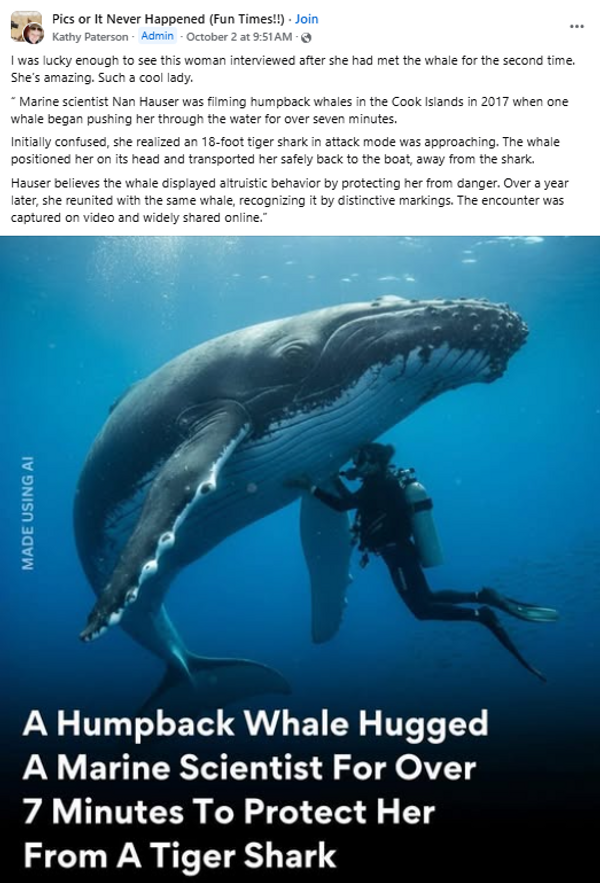
(Facebook user Kathy Paterson)
Hauser, president of the Center for Cetacean Research & Conservation, an organization dedicated to the research and conservation of whales and dolphins, shared footage and testimony of the 2017 encounter to multiple trustworthy news outlets, such as CBS News and National Geographic. However, there was no way to independently verify the contents of the footage or Hauser’s account of the encounter. As such, we have left this claim unrated.
We reached out to Hauser for further information about what happened and to inquire about why the whale might have protected her. We will update this story if we receive a response.
What we know
Footage of the encounter from BBC Earth’s report did not show any signs of being altered or generated with artificial intelligence. It is worth noting that, while generative AI did exist in 2018, it was not yet in widespread use and the quality of produced images and videos didn’t match what models such as OpenAI’s Sora could produce in 2025.
Studies have shown that humpback whales are known to exhibit altruistic behavior, even between species. A peer-reviewed journal, Marine Mammal Science, published a paper on the subject titled “Humpback whales interfering when mammal-eating killer whales attack other species: Mobbing behavior and interspecific altruism?” The paper found numerous instances of humpback whales interfering with killer whale attacks, even if the orcas were attacking different species, like seals.
We reached out to Robert L. Pitman, an author of the paper and an affiliate of the Marine Mammal Institute at Oregon State University, for his opinion on Hauser’s story and to inquire about whether the encounter lined up with other studied instances of interspecific altruism among humpback whales.
Pitman confirmed via email that he believed Hauser’s account. “I think it fits in very well with the various accounts and conclusions we documented in our humpback ‘altruism’ paper,” he wrote. Hauser’s case was unique, though — the humpback whale supposedly protected her from a tiger shark, while the “Marine Mammal Science” paper documented humpback whales interfering only with killer whales.
Pitman noted that, although people like to view humpback whales as compassionate, “in nature, an explanation that leans towards self-interest and survival is always going to be the more likely explanation.” Echoing the paper’s conclusions, he explained that humpback whales might have evolved the behavior to protect other humpbacks from being attacked.
In a 2018 interview with Ari Shapiro, a former host of the NPR radio show “All Things Considered,” Hauser acknowledged the tendency for people to anthropomorphize the actions and behaviors of animals:
SHAPIRO: As a scientist, you are trained to be a skeptic. How likely is it that we are just trying to impose an anthropomorphic storyline on animal behavior that is not actually anything like whale saves diver from shark?
HAUSER: Exactly. If someone told me this story, I wouldn’t believe it. If it hadn’t been me, if it hadn’t been filmed in three different angles, I wouldn’t believe it. I tried a lot not to anthropomorphize any of the behavior that I see. It’s easy to do, but it’s not a good practice in science.
A year after the encounter, BBC Earth reported that Hauser was able to identify the same whale based off body markings and reunited with it.
For further reading, Snopes investigated the authenticity of a video that depicted a dolphin rescuing a dog that fell into the sea from a boat.