
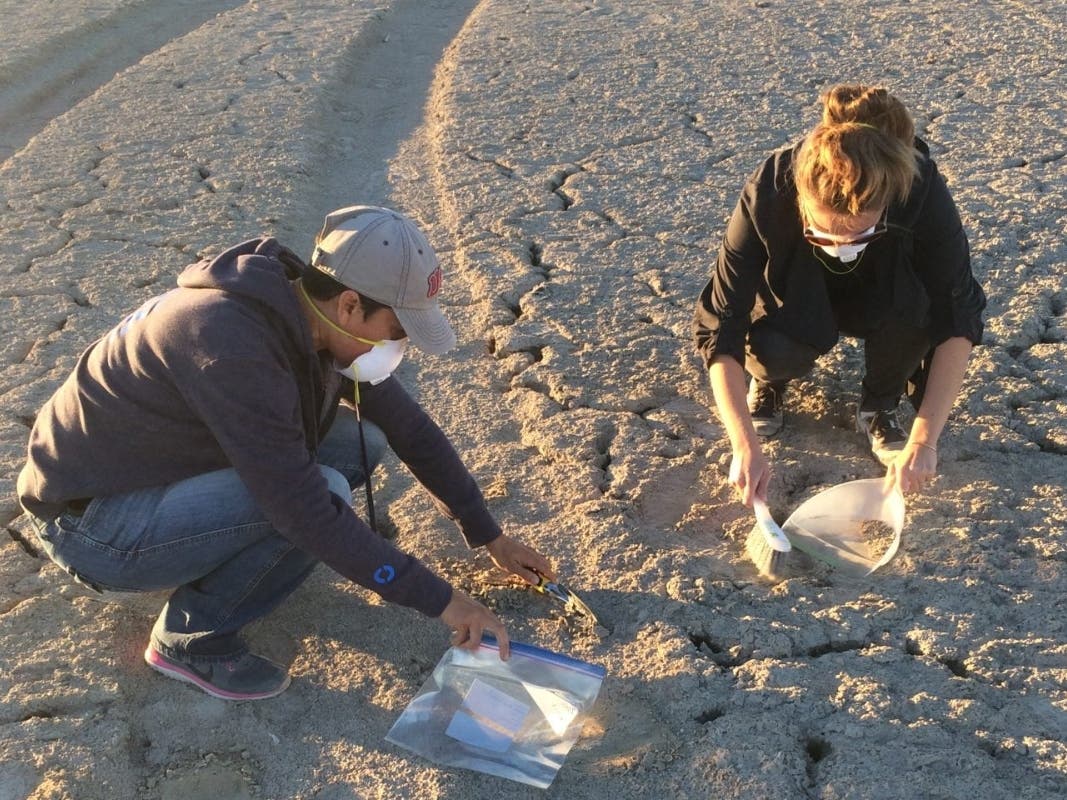
SALTON SEA, CA — Children living near the Salton Sea are experiencing poorer lung function than children exposed to less wind-blown dust, according to a new study led by researchers at the University of California, Irvine’s Joe C. Wen School of Population & Public Health.
The researchers found that higher dust exposure — measured in hours per year — was linked to lower lung function, with the negative effects most pronounced among children living closest to the Salton Sea.
The Salton Sea is California’s largest lake by surface area. It is located in the desert, straddling Imperial and Riverside counties.
The UCI research, published in the American Journal of Respiratory and Critical Care Medicine, marks one of the first investigations to directly link dust from a drying saline lake to measurable declines in children’s respiratory health.
From 2019 to 2022, investigators used spirometry on nearly 500 children, all around 10 years of age, to measure lung function. The test evaluates lung size and strength by gauging how much air a person can exhale, as well as how fast they can do so.
Team members collected nearly 1,300 lung function assessments, alongside health questionnaires and in-person clinical examinations.
Using data from 12 air monitors maintained by the California Air Resources Board, the researchers estimated participants’ exposure to particulate matter during dust events — defined as hours in which particulate matter concentrations exceeded regulatory thresholds. For each child, the researchers calculated cumulative dust event exposure during the three months preceding each lung function test.
The analysis revealed that children living near the Salton Sea experienced worse lung function due to their exposure to dust events.
According to the researchers, the study builds on growing evidence that the high particulate matter levels around the shrinking Salton Sea contribute to elevated rates of asthma, wheezing and other respiratory conditions — echoing health disasters such as “Dust Bowl pneumonia” in the 1930s, when widespread dust exposure led to severe and often fatal respiratory illness.
“The drying of the Salton Sea is not only an environmental crisis but also a public health crisis,” said corresponding author Jill Johnston, associate professor of environmental and occupational health at Wen Public Health. “Our study provides concrete evidence that children in surrounding communities are facing measurable harm to their lungs as a result of increased dust exposure.”
The Salton Sea has been receding for decades, exposing large stretches of dried lakebed that release dust into the air when disturbed by wind. This dust can carry contaminants including pesticides, metals and other toxic substances.
Communities near the lake, predominantly low-income and Latino, are disproportionately bearing the health burden, and there is an urgent need for continued monitoring and intervention to mitigate air pollution in the region, according to researchers.
“Protecting the health of children in the Salton Sea communities requires immediate attention through targeted public health strategies,” Johnston said.
The study adds critical evidence to the body of research on environmental health risks linked to climate change and ecosystem decline. As similar changes in inland lakes occur globally, these potential impacts demand greater public health attention, underscoring the importance of preventive policies and community-level protections, according to the researchers.
A federal grant from the National Institute of Environmental Health Sciences and the Southern California Environmental Health Sciences Center funded the research in partnership with the Imperial Valley community-based organization Comite Civico del Valle.