
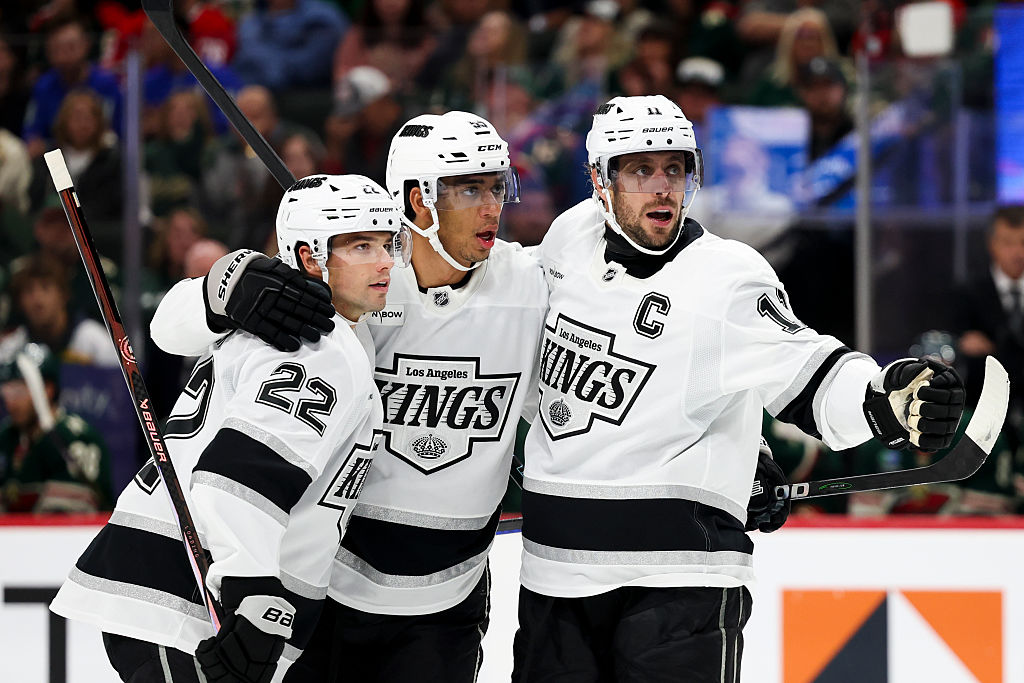
Man this thing might just be alright once the Kings ditch the penalties.
The list of questions wasn’t looking all that friendly at the second intermission. Then Kevin Fiala scored. Then Quinton Byfield. Finally Adrian Kempe. The Kings dug themselves a massive hole with four penalties in the first period, the second straight game played with 3+ minors in the first 20 minutes. In Winnipeg, the hole was only one goal down. Against Minnesota, it was three. The fight back was outstanding and the Kings earned their point. You just can’t spot a team three in the first and expect to win on most nights.
22 times shorthanded in four games is not going to win you very many games, no matter how good your penalty kill is. The goal against in Winnipeg was a direct breakdown by that unit but what’s interesting is that I really didn’t put the goals against on the penalty kill in Minnesota. The first goal came from outside the dot. Good shot, screen if you want to point to netfront play but it wasn’t a breakdown and the Kings limited chances until the goal stung them at the end. It’s really where you want to funnel shots from as a unit of four. The second was 3-on-5, so the way that one is on the kill is that the PK’ers took a penalty, but when a one-man advantage becomes a two-man advantage, power play conversion rate went from 21 percent to 36 last season. The third was from a sharp angle, with a nice move to get a shot off, but it wasn’t a breakdown in the way that Winnipeg’s power-play goal was on Saturday.
I’m not saying the penalty kill has been perfect or blameless or anything like that. What I am saying though is that taking the penalties have been a much, much larger problem for the Kings than the penalty kill has. That’s what needs to be corrected and fast.
It’s not like they don’t know it.
Jim Hiller – We’re taking too many penalties and we’re getting scored on.
Drew Doughty – It was penalties tonight, that was the killer. We need to stay out of the box, way too many kills.
Quinton Byfield – We can’t put ourselves in those holes, we’re taking too many penalties.
Byfield took accountability for his own minor, which was a weird delay of game call that contributed towards the second goal against. Byfield wasn’t clearing the puck out of his end in the way that the rule was intended, but as he looked to flip the puck ahead for Fiala to skate onto, he wound up flipping the puck directly into the stands from his own zone. And that’s a penalty. After another penalty 20 seconds later, Minnesota scored twice to turn 1-0 into 3-0.
I appreciated Byfield owning his part but we all know the problem is not just him. It’s universal right now and not only is it putting too great a strain on the PK, but it’s taking icetime away from players who don’t kill and preventing the Kings from getting into their rhythm of rolling four lines and three pairs. I want to see additional minutes for a few different players as well, but when you’re averaging more than eight minutes per game on the kill, that’s nearly 15 percent of the game right there. Limits what you can do.
And the thing is, when the Kings do build their rhythm, when they get their lines and pairs rolling, when they “put their head down and go to work”, as Byfield put it, the Kings have shown to be a pretty good team.
When you weed through the power plays, the Kings are right where they always have been and that’s one of the league’s best at suppressing scoring chances. The Kings rank fourth in the NHL in scoring chances against on a per/60 basis. Sixth in shots on goal. Fourth in xGA, which is a weighted accumulation of chances by type. As Jim Hiller put it last night, once you got through the penalties, the Kings gave up very little in terms of 5-on-5 offensive opportunities on this trip, between the games in Winnipeg and Minnesota. And he is correct.
Now, you can’t ignore the starts and he said as much. You can’t ignore the penalties and the Kings have to clean those up. However, the last two games should provide some optimism on what the Kings can look like when they just play the way they were designed to play. “The right way” as Doughty said after the game. “More like the way we play”, as Hiller put it.
I also think that Hiller deserves some credit for pulling the right lever defensively. One thing you can’t knock him for is hesitating to make changes he feels can help the group, especially changes that are perceived as unconventional. Three games in, he broke up his most reliable defensive pairing in an effort to better help the group. There was risk in that. I thought the results were evident in Minnesota. I felt that Brian Dumoulin had a really strong night. Noticed his 1-on-1 defending abilities a few times, saw some physicality and he blocked a key shot after a Doughty turnover to prevent a Grade-A chance. In total, he was on the ice for a 9-2 advantage in scoring chances and a 10-3 advantage in shots on goal. As far as Cody Ceci goes, I can’t say I remember noticing him much at all last night and for a defensive defenseman, sometimes that’s the best compliment you can give. While Anderson/Doughty wasn’t really an issue, I think that right now, making adjustments as the Kings did benefits the group of six as a whole. Both players looked more comfortable in new roles and overall, Anderson and Doughty both looked like themselves playing apart and the Kings allowed season lows in shot attempts and shots on goal at 5-on-5. Numbers that would’ve been Top-5 games even last season as well, so it’s not just good for a four-game sample size.
Those things should be encouraging, even if it’s hard to look past the glaring issue that comes with the number of penalties being taken. In time, it will go down. The 2023-24 Anaheim Ducks were shorthanded 330 times, the most of any team over the last 15 years. The Kings are currently on pace for 451. So, even by historic measures, the total will drop substantially just by law of averages. If the Kings change nothing, the penalties will even out over time. But you can’t just do nothing. Byfield offered up the solution of battling more to avoid stick infractions. Stick minors often times come from not moving the feet and there’s probably some truth to officials calling more ticky-tack stuff early in the season. It’s a hard question to answer because no two penalties were built the same. Ultimately, it just comes down to discipline during aggression. The Kings have to play an aggressive, forechecking game to be successful. Hard on pucks working to win it back. That can lead to penalties, and some are acceptable. Just not 22 in four games.
This trip, while unsuccessful in the standings in terms of collecting just one of a possible four points, showed a glimpse into how this team can come together when they play the way they are designed to. And that team just might be alright. Just gotta give yourself the chance to do it.