
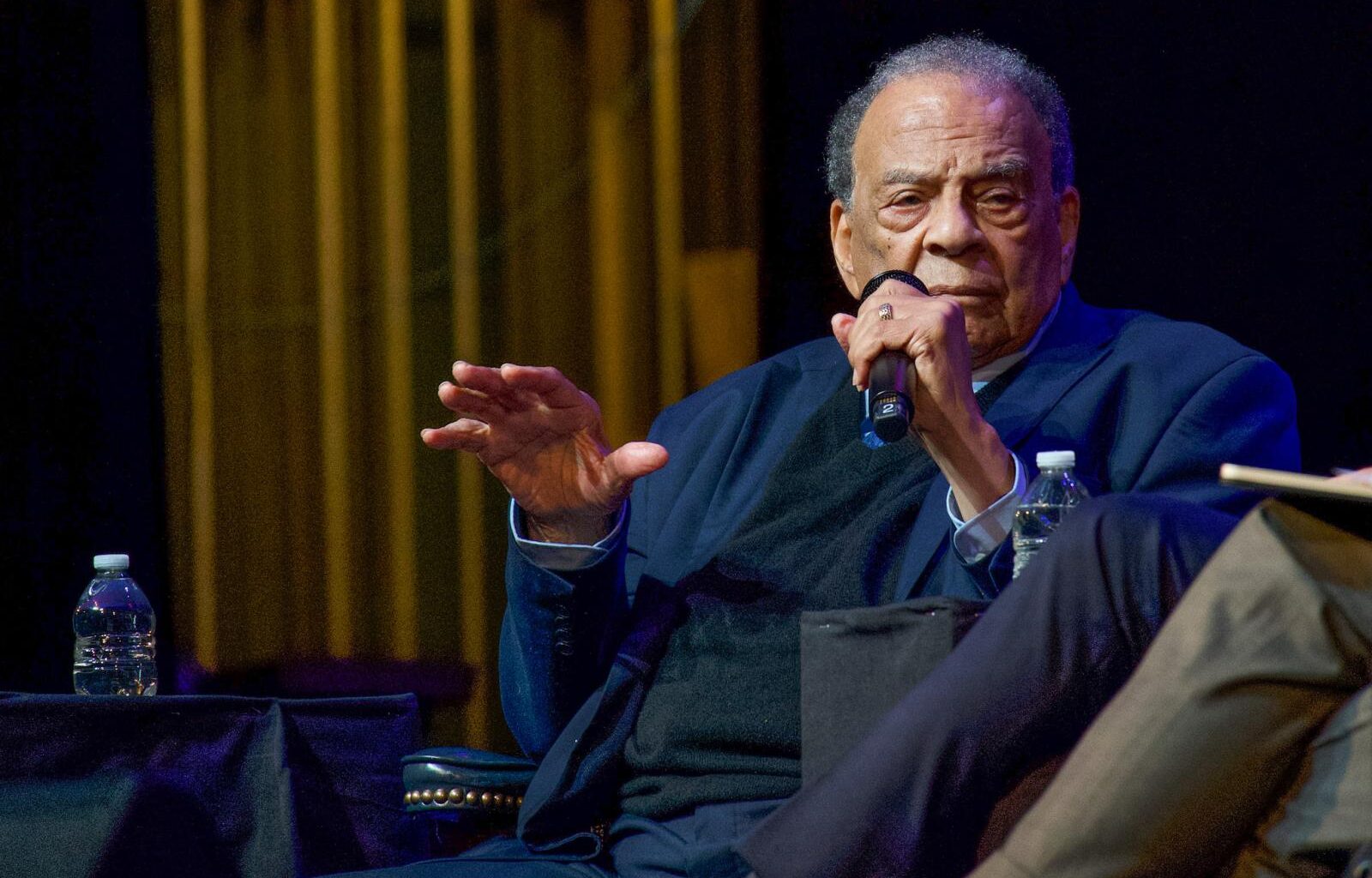
From the United States to the United Nations
After winning a seat in the U.S. House of Representatives in 1972, Young backed a then-Georgia governor named Jimmy Carter. When Carter later won the presidency, he tapped Young to be the United Nations Ambassador for the United States of America, charging him to reset American relationships with Africa and the broader Global South.
Young’s tours on the continent drew enormous crowds and signaled a new era of engagement, but they also brought tension with hardline regimes like apartheid South Africa. Young recounted a harrowing trip in which he was isolated by security forces and prepared letters to Carter and to his wife in case he did not return.
“South Africa can be a scary place, simply because it’s so big and beautiful,” Young said. “In addition to the lions and the tigers, you’ve got white folk, Black folk, everybody’s different, everybody wants to be in charge, and emotions get out of hand quite frequently. I was on the other side of that, trying to keep things calm and make things reasonable.”
Despite these tensions, Young’s advocacy never wavered. He continued communicating respectfully but firmly, even with hardline apartheidist P.W. Botha in what Young described as “probably [his] worst meeting with any foreign leader,” only underscoring the American belief that a multiracial democracy in South Africa was not only possible but necessary.
“I’m very well prepared to work with people I disagree with,” Young said. “That’s the key to our relationships around the world.”
Atlanta’s International Architect
Bryant, part hype-man and part historian, reminded the audience that Young’s gifts did not end with the Civil Rights Movement or international diplomacy.
As Atlanta’s mayor, Young aligned business and political coalitions behind projects that transformed it into a global city: expanding mass transit, recruiting international investment, serving on corporate boards, and championing Hartsfield-Jackson Atlanta International Airport, which has become the world’s busiest airport. He delighted in a recent visit to the airport’s command room: a $62 billion operation (cumulatively since its opening in the early 1980s), led predominantly by Black women.
“None of [the airport funding] came from Washington, the state, the city,” Young said. “We went to Wall Street. It’s integrating business and politics. I was in Congress, and I couldn’t get the money from Congress, so we got together and went to Wall Street, and we put $62 billion into that airport.”
Bryant added that Young’s style — pressure and protest followed by principled negotiation — was a repeatable model. King would often “set it up,” Bryant said, and Young “paid it off,” persuading chambers of commerce to remove “whites only” signs when boycotts hit their bottom lines and showing investors across the globe that Atlanta meant business. The 1996 Olympics followed, not as spectacle but as strategy, and a statement of what a Black-led Southern city could build with vision and coalition.
“This guy hardwired the largest economy in the traditional South,” Bryant effused of Young. “There’s no other model like Atlanta in the world, and the guy who built it into an international juggernaut is sitting right in front of you. That can be replicated. You can do well and do good at the same time.”
A Howard Education, A Global Calling
Time and again, Young acknowledged Howard as the foundation for his illustrious career. While university legends such as Thurgood Marshall and Ralph J. Bunche gave him both a superlative education and a unique worldview, Young was just as impacted by his peers. He recalled the late Dr. Emanuel Latunde Odeku, a Nigerian classmate who became a nationally renowned surgeon, gently telling a restless 16-year-old Andy to “slow down.”
“If you can ever settle down, you could really be somebody,” Odeku advised a teenaged Young, a message that continues to resonate. “That was 80-something years ago, and he went back to Nigeria and became one of their leading surgeons. Streets are named after him. The hospital is named for him in Ibadan, and he was a student here with me.”
“It’s your job now to figure out the lessons that I learned here and put them into action wherever and anywhere you go,” Young told students. “I didn’t know it when I left here, but every time there was a problem, I could think of somebody who had said something that led me to an answer. This is a wonderful institution, and I want you to appreciate it.”
Young left attendees with a charge to join these movements for justice and equality, and hoped his documentary proves motivational for those who want to participate but fear their work being unneeded or unnoticed.
“I was always in the back of the line doing the dirty work, and nobody ever was able to tell a story until MSNBC dug it up and fleshed it out,” Young said. “I’m grateful because it tells you what’s in store for you. Whether you like it or not, you are part of the leadership, and whatever this nation becomes, you will help to decide. Or if you don’t want to decide, or run and hide, you’ll catch hell for the rest of your life for doing it.”
“It doesn’t matter how old you are, how big you are, how important you are — everybody can be well-loved.” Young said. “I think that one of the things I learned is you can love the hell out of an evil person.”
“I did that, and it worked.”
“Andrew Young: The Dirty Work” premieres Friday, Oct. 17 at 9pm ET on MSNBC.