
A Planetary Geologist says the origins of the meteorite were older than the earth
MCDONOUGH, Ga. —
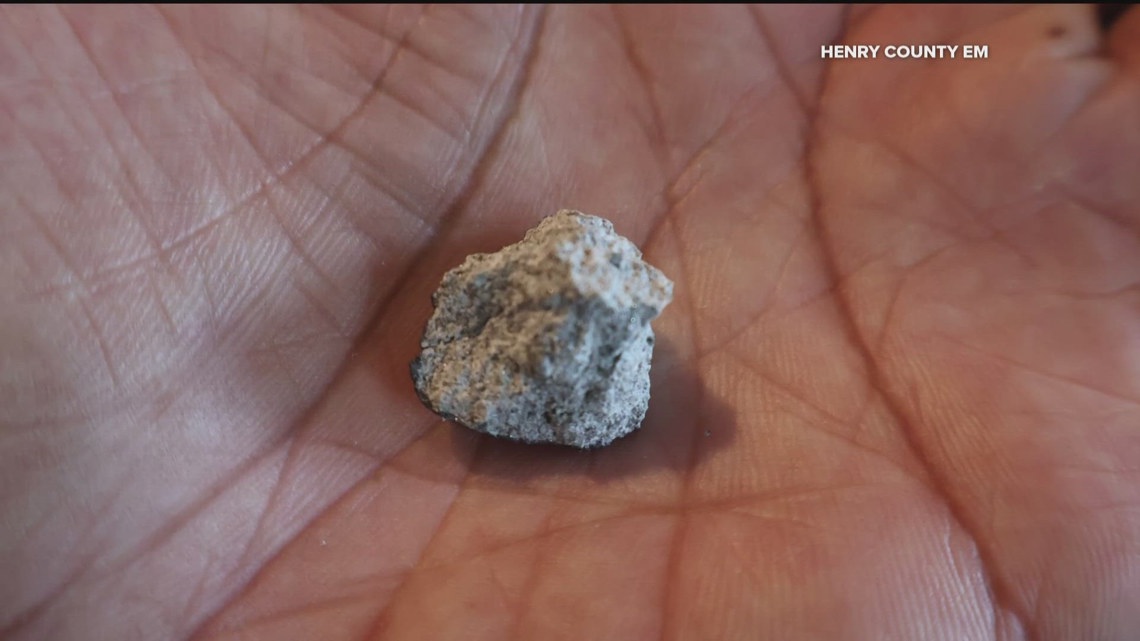
Three weeks after a bolide soared across and exploded over north Georgia skies, we’re now getting our first close-up look at Georgia’s 29th recovered meteorite in history.
Planetary Geologist R. Scott Harris, working under the auspices of UGA, analyzed fragments of the meteorite with an electron microprobe in Tennessee to figure out its chemical composition and connect the dots of where the meteorite may have originated from and how old its parent asteroid may have been.
The fireball on June 26th entered Earth’s outer atmosphere at supersonic speeds, but slowed as it hit the friction in our atmosphere. Some of the space rock survived the journey, landing in a McDonough home.
Harris, working with Henry County Emergency Management and the homeowner, examined the entry point and fragments of meteorite within the home. It left a clean entry hole through the roof, air ducts, and ceiling before finally slamming into the floor and concrete slab.
The homeowner happened to be in a room nearby, with headphones on in a Zoom meeting. They say it sounded like a gunshot.
“We’re here just 14 feet away from a homeowner having a very different experience,” said Harris.
Harris took measurements of the path the meteorite took through the home. “What were the dynamics of this object coming through the house? That is as fascinating a story as is the material,” said Harris.
On the way down, the bolide exploded, but Harris feels rather than a straight freefall down into the McDonough home, something else could have transpired. “Some of the pieces I think were sort of kicked forward… they’re they’re not just falling under gravitational influence, they’ve actually got the acceleration of the sudden detonation and I think this one this piece got kicked forward, and so entered the house still going maybe as much as a 0.5 mile a second or about 1 kilometer per second.
Harris equates it to being faster than the fastest military-grade rifle. He is currently working with colleagues to run simulations of the meteorite’s entry, estimating how fast it may have been traveling.
Just over 23 grams of the meteorite were donated by the homeowner to the state of Georgia for classification and to be archived. After classification, it can receive an official name. That makes the meteorite pieces even rarer, increasing their value. Some of the pieces of meteorite were as large as the size of a small blueberry, but many of the fragments were much, much smaller.

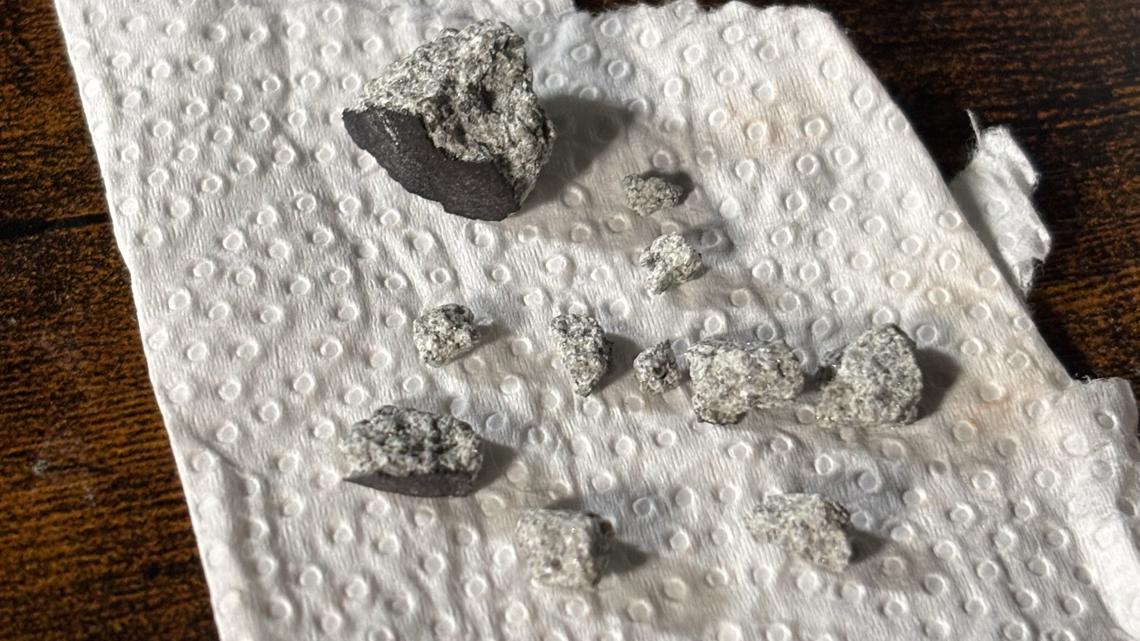
“When it hit the floor, it was still traveling fast enough to hit with enough of an impact to put a small crater in the floor and to fragment, so there were pieces that the homeowner reported went bouncing down the hallways 20 feet or more, and a lot of material actually just became dust. “I didn’t imagine I was there that it was going to be as big a mess as it as it was and that there would be a significant crater in the floor, so it was quite a fascinating event,” added Harris.

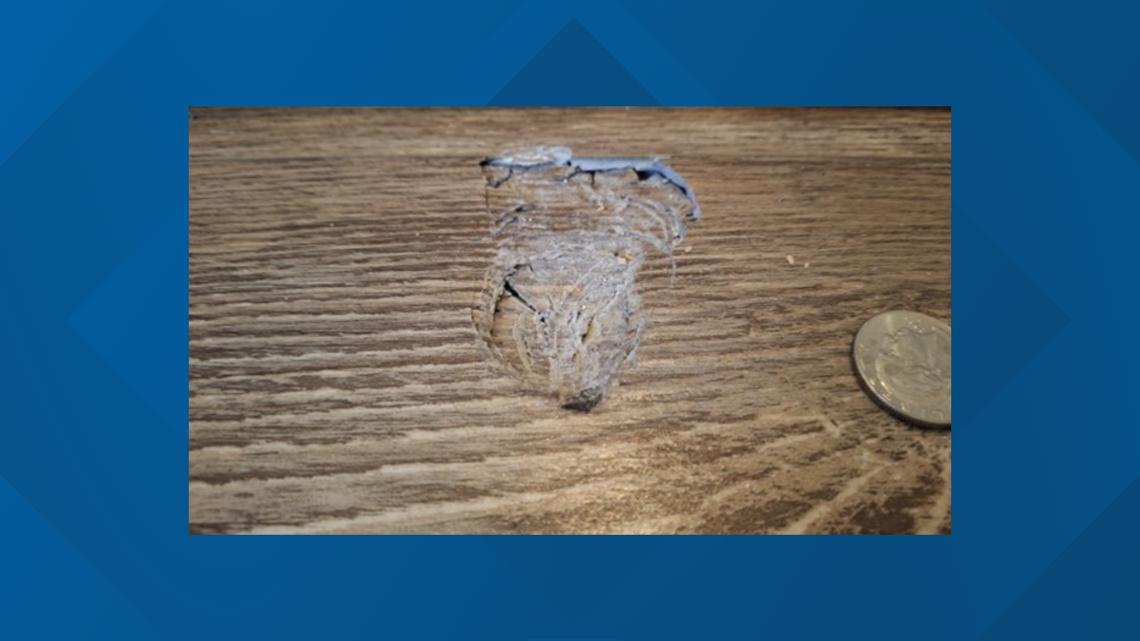
Still, if we make some estimates about the size of the object based on the crater, about one quarter of the mass is missing.
That missing mass isn’t actually missing. Harris says it’s in the house. “The homeowner is still picking dust out of the fabric of their furniture, and that’s how hard it hit!”
The original piece that would have entered the roof was probably the size of a half dollar or large cherry tomato, according to Harris.
Harris took the meteorite pieces to the electron microprobe at the University of Tennessee to look into its chemistry and to answer several key questions: “Where in our solar system did this originate? Are they part of something that’s larger that we might encounter again?” Harris posted.
“For that I took these pieces, polished them down, and then colleagues at the University of Tennessee allowed me to come use their microprobe to be able to get very precise chemistry of the minerals and through that then we can tell you what kind of meteorite it is,” said Harris.

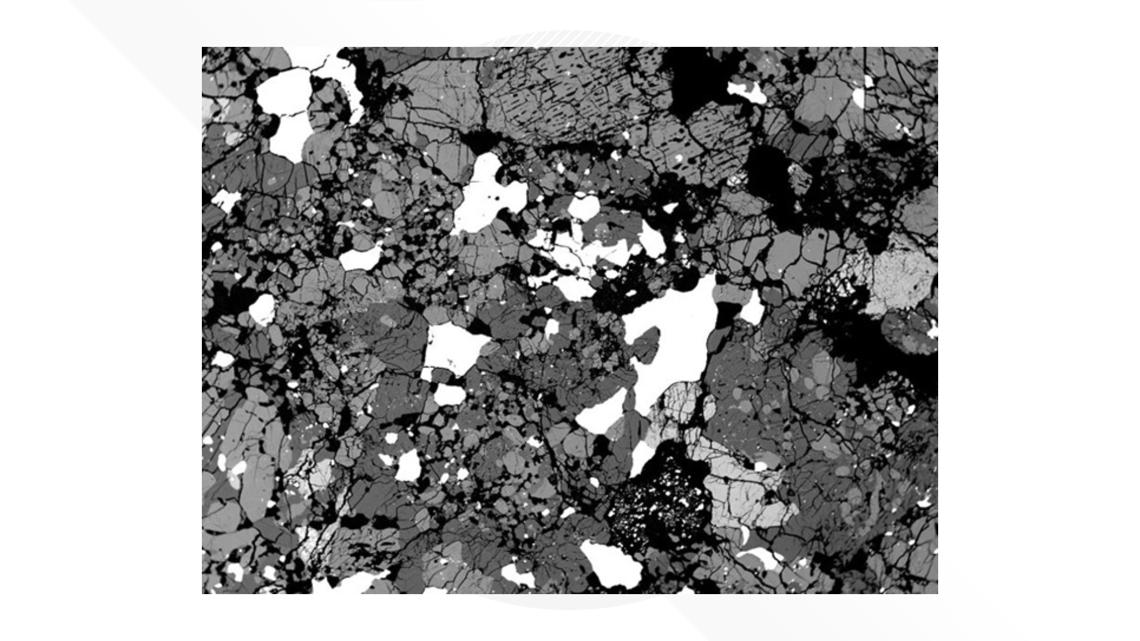
This particular meteorite was of similar origin to others Harris has studied before. “It’s what we call an L ordinary Chondrite,” said Harris, “The L stands for Low Metal. It tells us something about the chemical history of this rock. In fact, how much oxygen was around for the formation of the original asteroid. To really tell that it’s not just a matter of looking at it. We have to put it in these instruments to be able to get the chemistry and doing that, we can see, ‘OK, this is this this L ordinary chondrite.'” added Harris.

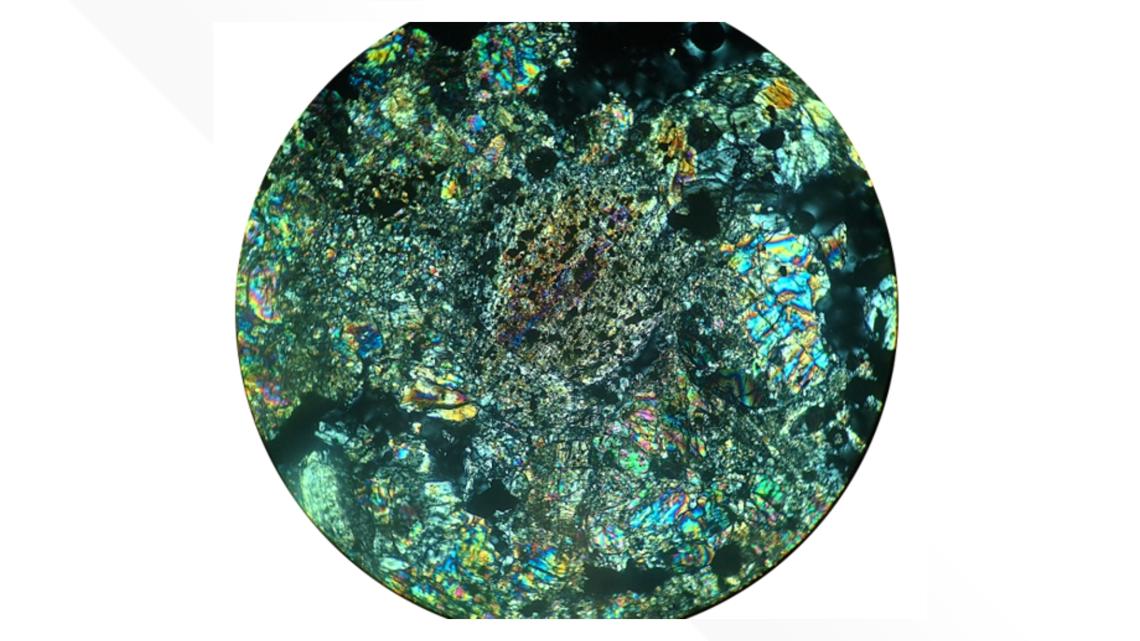
Harris is also interested in what happened to the original asteroid, and collisions it may have been through. “We look for evidence of shock metamorphism of the material. And so for this one, some of the material that I know colleagues are looking at [meteorites recovered elsewhere in Henry county], they want to call what’s called L6, which means it’s really it, it’s original textures and all have been so messed up by other collisions….it’s just everything sort of crunched together,” added Harris.
“This particular piece though that went through the house has a few more of the chondrules. The chondrites comes from chondrules that are little round droplets of melt that crystallized in the original asteroid to put that original asteroid together, and this one has more of those than some other pieces, which might explain the less shocked it is, probably the stronger the material is, so it’s more likely to stay intact after that original detonation and be there to actually go through a house. So the likelihood is this is a mixture of metamorphic grades.”
Harris categorizes this meteorite as an L5-L6 chondrite based on its iron content and degree of metamorphism the meteorite experienced. “The neat thing about that from just the materials, is that most L ordinary chondrites are from a single group of asteroids that originated from one larger asteroid breaking apart almost 500 million years ago.”
Harris dates the origins of that larger asteroid to around 4.56 billion years ago, which would make the fragment of meteorite that landed in the McDonough home older than Earth itself.
Once the meteorite is officially classified, it will have a name. Harris said it will probably be called the “McDonough Meteorite”.