
When the state’s dredging of Pohoiki Bay began in June, project critic Dane DuPont wasn’t speaking prophecy. He was reading the data.
As co-founder of the Hawaiian Volcano Education and Resilience Institute, DuPont helped design digital tools to track the 2018 Kīlauea eruption and map homes lost to lava. Later, he worked with state officials and contractors on community recovery projects, including plans to reopen Pohoiki’s landlocked boat ramp.
“Unsupported sand, four-to-one slope, no maintenance budget,” he said of the dredging project. “We told them it wouldn’t hold.”
He wasn’t wrong.
On Monday, the Department of Land and Natural Resources confirmed that the newly dredged Pohoiki Boat Ramp channel has already filled back in with sand — just weeks after completion.

Ideas showcases stories, opinion and analysis about Hawaiʻi, from the state’s sharpest thinkers, to stretch our collective thinking about a problem or an issue. Email news@civilbeat.org to submit an idea or an essay.
“The closure was caused by heavy tidal conditions,” said Andrew Laurence, DLNR communications director. “Nature proved more than a match for this solution.”
For a project celebrated as the reopening of Puna’s ocean access after seven years, the reversal is stark. It didn’t even take a storm to do it.
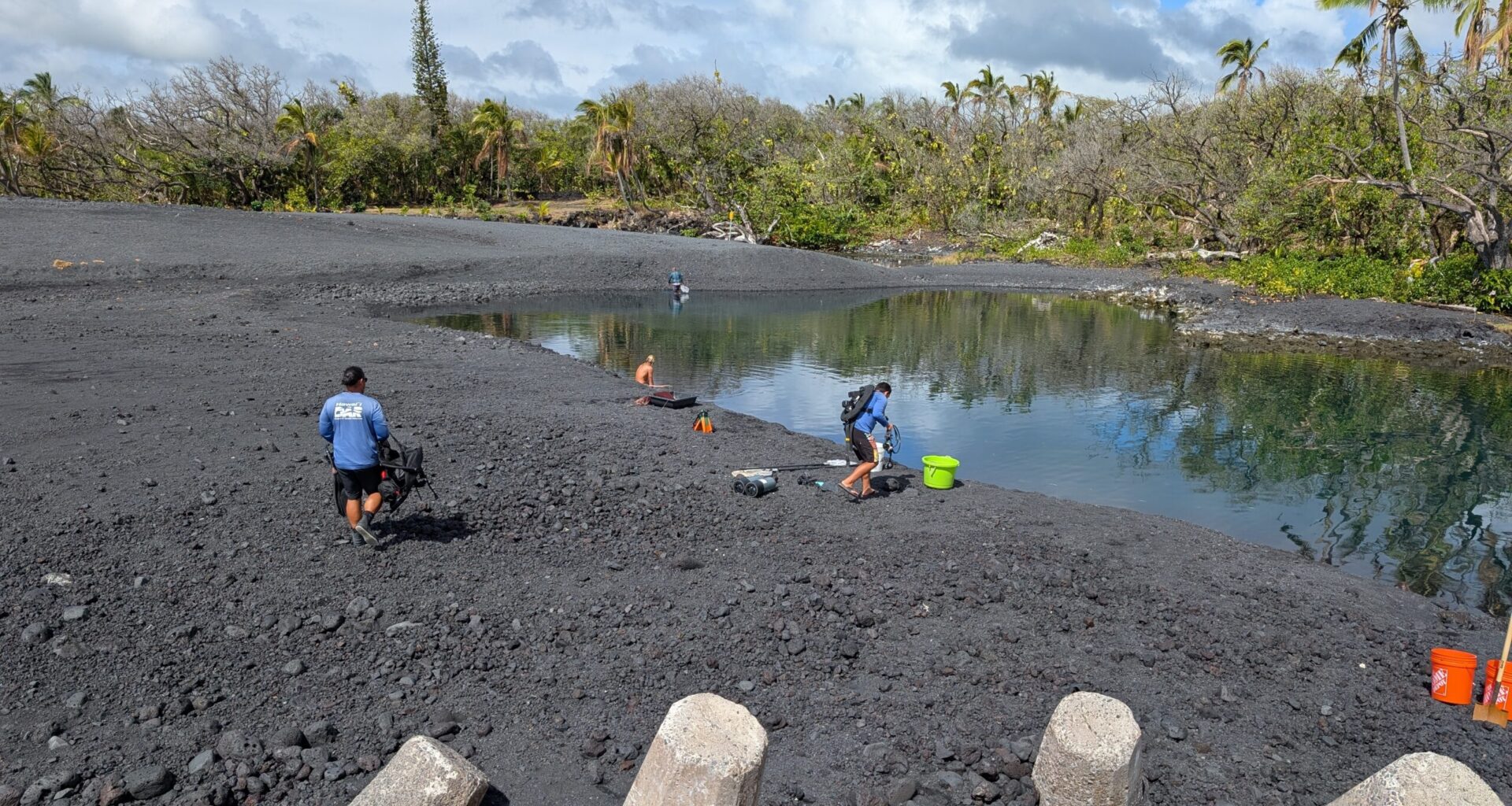
When I visited the site Tuesday, the channel was gone and the resulting basin was still and sour.
DLNR crew members in wetsuits and scuba tanks moved slowly through the mostly stagnant water, hauling nets heavy with small dead fish.
“We have been working on this project for nine years and we are all extremely disappointed,” Laurence said.
The Cheaper Fix
DLNR’s own documents show how it happened.
According to the agency’s 2023 Environmental Assessment, three alternatives were considered: twin breakwaters ($46 million), full removal of volcanic debris ($40 million), and a smaller $5.4 million channel dredge. The state ultimately pursued the smaller dredge, later expanded under the Federal Emergency Management Agency’s cost-share program to a $9.28 million contract awarded to Goodfellow Bros.
The state preferred the full dredge, but funding fell short. “It was important to do something rather than nothing,” Laurence said.
That “something” lasted less than a month.
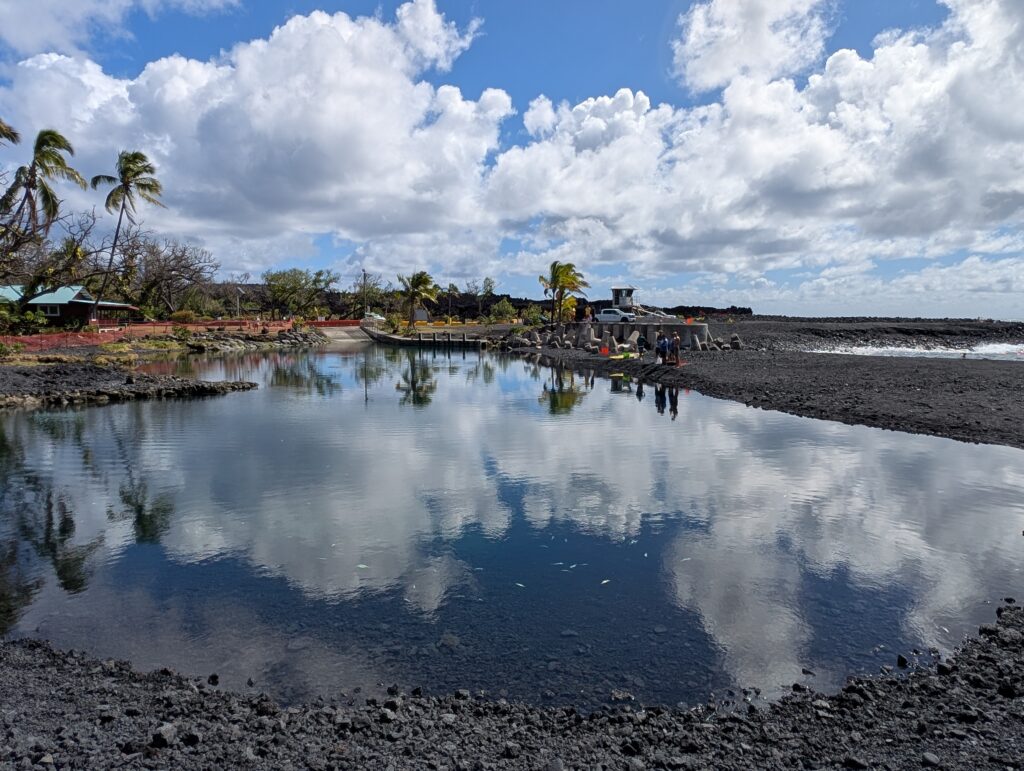 The dredged path at Pohoiki Bay has completely refilled, leaving a stagnant basin full of dead fish. Access to the boat ramp is again cut off, as it had been since the 2018 eruption of Kīlauea. (Will Bailey/Civil Beat/2025)
DuPont said the community’s original plan called for complete sand removal followed by a testing phase to observe current flow before reopening. As it turned out, “We never even got to put a boat or a jet ski in the water. The channel failed before we could test it.”
He said the DLNR’s Division of Boating and Ocean Recreation staff later messaged him asking for drone footage of the collapse.
“They said, ‘Can you send us some video? We don’t know what happened.’”
The cause, DuPont said, is no mystery. Pohoiki sits in the path of a strong south swell that drives a north-flowing longshore current, pushing sand back across the bay.
“The window of calm was perfect when they dug it,” he said. “As soon as that window closed, so did the channel. That’s just normal out there.”
Even DLNR engineer Finn McCall had cautioned at the time: “We really can’t predict how quickly the new channel might fill back in.”
Now we know — weeks, not years.
A public notice from FEMA last year described the dredge as a one-time restoration, not a rebuild. It explicitly warned that Pohoiki lies in a flood zone “subject to future flooding events.”
A FEMA grant was supposed to reimburse initial construction only, leaving no maintenance funding. DuPont said FEMA hasn’t yet reimbursed the state or signed off on completion — meaning the project is in limbo even as the bay has closed again.
“The department is currently examining the site conditions and evaluating options to address the situation and long-term solutions,” said the DLNR’s Laurence.
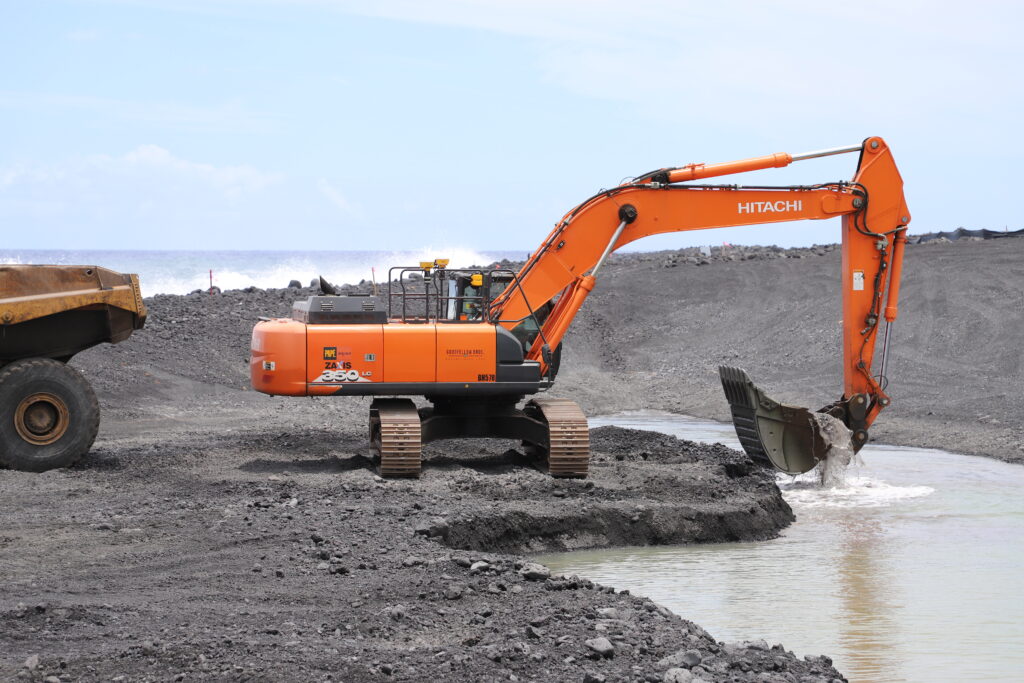 The dredging project last summer was supposed to restore access to the Pohoiki boat ramp. (DLNR photo/2025)
A Symbol Of What Went Wrong
By last weekend, videos from local residents showed a spotted eagle ray — a protected species — circling inside the closed basin. The ray had entered when the channel was open and became trapped as sand drifted back across the cut.
In one clip, residents stood on the new sand-and-rock bridge that now separates the basin from the sea, using shovels and buckets to carve a shallow trench toward the surf — a desperate attempt to give the animal a path out.
DLNR’s Division of Aquatic Resources confirmed receiving reports about the ray and sent staff to rescue it Monday.
“They opened the ocean, then sealed it again,” resident Cheyne Johnson said. “Now even the fish are paying the price.”
For many in Puna, the image hit hard — a symbol of what went wrong.
A project meant to restore access had instead created a trap, not only for boats and people but for the wildlife the bay once sustained.
The Human Cost
Pohoiki was never just a boat ramp.
It was the east side’s lifeline — connecting subsistence fishers, charter crews and families whose lives move with the tide.
Before the eruption, fishers launched here to chase ahi, often landing 100- to 200-pound yellowfin during the summer run. The ramp supported small commercial crews that supplied markets with fresh tuna rivaling Kona’s in quality, if not scale.
When lava sealed it off in 2018, the loss was economic and cultural.
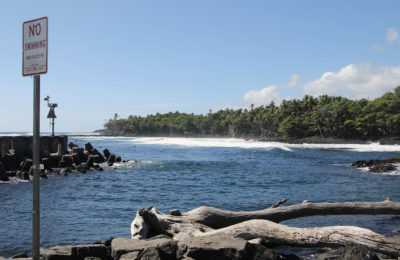 Pohoiki Bay used to open right into the ocean before the eruption. (Nathan Eagle/Civil Beat/2017)
Fishers were forced to haul to Hilo — 30 extra miles, two extra hours, and far more fuel. Some folded their operations entirely. Reopening wasn’t about convenience; it was about survival.
That’s what the community’s full-dredge plan was meant to protect — after a broader $60 million harbor-improvement concept discussed in 2022–23 was dropped. The larger plan, never formally adopted, would have added breakwaters and deeper dredging but required long-term federal investment the state couldn’t match.
The design that survived wasn’t built to last — only to appease.
Now the sand has returned, and with it the same waiting, the same questions, the same quiet frustration that comes when a preventable failure is blamed on nature.
The Lesson In The Sand
The physics are simple and merciless: sand moves.
Ignore that, and the sea will undo your math.
Pohoiki’s collapse may yet serve a purpose. Each refill, each recorded tide, is data — proof of what the next plan must confront.
But only if that data is made public, and the next design is funded to match the scale of the coast, not the size of the budget cycle.
Because out here, doing “something rather than nothing” can become the most expensive choice of all.
Puna doesn’t need another ribbon cutting. It needs an as-built drawing, a monitoring plan and a maintenance budget.
It needs to know who’s accountable when the next tide turns.
Pohoiki has always been a teacher.
This time its lesson is brutal and clear: The warnings weren’t mystical. They were measurable. And the people who measured them were right.

Sign up for our FREE morning newsletter and face each day more informed.
Sign Up
Sorry. That’s an invalid e-mail.
Thanks! We’ll send you a confirmation e-mail shortly.