

U.S. Freight Brokerage Market Size
The U.S. freight brokerage market was valued at USD 17.50 billion in 2024, is estimated to reach USD 19.00 billion in 2025, and is projected to reach USD 35.15 billion by 2033, growing at a CAGR of 8.6% from 2025 to 2033.
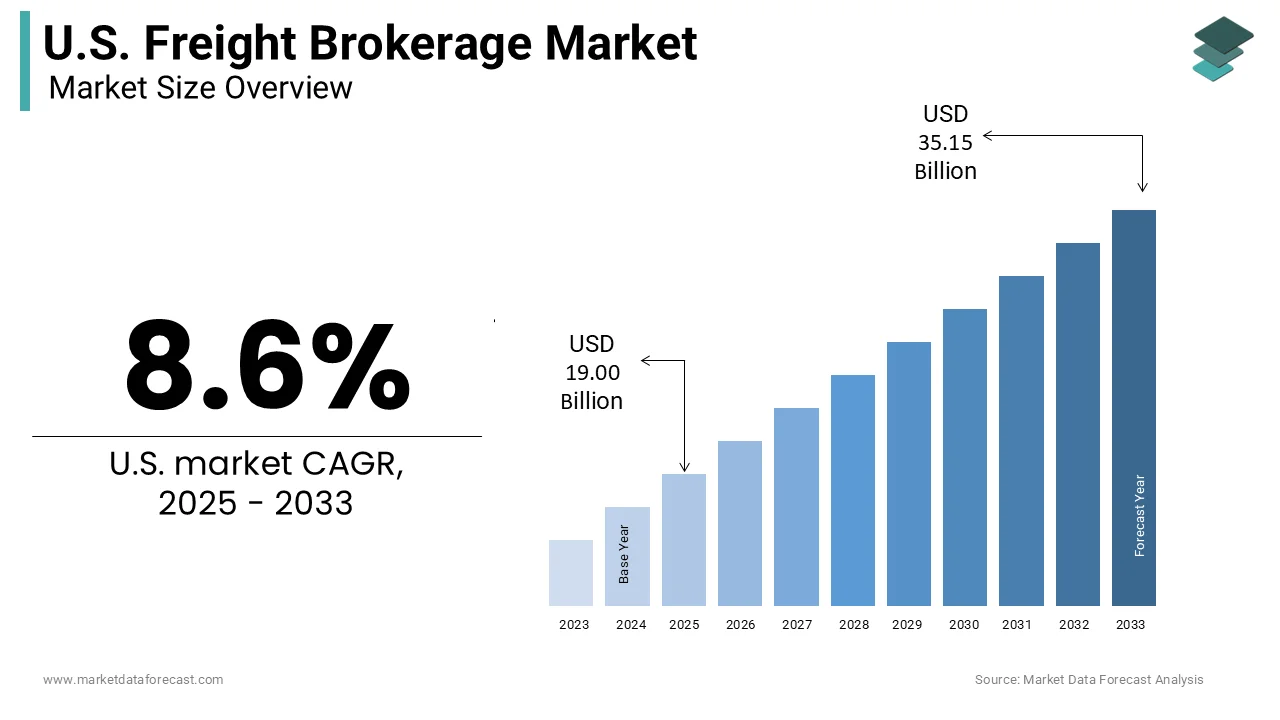
The freight brokerage is the intermediary layer between shippers requiring transportation services and carriers possessing available capacity to move goods across road, rail, and intermodal networks. Brokers do not own physical assets but leverage digital platforms, MS relations, hips, and regulatory compliance to match supply with demand, optimize routing, and ensure contractual and financial accountability.
MARKET DRIVERS Rising Fragmentation of Carrier Capacity and Shipper Demand Imbalance
The structural imbalance between highly fragmented carrier supply and concentrated shipper demand has elevated the strategic necessity of freight brokers as market stabilizers and capacity aggregators, which is driving the growth of the United States freight brokerage market.
Digital Freight Matching Platforms and Algorithmic Rate Discovery
The proliferation of cloud-based freight matching platforms powered by machine learning and real-time pricing algorithms has transformed brokerage from a relationship-driven service into a technology-enabled efficiency engine. This factor is also enhancing the growth of the United States freight brokerage market. Shippers benefit from transparency, with 89% of logistics managers indicating they now compare broker quotes against algorithmic benchmarks before awarding contracts.
MARKET RESTRAINTS Persistent Trust Deficit Between Small Carriers and Institutional Shippers
The deep-seated trust deficit between asset-based carriers, particularly owner operators and institutional shippers, is hampering the growth of the United States freight brokerage market. Shippers reciprocate awareness, with 68% of logistics executives avoiding direct contracts with carriers under twenty trucks due to perceived compliance and insurance risks. Brokers bridge this chasm by acting as financial intermediaries, credit verifiers, and dispute resolvers.
Regulatory and Compliance Burden Amplifying Operational Costs
The mounting regulatory complexity that inflates compliance costs, erodes margins, and creates barriers to scalable growth, particularly for mid-sized and new entrant firms, is also restricting the growth of the United States freight brokerage market. Legal exposure is equally daunting, with the Transportation Intermediaries Association reporting a two-hundred-seventeen % increase in cargo claim litigation against brokers between 2020 and 2023. These cumulative pressures force brokers to invest in compliance automation, legal counsel, and audit preparation,n diverting capital from customer acquisition and technology innovation.
MARKET OPPORTUNITIES Integration of Carbon Accounting and Green Freight Procurement Services
The freight brokers are uniquely positioned to monetize sustainability mandates by embedding carbon tracking, emission benchmarking, and green carrier scoring into their core service offerings. Brokers are responding by integrating telematics-derived fuel consumption models with route optimization algorithms to generate lane-specific carbon footprints for every shipment.
Expansion Into Managed Transportation and End-to-End Control Tower Services
The leading freight brokers are transcending transactional intermediation by offering fully outsourced transportation management and real-time supply chain control tower capabilities, which is escalating the growth of the United States freight brokerage market.
MARKET CHALLENGES Talent Shortage in Logistics Execution and Carrier Relationship Management
The skilled professionals capable of managing complex carrier relationships, interpreting real-time data, and executing exception-based logistics in high-pressure environments are challenging the growth of the United States freight brokerage market.
Algorithmic Rate Volatility and Margin Compression in Digital Marketplaces
The proliferation of algorithm-driven freight exchanges has created unprecedented pricing transparency, but also intensified margin erosion as brokers compete on rate alone rather than service value or relationship depth,h is thinderser the growth of the United States freight brokerage market. Carrier loyalty is equally fragile, with Convoy data showing that seventy-three % of small carriers switch brokers weekly based solely on rate per mile without regard to payment history or service quality.
REPORT COVERAGE
REPORT METRIC
DETAILS
Market Size Available
2024 to 2033
Base Year
2024
Forecast Period
2025 to 2033
Segments Covered
By Mode, Trailer Type, Service Type, and Region.
Various Analyses Covered
Global, Regional, and Country-Level Analysis, Segment-Level Analysis, Drivers, Restraints, Opportunities, Challenges; PESTLE Analysis; Porter’s Five Forces Analysis, Competitive Landscape, Analyst Overview of Investment Opportunities
Countries Covered
New York, Massachusetts, Pennsylvania, Illinois, Ohio, Michigan, Texas, Florida, Georgia, California, Washington, Colorado.
Market Leaders Profiled
C.H. Robinson Worldwide, Total Quality Logistics (TQL), XPO Logistics, Echo Global Logistics, Coyote Logistics (UPS), J.B. Hunt Integrated Capacity Solutions, Mode Transportation, Landstar System, Uber Freight, Schneider National, ArcBest Corporation, Hub Group, GlobalTranz Enterprises, Worldwide Express, Allen Lund Company
SEGMENTAL ANALYSIS By Mode Insights
The full truckload segment was the largest in the United States freight brokerage market by capturing a significant share in 2024, with the operational preferences of large shippers seeking dedicated capacity, predictable transit times, and reduced handling risk for high-value or time-sensitive cargo.
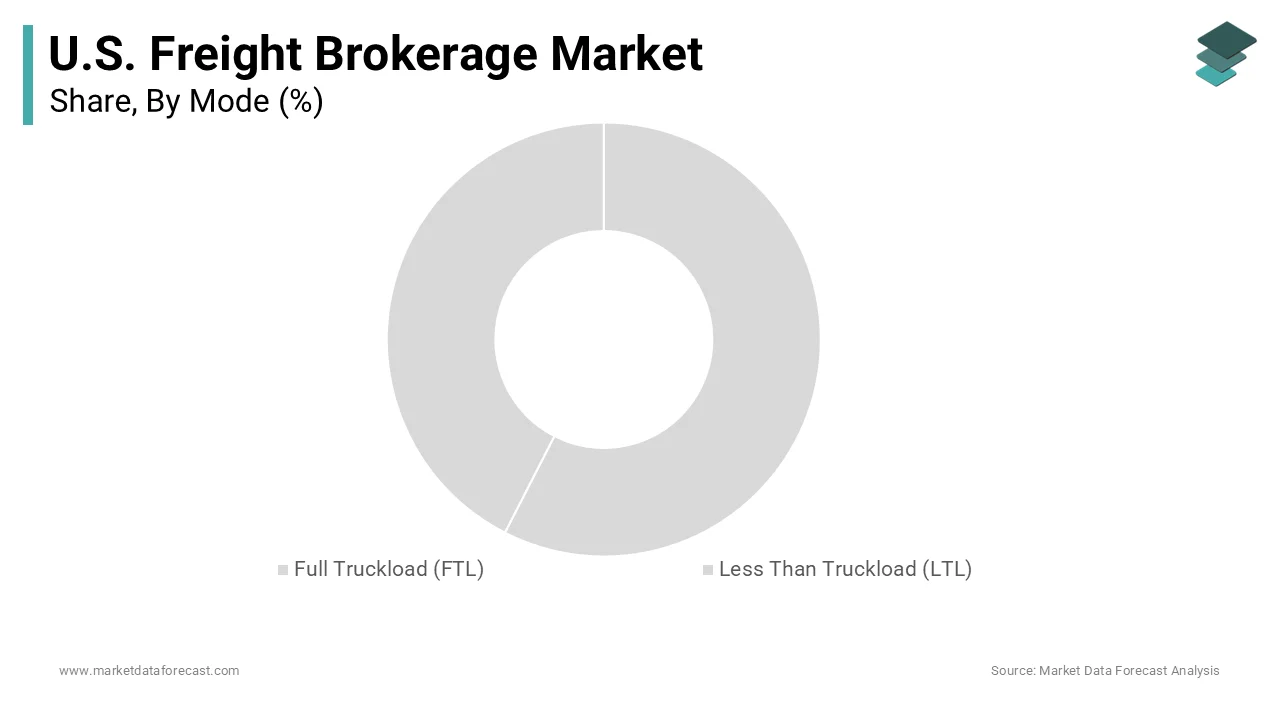
The less-than-truckload segment is lucratively growing with an estimated CAGR of 14.3% during the forecast period, with the proliferation of e-commerce fulfillment models, regional distribution center networks, and the rise of mid-sized shippers seeking cost-efficient alternatives to parcel and FTL. Technology adoption is a key enabler, with Coyote Logistics and Uber Freight launching dynamic LTL pooling algorithms in 2023 that reduce transit times by up to twenty-eight % through real-time lane matching and backhaul optimization.
By Trailer Type Insights
The dry van trailers segment was the largest and held 62.3% of the United States freight brokers market share in 2024, with the trailer’s versatility to transport the broadest range of non-perishable non-over-sized goods, including retail merchandise, packaged foods, electronics, and industrial components. Equipment availability remains high with ACT Research noting that the United States dry van fleet exceeded 2.1 million units in 20,23, ensuring rapid matching even during peak demand.
The refrigerated trailer segment is projected to register a CAGR of 18.2% throughout the forecast period, with the structural expansion of perishable goods consumption e e-commerce grocery adoption, and pharmaceutical logistics demand. Technology integration is accelerating adoption,n with 86% of new refrigerated trailers sold in 2023 featuring telematics-enabled temperature monitoring and remote adjustment capabilities.
By Service Type Insights
The traditional segment was the largest and held 43.2% of the United States freight brokerage market share in 2024, with the enduring value of trust-based relationships, complex problem-solving, and exception management that algorithms cannot replicate. Compliance and liability management also favor humaover with 99%-nineeee % of brokers reporting that they resolve cargo claims faster through direct carrier communication than through automated platforms.
The digital freight matching platforms segment is likely to grow with a CAGR of 22.6% throughout the forecast period, with the algorithmic efficiency, efficiency, pricing transparency, and the generational shift toward self-service procurement among mid-market shippers.
COMPETITIVE LANDSCAPE
The US’s freight brokerage market is intensely competitive with numerous players vying for dominance through innovation, service differentiation,n and global reach. Large firms leverage technology to automate processes and reduce cost,s and provide real-time. Mid-sized brokers focus on niche verticals and personalized service. Competition is not only domestic but increasingly global as companies expand into the Asia Pacific to capture transpacific trade flows. Customer expectations for speed, transparency, and reliability continue to rise, forcing brokers to invest heavily in digital infrastructure and carrier networks. Talent acquisition and retention also play a critical role as skilled logistics professionals drive client satisfaction. Regulatory compliance and sustainability initiatives are becoming key differentiators. The market rewards agility, scalability, and the ability to manage complexity across borders and modes.
KEY MARKET PLAYERS
Some of the companies that are playing a dominating role in the U.S. freight brokerage market include
C.H. Robinson Worldwide Total Quality Logistics (TQL) XPO Logistics Echo Global Logistics Coyote Logistics (UPS) J.B. Hunt Integrated Capacity Solutions Mode Transportation Landstar System Uber Freight Schneider National ArcBest Corporation Hub Group GlobalTranz Enterprises Worldwide Express Allen Lund Company TOP LEADING PLAYERS IN THE MARKET C H Robinson operates as a global logistics provider with deep roots in North American freight brokerage and significant activity across the Asia Pacific region. The company facilitates ocean and air freight movements between Asia and the United States through its global forwarding division. Recently, it invested in digital freight platforms to automate bookings and improve real-time shipment tracking. It also expanded its local agent network in key Asian ports to enhance customer service. These initiatives aim to reduce transit variability and improve supply chain resilience for multinational shippers relying on transpacific trade lanes. XPO Logistics delivers integrated freight brokerage and last-mile solutions across the United States with growing influence in Asia Pacific corridors. The company supports Asia-bound and Asia-originating freight through partnerships with regional carriers and terminal operators. It recently deployed machine learning tools to predict capacity gaps and optimize lane pricing. XPO also established a regional control tower in Singapore to oversee Asia Pacific operations and improve coordination. The firm continues to prioritize technology investments to differentiate its service offering in competitive international lanes. TQL is one of the largest privately held freight brokers in the United States, with emerging capabilities in Asia Pacific logistics through third-party alliances. While primarily focused on domestic truckload services, it has begun facilitating import and export shipments via collaborations with ocean forwarders in China, a Ja p, and Vietnam. The company recently launched a bilingual customer support team to serve Asia-based clients and introduced a digital portal for real-time documentation and customs tracking. TQL also increased its headcount in international operations to handle rising cross-border volumes. These actions reflect its strategic intent to capture more global freight demand while leveraging its domestic scale and carrier relationships. TOP STRATEGIES USED BY THE KEY MARKET PARTICIPANTS
Key players in the US freight brokerage market focus on technology adoption to automate operations and improve transparency for shippers and carriers. They invest in artificial intelligence and machine learning to forecast capacity and optimize pricing dynamically. Strategic partnerships with regional and global logistics providers help extend their international reach, especially in the Asia Pacific corridors. Companies also expand their asset-light networks by onboarding more owner-operators and small fleets to ensure flexible capacity. Customer experience enhancements through digital portals and real-time tracking remain central to retention. Workforce development and specialized teams for global trade compliance further strengthen their competitive edge in complex international lanes.
MARKET SEGMENTATION
This research report on the U.S. freight brokerage market has been segmented and sub-segmented into the following categories.
By Mode
Full Truckload (FTL) Less Than Truckload (LTL)
By Trailer Type
Dry Van Trailers Refrigerated Trailers
By Service Type
Traditional Brokerage Digital Freight Matching Platforms
By Country
California Texas Florida Rest of the United States