
If there were any doubts regarding a political divide around spent nuclear fuel waste in Wyoming, Gov. Mark Gordon put them to rest.
Following Radiant Industries’ announcement this month that it was pulling its proposed nuclear microreactor manufacturing facility from Natrona County and taking it to Oak Ridge, Tennessee, Gordon pinned the blame on the Wyoming Freedom Caucus.
“Members of the Freedom Caucus inspired ‘Club No’ convinced Radiant that Wyoming isn’t about leadership and problem solving,” Gordon said in a prepared statement. “‘Club No,’” he continued, “has ushered in a new culture of no matter who began or who commenced it, we’re against it. That is not the way Wyoming became the great state it is.”
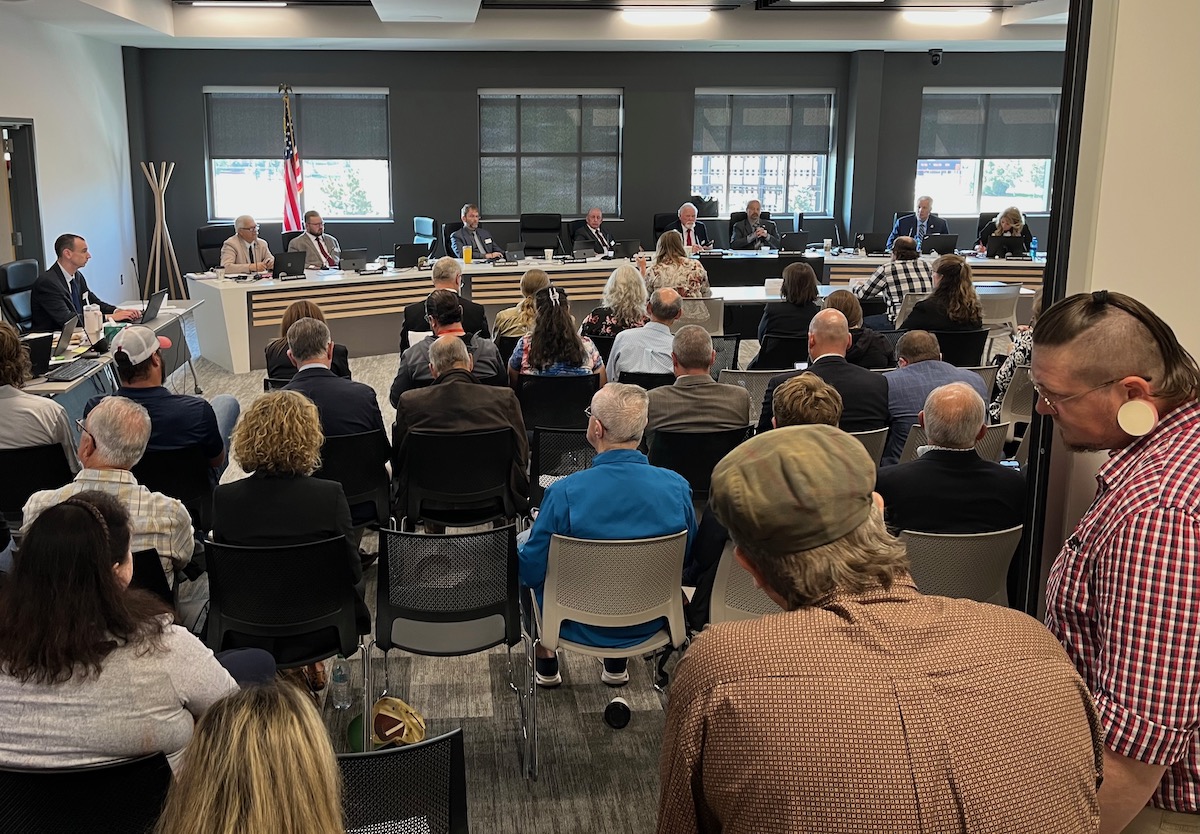
Key to Radiant’s proposal was the fact that it required a change in state law to allow storage of spent nuclear fuel waste. A measure to do just that was tabled this summer by the Joint Minerals, Business and Economic Development Committee amid an outpouring of opposition from around the state.
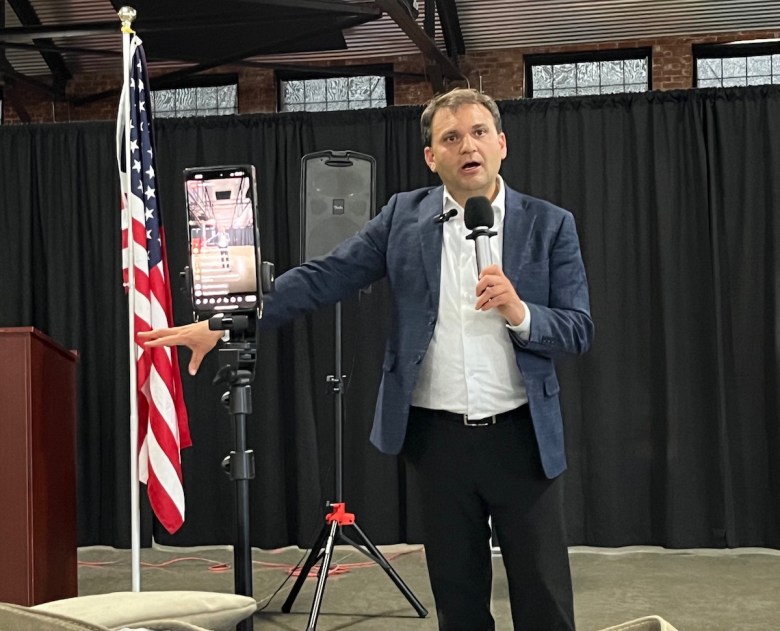 Secretary of State Chuck Gray speaks at a town hall event in Bar Nunn on July 21, 2025. (Dustin Bleizeffer/WyoFile)
Gillette Republican Rep. John Bear said he suspects Gordon is vying to win support from political donors associated with the nuclear industry to potentially oust Freedom Caucus members in future elections.
“He’d like to have free reign over the state of Wyoming policies, even if it’s not him in office,” Bear told WyoFile.
As Emeritus Chairman of the Wyoming Freedom Caucus, Bear pointed to the group’s statement issued in July: “Wyoming must continue to be a leader in proven energy production, not settle as a dumping ground for nuclear waste from other states.”
“I’m taking an educate-the-public [approach] and detractors are taking an opposite approach, which I believe is to make the deal and tell the public about it,” Bear said.
Though no less caustic at times, residents in Natrona and Campbell counties have grappled with nuclear energy proposals, searching for answers about a high-stakes industry they’re not familiar with and assurances about the prospect of storing highly radioactive spent nuclear fuel waste near their homes.
“We’d like to get some fair information, some unbiased information that isn’t coming from people who stand to gain from these proposals,” Bar Nunn resident Lee-Ann Newquist told WyoFile. “It’s not a for-or-against issue. There are people in the middle who are not being represented.”
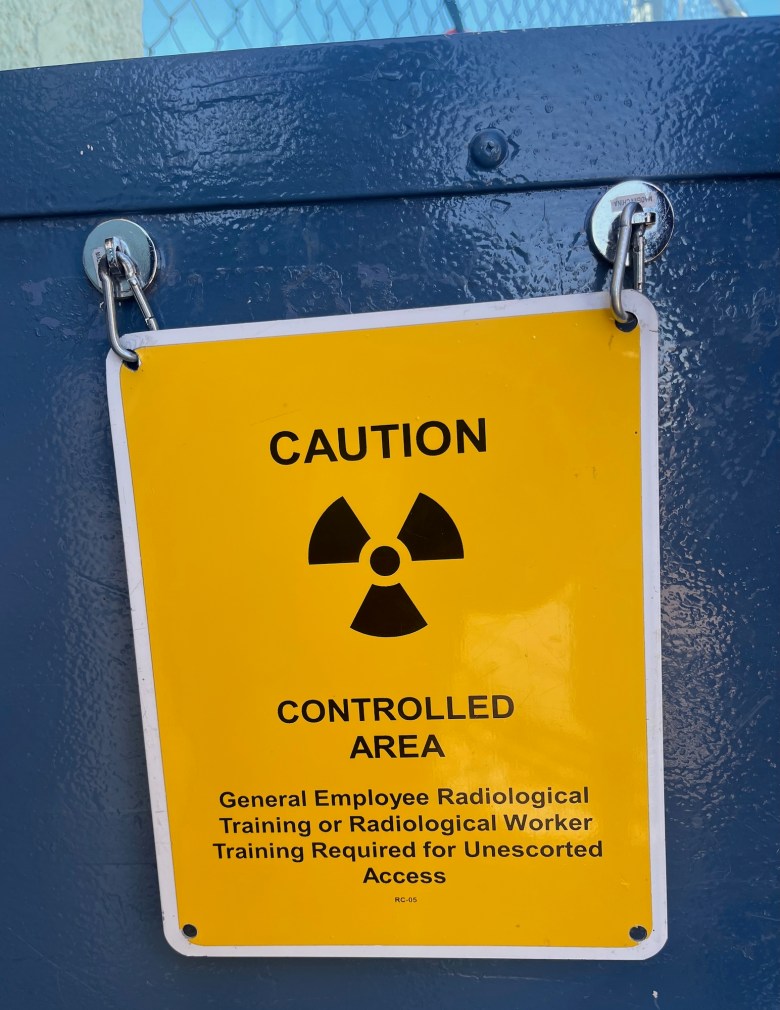 A sign alerts of required radiological training at the Idaho National Laboratory. (Dustin Bleizeffer/WyoFile)
Monied, outside companies eager to plant the next generation of nuclear energy facilities in and around Wyoming are moving too quickly, some residents say, while fervent supporters — including some state and local elected officials — tend to cast doubters as reactionary NIMBYs. Many residents haven’t made up their minds about nuclear energy in Wyoming, which has triggered debates even among married couples.
WyoFile interviewed a dozen residents during two recent public meetings: One on Sept. 29 at Casper College, and another on Sept. 30 in Gillette, to get a gut-check on the nuclear energy conversation in Wyoming. Though some were decidedly for and some decidedly against various aspects of nuclear energy proposals, their responses were mostly apolitical. They revealed conflicted feelings about potential benefits and risks and much frustration about who to trust for credible answers to endless questions.
Here’s what they said.
Natrona County
About 100 Natrona County residents attended, “Let’s Set The Table — Nuclear 101,” presented by retired uranium mining engineer Wayne Heili. Though the presentation, which included a question-and-answer format, didn’t focus specifically on Radiant’s proposal — which was still active in Wyoming at the time — it was top of mind.
“[Radiant] can come in if it’s the right business for the community,” Bar Nunn resident Chris Hermel told WyoFile. “But the safety issues, to me, have not been addressed — not to my satisfaction.” The company’s assurances regarding safety protocols for transporting radioactive materials in and out of the community, for example, lacked details. “It needs to come with proof, not just somebody saying, ‘It’s safe,’ and ‘Trust me.’”
Radiant Industries
California-based startup Radiant Industries announced plans early this year to build a nuclear microreactor manufacturing plant just outside the town of Bar Nunn, a few miles north of Casper. The community was an ideal location, company officials said, for its existing manufacturing and heavy industry support services — and the fact that Wyoming is already home to uranium mining, which Radiant would eventually tap for its fuel supply chain.
Radiant’s portable, TRISO-fueled Kaleidos microreactors would be deployed to clients, including the U.S. Military, around the world. When a unit needs refueling, it would be sent back to the manufacturing plant, and the spent fuel would be stored on site and presumably moved to a permanent federal nuclear fuel waste repository if one is built.
The plan would require a change to Wyoming’s decades-long ban on spent nuclear fuel waste, which lawmakers considered but so far have not taken action on. The company announced Oct. 13 that it was withdrawing its plans in Wyoming to instead build in Tennessee.
Like many others, Hermel wasn’t convinced that Radiant’s nuclear fuel waste would ever leave the Natrona County facility, noting there is no federal repository. “It seems like they’re trying to rush it through without having all of the details,” he said.
The divide over Radiant and other nuclear energy proposals in Wyoming sometimes includes disagreements within the same household.
Lisa and Wayne Kasparek of Bar Nunn, after listening to Heili’s presentation, challenged each other over the safety of storing spent nuclear fuel near their community.
“If they have so many places that are already storing waste, why can’t the waste be stored at a facility that is already storing it?” Wayne posed to his wife.
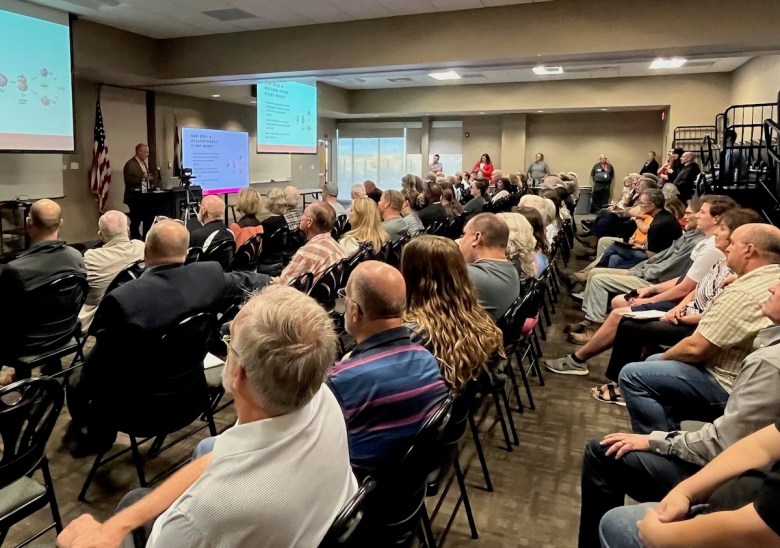 Retired uranium miner Wayne Heili delivered a “nuclear 101” presentation at Casper College in September. (Dustin Bleizeffer/WyoFile)
“They addressed that in there,” Lisa responded. “They’re looking to possibly have one storage facility,” she said, referring to hopes for a renewed effort to establish a federal nuclear waste repository.
“Yeah, and Wyoming might be it, since we’re wide open and we don’t have a large population,” Wayne said.
Though not opposed to nuclear energy manufacturing, both Kaspareks said they worry about other projects that would generate electricity in Wyoming but ship the power out of the state — like TerraPower’s Natrium nuclear plant under construction in Kemmerer — fearing it might increase their power bills.
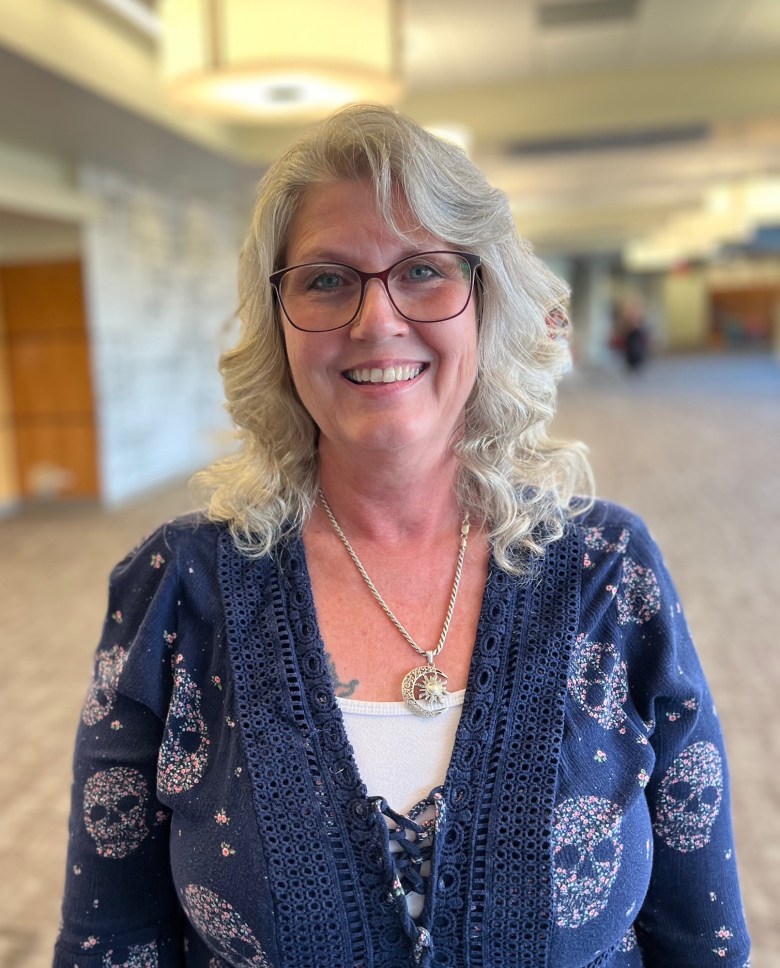 Bar Nunn resident Lee-Ann Newquist. (Dustin Bleizeffer/WyoFile)
“I want to hear specifics on how it’s going to affect our pocketbook,” Lisa Kasparek said. “I’m comfortable with the safety features because I think we’ve come so far in learning about nuclear power.”
Others lamented what they see as a tendency — including among elected officials — to draw lines for residents to either be for or against nuclear energy, particularly regarding Radiant’s proposal. Lee-Ann Newquist of Bar Nunn, said that tendency to draw lines amplified tensions over the issue in Bar Nunn and left many, including herself, doubtful about who can be considered a trusted, unbiased source of information.
Rather than town hall meetings organized by elected officials, Newquist said, “maybe set up a citizens committee so we can have a roundtable discussion long before things are actually breaking ground and money is being spent.”
Campbell County
In Gillette, BWXT hosted a public information session, attracting nearly 300 attendees. The company’s director of business development, Joshua Parker, gave a short presentation, and attendees milled around to pose questions to company officials posted around the venue.
DJ Towne brought a notebook with questions and penciled in answers as she visited each station.
“I asked them about worst-case scenarios when you’re transporting the stuff: What happens if?” Towne told WyoFile. “She said there’s required packaging, so that in case of a crash in bad weather, it’s not radioactive.”
BWXT
Lynchburg, Virginia-based BWXT proposes to build a $500 million TRISO nuclear fuel manufacturing facility in Gillette. Construction of the “Category II” plant is expected to begin about a year from now, with an in-service target of 2030, according to the company.
TRISO consists of tiny enriched uranium pellets the size of poppyseeds, each encased in “carbon- and ceramic-based materials that prevent the release of radioactive fission products,” according to the Department of Energy. The facility will not produce or store any high-level radioactive waste or spent nuclear fuel in the state, according to the company. BWXT hopes to eventually tap Wyoming’s uranium mining industry to supply its fuel chain.
The Wyoming Energy Authority announced earlier this month that it is recommending a $100 million state grant to support the project.
Towne was still hunting down a BWXT official to answer another question: What kind of tax breaks is the company seeking from the federal and state government? She arrived at the event uncertain about whether she might ultimately support BWXT’s project.
“I just wanted more information before I made a decision,” Towne said. “That’s what a lot of people are here for, to be informed so we don’t misunderstand what it actually is.”
Ronda Boller was equally undecided when she arrived at the event. Though she was there to learn about the proposed nuclear fuel manufacturing facility, she was also wary about a sense of enthusiasm for nuclear energy throughout the community. The town’s long boom-and-bust history instills a sense of desperation, she noted.
“When we get on a boom, we’re like, ‘Let’s run with it,’” Boller said.
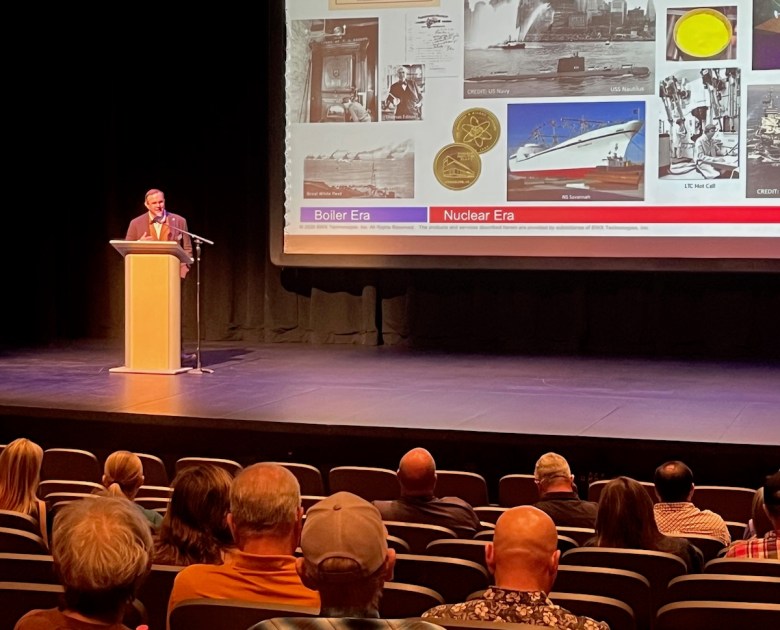 Joshua Parker of BWXT speaks to a crowd of about 300 in September 2025, in Gillette. (Dustin Bleizeffer/WyoFile)
That’s what happened with the coal-bed methane boom of the 2000s, she said. Local and state officials eagerly embraced hundreds of companies that flooded into northeast Wyoming, overlooking some important safeguards and long-term implications. “And now the state is stuck filling those wells,” Boller said.
Millions in taxpayer dollars have been earmarked to clean up more than 2,000 orphaned wells, which can release methane, pollute groundwater and pose other hazards to people and wildlife.
Her advice to fellow residents: “Don’t get greedy. Don’t get in a hurry. Whatever you do, take your time. Make sure you understand everything and don’t think this is the next big boom.
“After watching what happened with [coal-bed methane], you can’t do that with nuclear,” Boller added. “I just want to make sure that if we do this, we do it right and we think it through.”
Kyle Van Lant was among those excited to see the nuclear energy industry come to town.
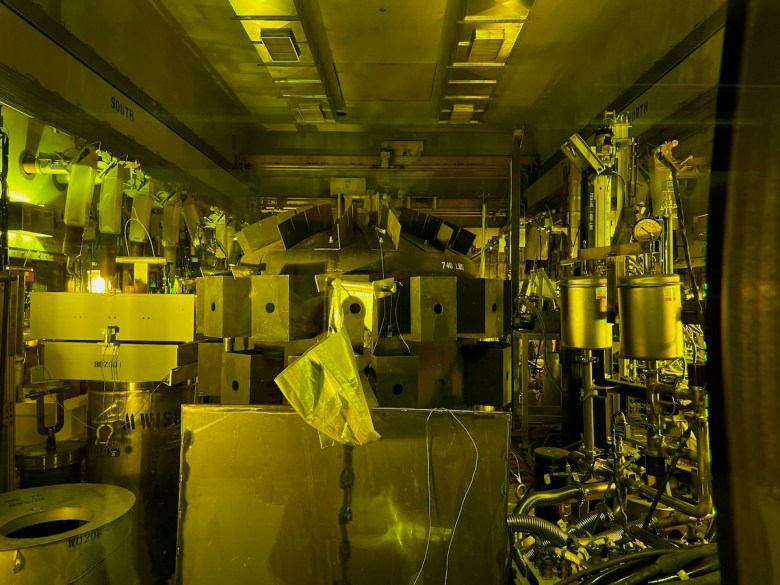 Irradiated equipment inside a fortified examination tank at the Idaho National Laboratory testing center. (Dustin Bleizeffer/WyoFile)
“This might not be the consensus in Gillette, but I’m a big believer in renewable energy,” the 25-year-old civil engineer said. “I think it’s extremely important that we learn how to balance our carbon output and input, and nuclear energy, I think, is probably the most feasible way for that to happen.”
Van Lant moved to Gillette from Los Angeles two years ago and has become increasingly interested in how the community — famous for its prolific coal, oil, natural gas and uranium production — might adapt to changing energy markets. “So I’ve been learning about nuclear energy and its feasibility in Gillette,” he said. “I’m excited and optimistic. I just hope people are receptive to it.”
Similar to some events in Bar Nunn this year, Van Lant said there were a handful of public meetings in Gillette that he felt were intended to incite fear rather than offer information or answer questions.
“People were standing up and saying ‘We want experts to talk to us, because this just seems like a scare meeting with nobody actually knowing what’s going on,’” he said.
Though BWXT’s Sept. 30 event might have included a “certain amount of fluff,” Van Lant said, company officials came with a lot of answers and explanations. “So it will be interesting to hear about how people respond to this.”
While Radiant has exited the discussion in Wyoming, there remains a possibility that nuclear waste storage will get attention during the upcoming legislative budget session, according to lawmakers close to the issue.
Though waste storage is not part of BWXT’s proposal, the Campbell County Board of Commissioners is mulling whether to put the question of spent nuclear fuel waste storage to a public vote next year. Meantime, the commission will not allow any form of spent nuclear fuel waste storage.
The public can go to this website to access the draft resolution and comment on it.