
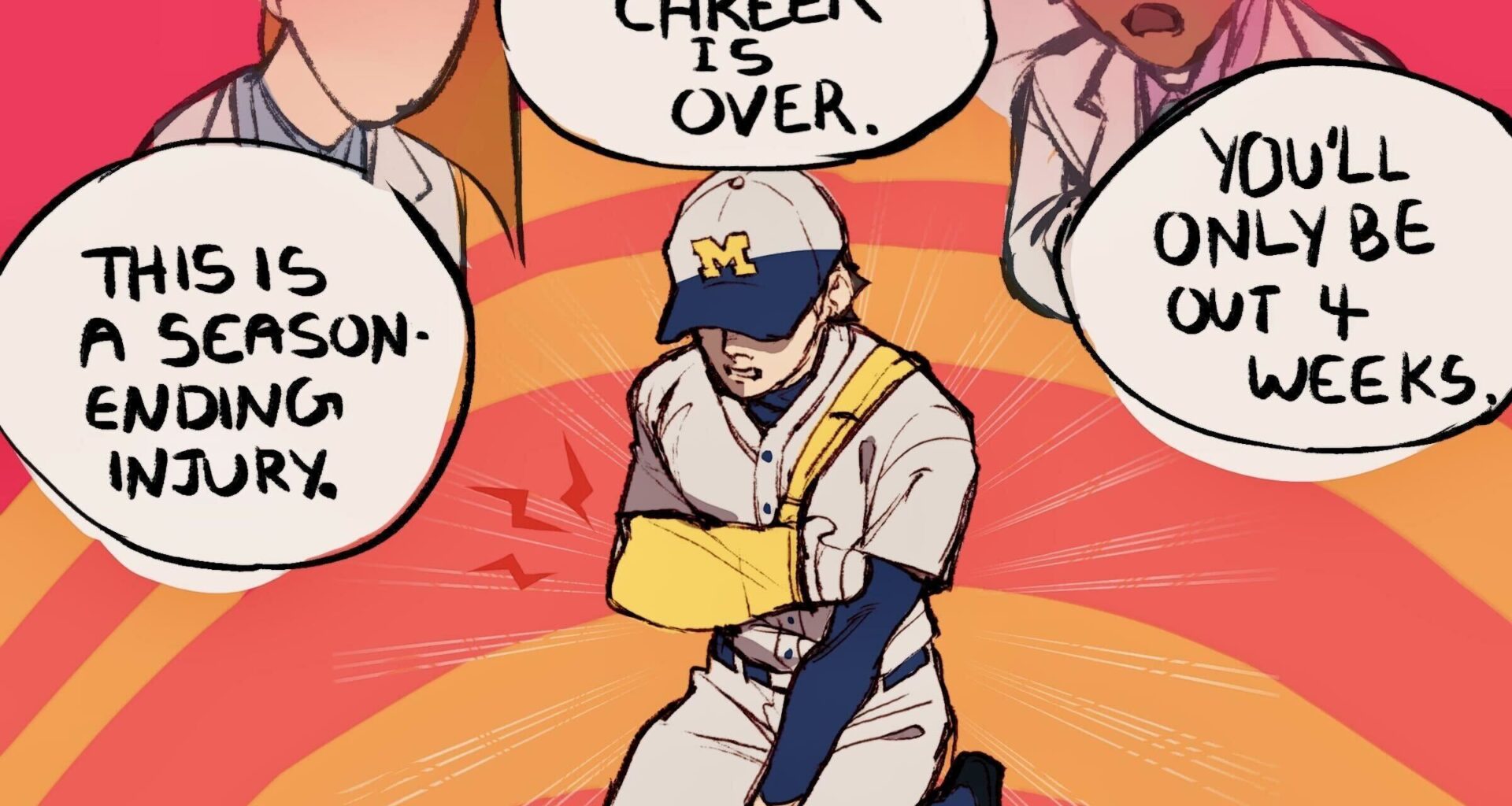
A study published in Economic Inquiry Sept. 2 by Richard Paulsen, assistant professor of sport management, analyzed Major League Baseball injury and playing-time data to examine how employment status affects the way teams manage player injuries. The research found that players with shorter or temporary contracts missed significantly fewer games following injuries compared to athletes with longer contracts.
In an interview with The Michigan Daily, Paulsen said he first became curious about injury management when following the 2022 Most Valuable Player race in the American League between Aaron Judge, New York Yankees outfielder, and Shohei Ohtani, then-Los Angeles Angels designated hitter and pitcher, whose contract ended after the 2023 season.
“I was following the 2023 season pretty closely, that came after the 2022 MVP race between those two players,” Paulsen said. “I’m a Yankees fan, I like Aaron Judge, and I was surprised that he was spending so much time sidelined with a toe injury, while at the same time following what’s happening with Shohei Ohtani and … all the injuries he was suffering, and he was not missing so much time.”
In an email to The Daily, Rackham student Georgy Shukaylo, whose studies focus on sport management, explained how roster rules, contract types and injury history affect players’ risk for injury.
“In the MLB, you are allowed to expand the roster size for the major league as the season progresses (say, before September 1st),” Shukaylo wrote. “Some teams leverage that to have more players available later on. Also, contract structure is a vital point here: on short-term and non-guaranteed deals, players own the risk. An injury or what is even worse — a reinjury — might make a player absent for some time. And, at a risk of getting injured again, faster returns are initiated by players.”
Paulsen said the findings of his study reflect that athletes with temporary contracts have similar experiences to temporary employees in other industries in terms of how much their employers value their wellbeing.
“You could envision that the employer doesn’t have a super strong incentive to invest in the health of interns, because the intern’s only with the employer for the summer,” Paulsen said. “They just want to have the intern do the work they need done, and they’re not the ones that are going to suffer in the long term if the intern productivity declines because they’re not investing in that health.”
Rackham student Tyler Fioritto told The Daily fatigue and overuse can affect players even when they aren’t officially injured, citing a recent example with Detroit Tigers starting pitcher Jack Flaherty.
“You can see a guy like Jack Flaherty, where he wasn’t officially injured, but he basically played a whole postseason run last year after being an all star,” Fioritto said. “I would say he was used so excessively that even though he wasn’t technically injured, there had to be some level of fatigue there. He basically played two years straight of baseball without a break.”
In an interview with The Daily, Kinesiology senior Cal Forde said players often face pressure to not report their injuries.
“I’ve heard from friends of mine that are playing at the collegiate level and professional level right now that there’s a big stigma around being open and honest about how your body feels,” Forde said. “So there are times where definitely … you might not feel your best, but you kind of play through it, because you want to get playing time — you want to be able to produce.”
Forde emphasized the ethical considerations of balancing player health with business priorities in sports.
“A big thing that we talk about in my classes is that at the end of the day, sports — whether we like it or not — they’re a business, so most of the time, owners and player personnel are going to do what’s best for the business,” Forde said. “Oftentimes, that can lead to what might sometimes seem like unethical decisions. I think there’s a fine balance between making decisions that reflect the human but also running the business and being competitive on the field.”
Daily Staff Reporter Kayla Lugo can be reached at klugo@umich.edu.
Related articles