
DETROIT – One of the oldest and most complete collections of African American art in the nation just got a major upgrade – and you can see it now at Detroit’s world-class art museum.
The Center for African American Art at the Detroit Institute of Arts was the first department of its kind in the nation when it was founded in 2000. Seven years later, the museum opened its first gallery dedicated specifically to African American Art, then located on the upper floor of the DIA in Midtown Detroit.
Now, 25 years after the historic founding of the department, the Detroit Institute of Arts has debuted an expanded, four-room gallery at the heart of the building. The reimagined Gallery of African American Art takes center stage, located directly next to the iconic Rivera Court, which features floor-to-ceiling frescoes of Detroit industry painted by muralist Diego Rivera.
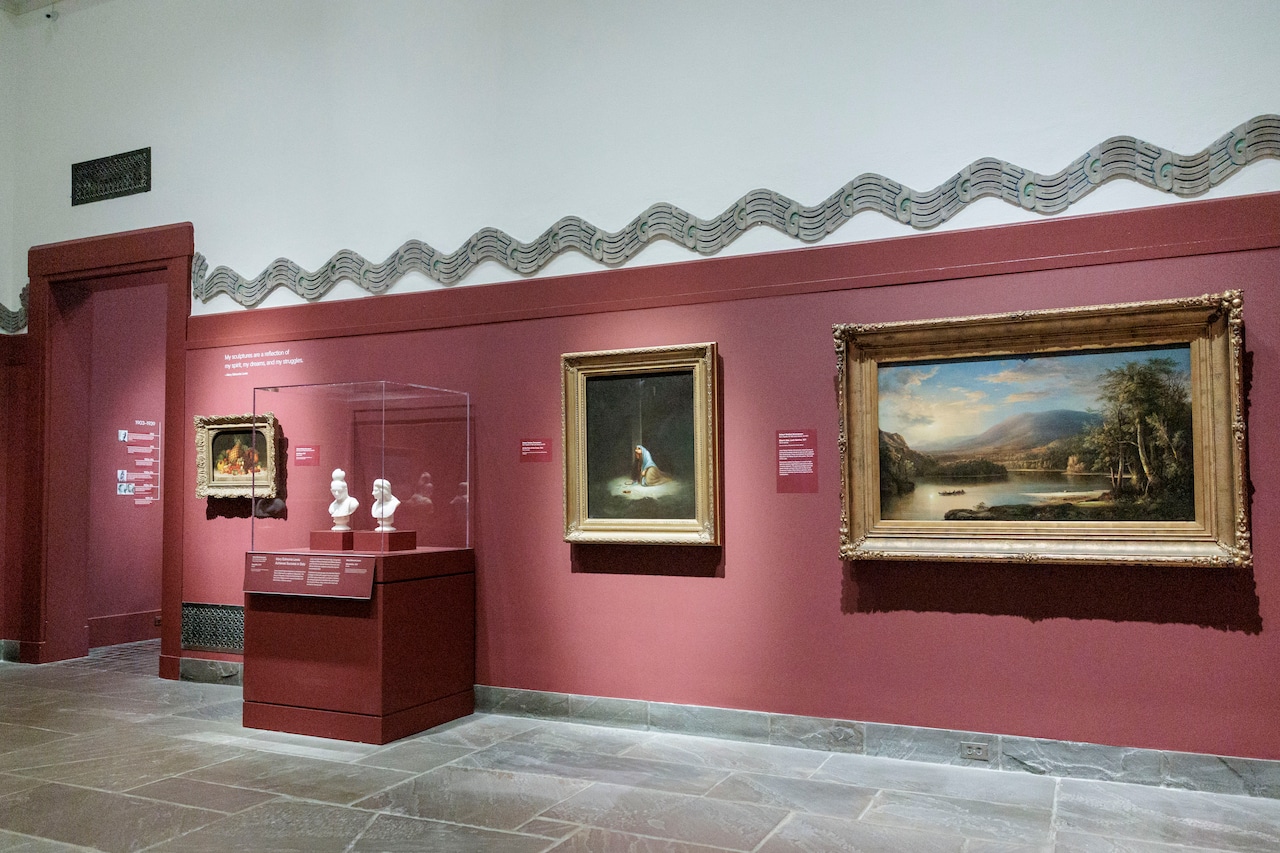 The new African American Art gallery at the Detroit Institute of Arts, 5200 Woodward Avenue in Detroit on Thursday, Oct. 23 2025.Jacob Hamilton | MLive.com
DIA director Salvador Salort-Pons said the new gallery is the culmination of more than 80 years of work in collecting African American artwork. In that time, the DIA has led the way in curating and displaying work by African American artists, including becoming the first major American encyclopedic fine art museum to establish a department specifically for curating African American art.
“We started to collect African American art in the 1940s, and over time we’ve been more strategic and purposeful about this to the point that we have, now, one of the best, largest collections of African American art in the world,” he said. “We just wanted to take this to the next level. Since we have this great history, we wanted to bring African American art at the center of the museum experience.”
The exhibit includes artwork created between 1840 and 1986. It opens with a room full of Civil War-era pieces, many commissioned by abolitionists, that became some of the earliest publicized works by African American artists to achieve national acclaim.
The next room highlights the role of African American artists in movements like Social Realism and the Harlem Renaissance, as well as art created for the federally-funded Works Progress Administration.
Hughie Lee-Smith’s 1953 painting “The Piper” is placed prominently as an example of work created during the Great Migration, during which six million African Americans moved from the South to cities in the Northeast, Midwest and West. The painting, which depicts a lone child playing a recorder on a Detroit street, is said to symbolize the hope and alienation migrants felt after moving away from the South.
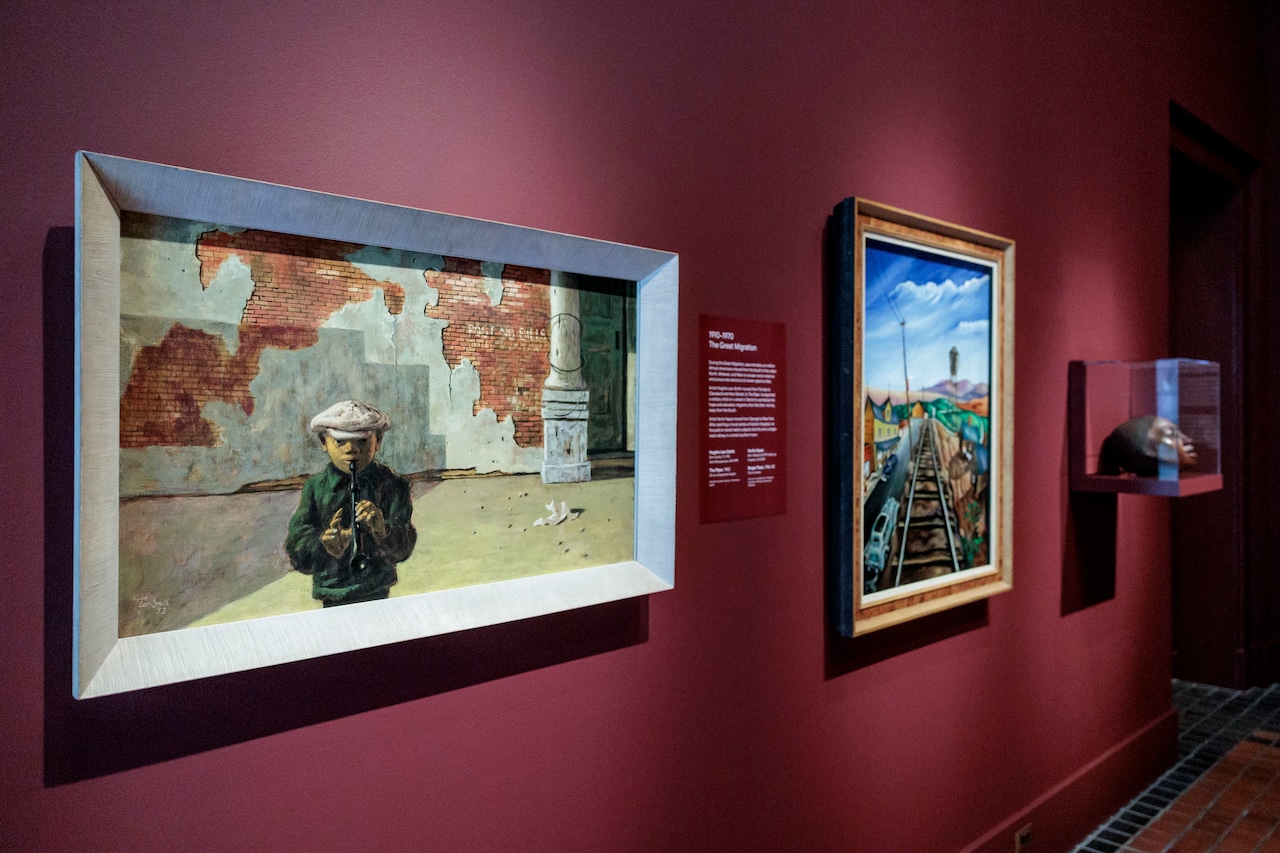 at the Detroit Institute of Arts, 5200 Woodward Avenue in Detroit on Thursday, Oct. 23 2025.Jacob Hamilton | MLive.com
As visitors move through the space, they’re confronted with the activist artwork of the Civil Rights Era and its immediate aftermath, which occupies three sides of a room opposite a wall of Haitian artwork that addresses colonialism.
At the center of a gallery wall featuring work made during the 1960s and 1970s is a painting by Allie McGhee, titled “Black Attack”, which depicts an African American man defending himself from the violence around him. The painting was created in response to the Detroit Rebellion, also known as the Detroit Uprising or 1967 Detroit riot, when racial tensions in the city reached their peak.
It’s placed next to “Revolutionary (Angela Davis)” by Chicago-based artist Wadsworth A. Jarrell, an internationally-famous depiction of the Civil Rights Era icon formed from colorful letters that spell works like “Resist” and “Revolution” as well as a quote from Davis herself: “”I have given my life in the struggle. If I have to lose my life, that is the way it will be.” The mixed-media piece is a defining artwork of the Black Arts Movement.
The final room features abstract artwork created as recently as 1986, when African American artists helped lay the groundwork for contemporary abstract painting and sculpture. It includes work by abstract artists like Robert Reed, whose painting “Plum Nellie” on a pair of triangular canvases hangs next to Edward Clark’s “Maple Red.” Clark became famous late in his career for pioneering the use of a push broom to spread thick acrylic paint over canvas.
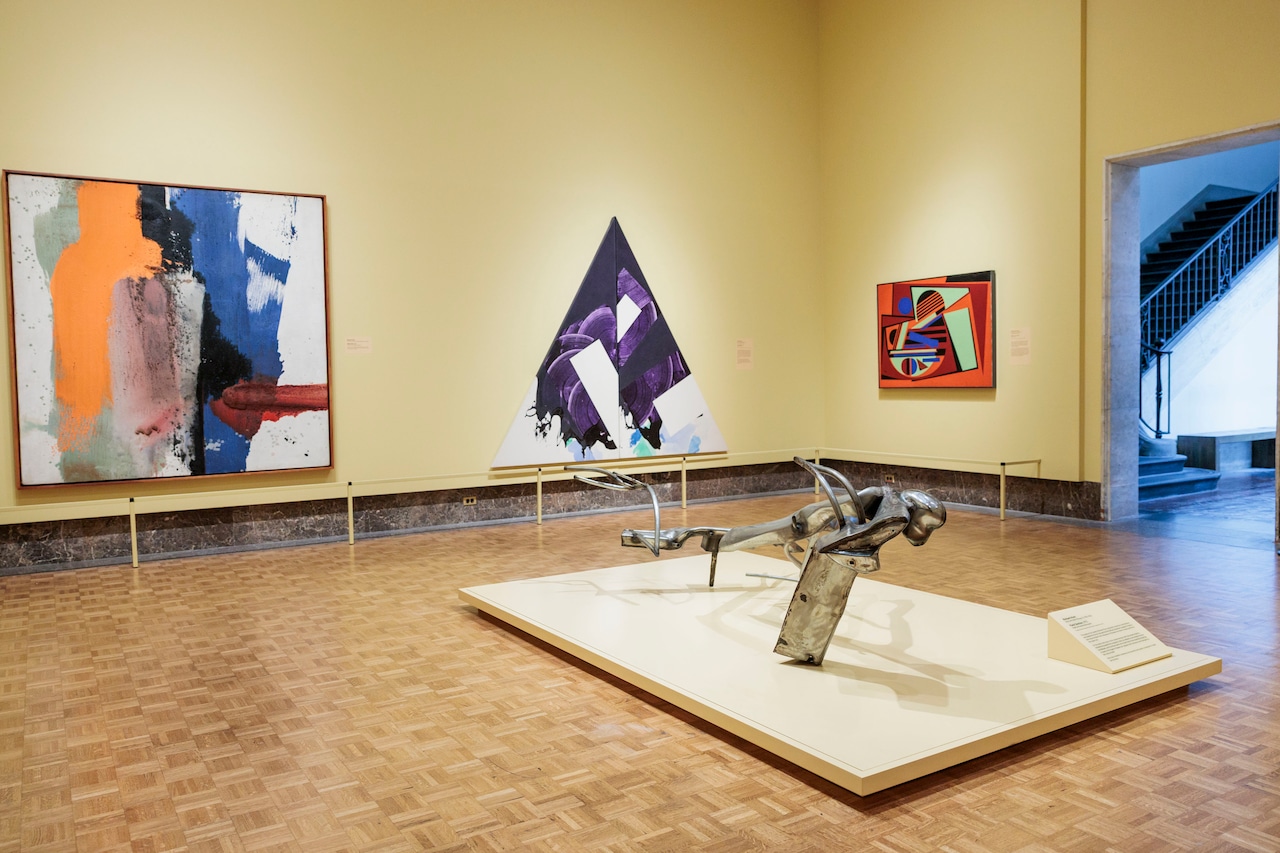 Abstract artwork in the final room of the new African American Art exhibit at the Detroit Institute of Arts, 5200 Woodward Avenue in Detroit on Thursday, Oct. 23 2025.Jacob Hamilton | MLive.com
Richard Hunt’s metal sculpture “Field Section,” which combines welded steel forms with automotive parts, takes center stage in the room. In 1970, Hunt became the first African American sculptor to have a solo show at New York’s Museum of Modern Art.
“When the visitor comes, they’ll get the whole picture – the vision, the sequence of what has happened,” Salort-Pons said. “When you walk in these galleries, and you get to the end and you look back, you can see the development of the themes of the forms and the colors that these creatives have done over time.”
The new exhibit, entitled Reimagine African American Art, is the first step in a renovation of the museum’s North Wing. The Modern and Contemporary galleries are currently undergoing a full renovation and are expected to reopen in Fall 2026.
“We’re upgrading our galleries, putting in new floors and a new ceiling, we’re really changing the navigation and we’re preparing an installation of our Modern and Contemporary art that is going to impress,” he said. Works by contemporary African American artists will be incorporated into the upcoming space.
“You will see Mickalene Thomas with Andy Warhol and [Anselm] Kiefer and others,” Salort-Pons said.
In the meantime, visitors can see artwork from the Modern and Contemporary galleries – including famous works like Van Gogh’s self-portrait as well as works by Picasso, Cézanne and Monet – in a condensed salon-style special exhibition near Rivera Court.
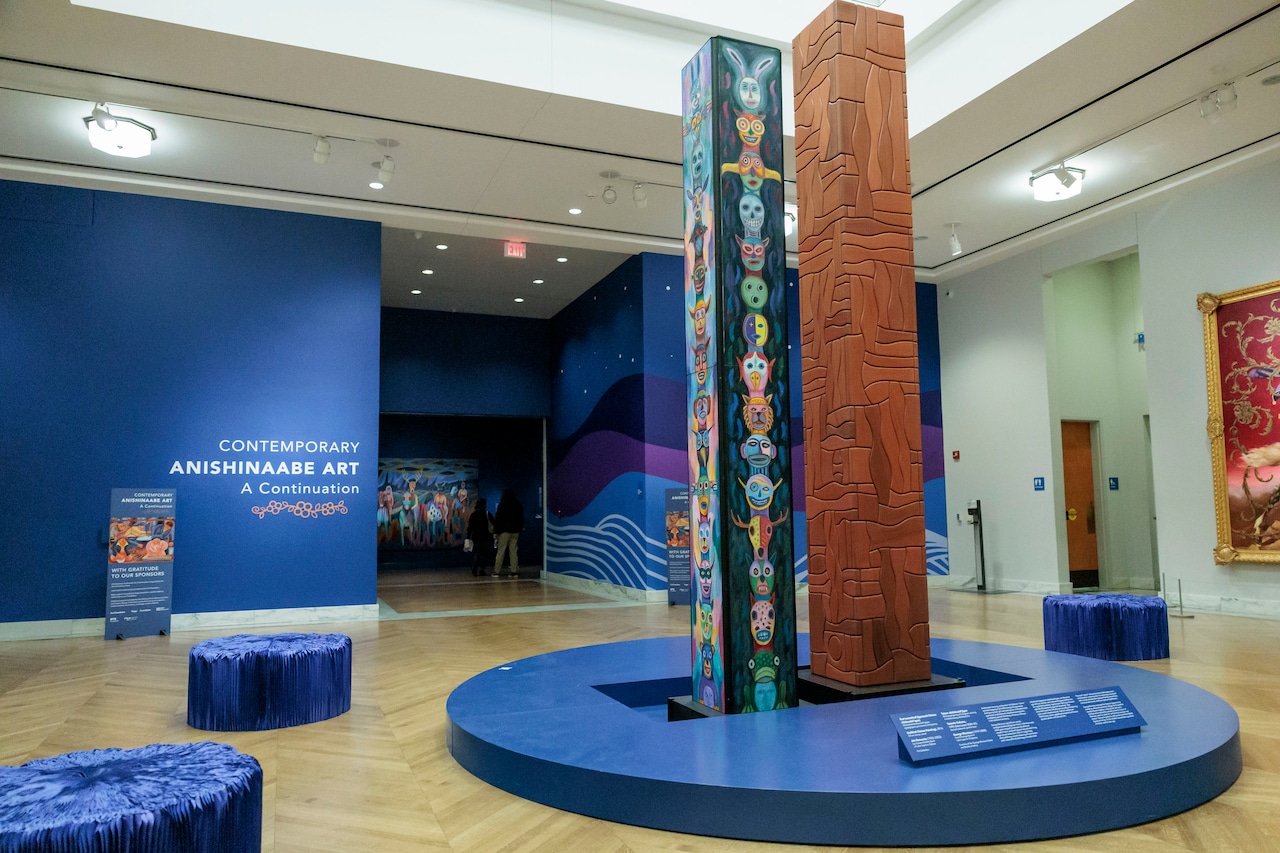 Totems by George Morrison, left, and Jim Denomie outside the entrance to the Contemporary Anishinaabe Art: A Continuation special exhbit at the Detroit Institute of Arts, 5200 Woodward Avenue in Detroit on Thursday, Oct. 23 2025.Jacob Hamilton | MLive.com
Contemporary Anishinaabe Art: A Continuation
On the other side of the museum’s second floor is a new special exhibit highlighting contemporary artwork by Native American artists from the Anishinaabe group of peoples, which includes Ojibwe, Potawatomi and Odawa artists. Those ethnic groups are also known as Chippewa, Ottawa and Pottawatomi.
Titled “Contemporary Anishinaabe Art: A Continuation,” the sprawling exhibit features a variety of media, from hand-crafted canoes and woven birchbark vessels to photographs of punk icon Iggy Pop and even a seven-minute short film by Anishinaabe filmmaker Ishkwaazhe Shane McSauby.
Denene De Quintal, Associate Curator of Native American Art at the DIA, said the goal of the special exhibit, which has been years in the making, is to challenge the viewer’s idea of what Native American art can be. It’s designed to buck stereotypes of artwork created by Native Americans by presenting a varied collection of contemporary work alongside artist statements.
“It’s basically pushing back against the stereotypes that people have,” De Quintal said. “The preconceived notions of what they think Native American art is and can be and what it should look like.”
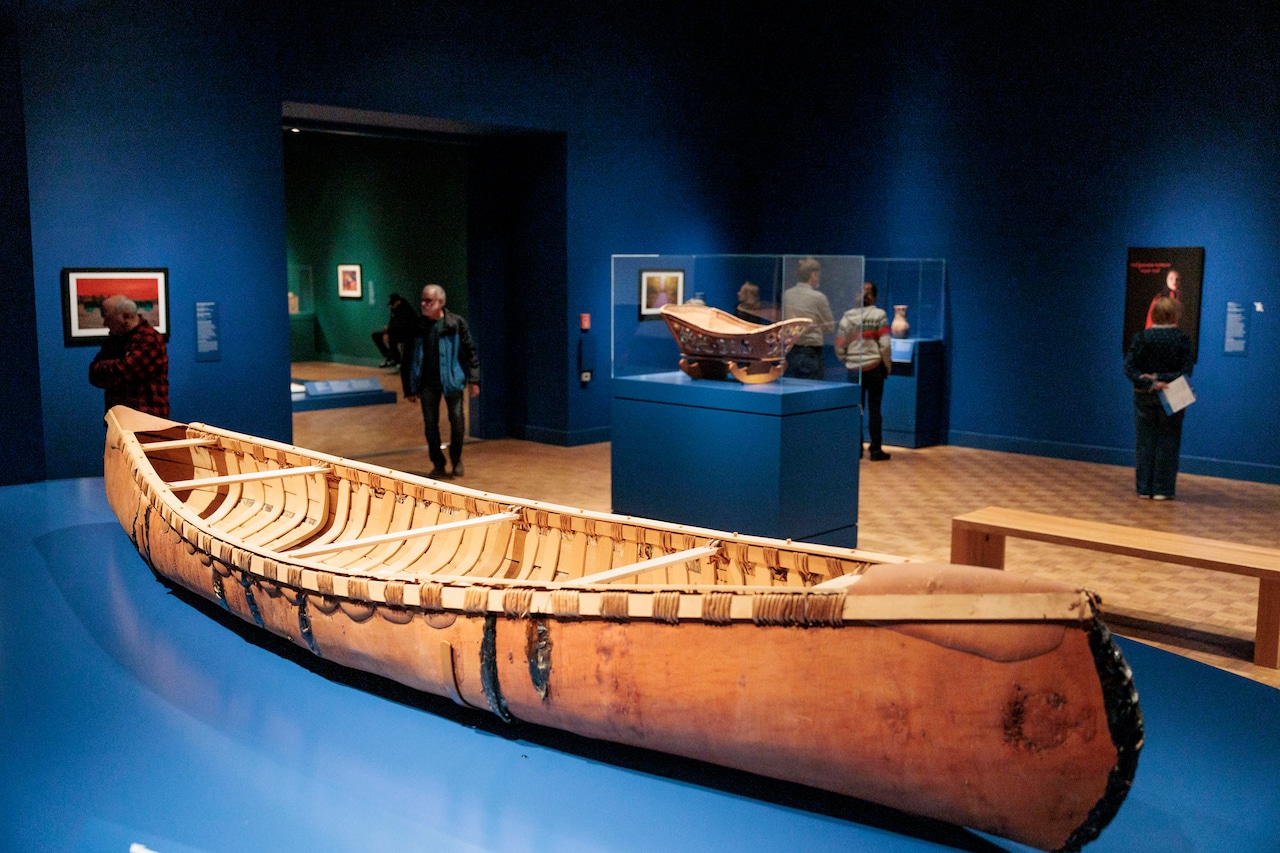 A birchbark canoe by Ronald J. Paquin in the Contemporary Anishinaabe Art: A Continuation special exhbit at the Detroit Institute of Arts, 5200 Woodward Avenue in Detroit on Thursday, Oct. 23 2025.Jacob Hamilton | MLive.com
De Quintal worked with an advisory board of Ojibwe, Potawatomi and Odawa artists to curate the exhibit. Anishinaabe artist Eva Oldman served as the graphic designer for the space, incorporating Anishinaabe material themes by depicting stars, sky, water and birch bark.
“Our artist advisors and the DIA team wanted to show the depth and the breadth of Native American art, especially contemporary Anishinaabe art,” she said. “That’s why you see so many different media – painting, birch bark, quill work, et cetera. But it’s also all contemporary art.”
With the help of translator Helen Peltier Fuhst, each plaque and artist statement in the exhibit was translated from English into Anishinaabemowin, an original Native American language of the Great Lakes region. Interactive QR codes throughout the exhibit encourage visitors to learn relevant words in the language.
In keeping with the theme of continuation, the exhibition features a number of works by mentor artist and their protégés, including works by parents alongside those of their children. Guests are greeted by a pair of larger-than-life columns immediately recognizable as totems – the word has roots in the Ojibwe language – a painted totem created by artist George Morrison, and a stained redwood column designed by Jim Denomie.
In his artist’s statement, Denomie calls Morrison an “art-historical ancestor and mentor.” Denomie’s student, Jonathan Thunder, provided a tableau called “Basil’s Dream” for the show, and Thunder’s own student, Michelle Defoe, has a painting of a Thunderbird – a mythological bird-like spirit.
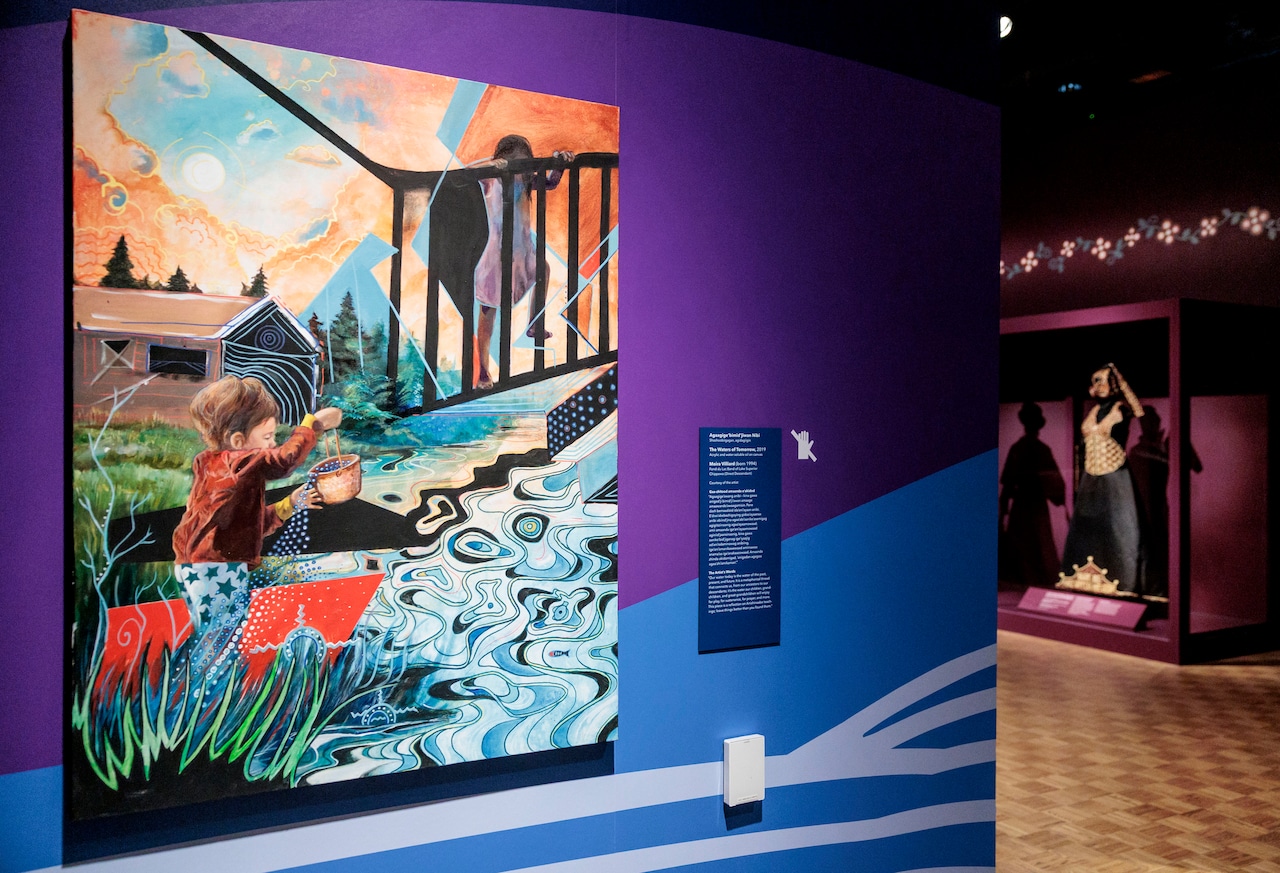 “The Waters of Tomorrow by Moira Villiard” in the Contemporary Anishinaabe Art: A Continuation special exhbit at the Detroit Institute of Arts, 5200 Woodward Avenue in Detroit on Thursday, Oct. 23 2025.at the Detroit Institute of Arts, 5200 Woodward Avenue in Detroit on Thursday, Oct. 23 2025.Jacob Hamilton | MLive.com
At different points throughout the special exhibit, guests can interact with life-sized video installations featuring artists describing their Anishinaabe heritage, their artwork and the messages they hope to convey.
“We really wanted the artists to be able to express their point of view – why they make their work, how they themselves feel about stereotypes when it comes to Native American art.” De Quintal said. “It’s life size, so it seems like you’re actually having a conversation with the artist.”
The two exhibits are linked by four marble busts – a pair in each – that were created by Mary Edmonia Lewis, a sculptor of mixed African-American and Anishinaabe descent.
The busts in the first room of the African American art exhibit depict Native American characters Hiawatha and Minnehaha from Henry Wadsworth Longfellow’s 1855 epic “The Song of Hiawatha.” The accompanying plaque describes how Edmonia Lewis’ sale of her artwork to abolitionists allowed her to move to Rome, Italy in 1865.
Edmonia Lewis’ central pieces in the Anishinaabe exhibit depicts Longfellow himself alongside Minnehaha. Hers is the only non-contemporary work in the exhibit.
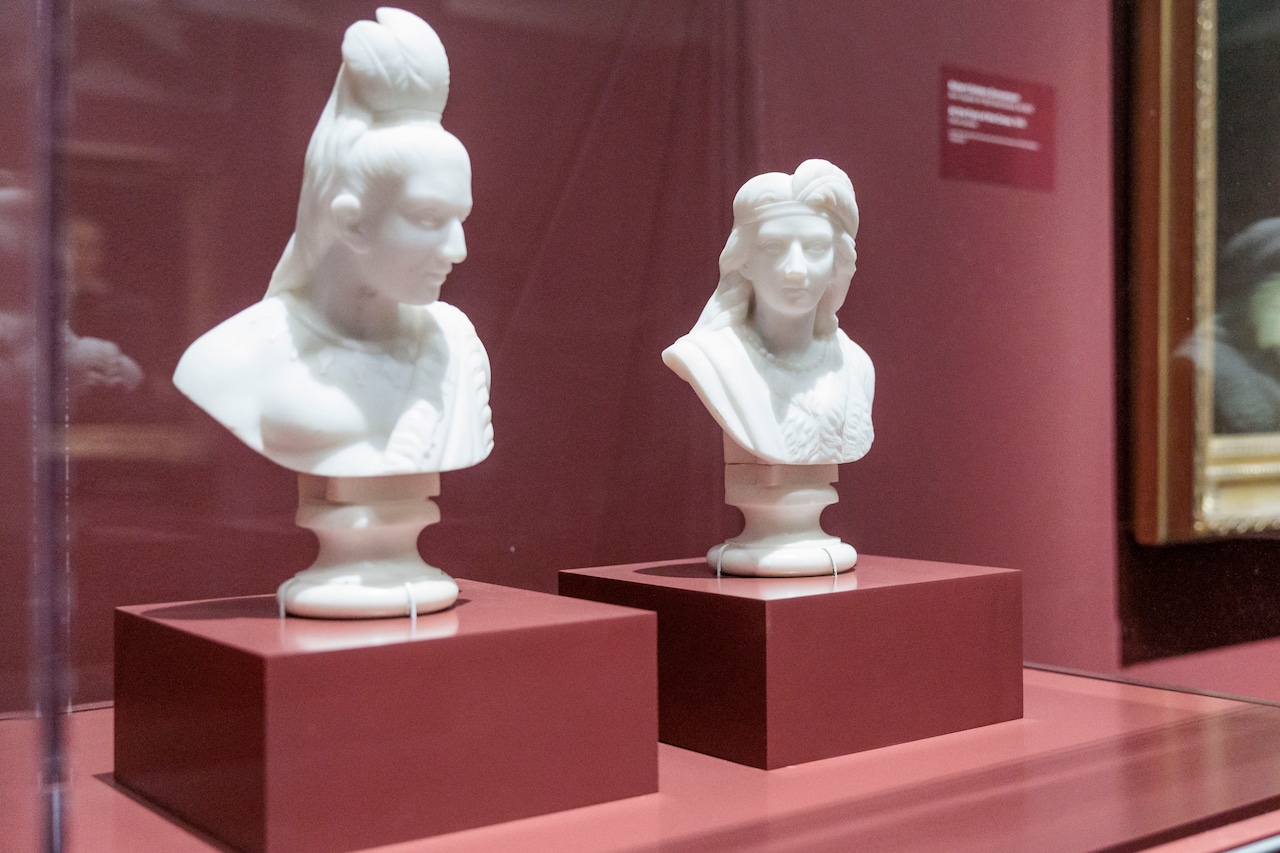 Marble busts by Mary Edmonia Lewis depicting Hiawatha and Minnehaha in the new African American Art gallery at the Detroit Institute of Arts, 5200 Woodward Avenue in Detroit on Thursday, Oct. 23 2025.Jacob Hamilton | MLive.com
The Anishinaabe special exhibit opened on September 28 and will run through April 5, 2026. The new African American art exhibit, which opened October 18, will be a permanent part of the museum.
Admission to the Detroit Institute of Arts, 5200 Woodward Avenue in Detroit, is free for residents of Oakland, Wayne and Macomb counties. General admission costs $20 for adults and $10 for seniors and college students for those living outside the tri-county area.
During the run of “Contemporary Anishinaabe Art: A Continuation,” admission is free for visitors who show tribal-issued identification.
Both the African American Art and Anishinaabe exhibits are included with general admission to the museum.
If you purchase a product or register for an account through a link on our site, we may receive compensation. By using this site, you consent to our User Agreement and agree that your clicks, interactions, and personal information may be collected, recorded, and/or stored by us and social media and other third-party partners in accordance with our Privacy Policy.