
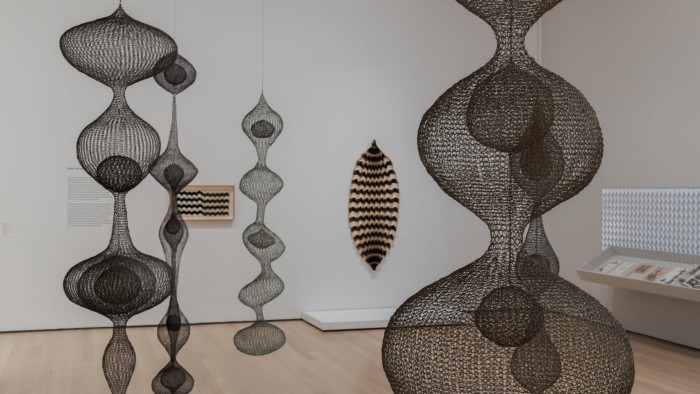
Just two years after the Whitney retrieved the astounding Ruth Asawa from near oblivion with a show of her drawings, the Museum of Modern Art has one-upped the competition with a full-scale retrospective. I worried at first that there might not be many more pleasures left to mine. I needn’t have: Asawa produced new works at an industrial pace and continued her practice of daily drawing almost right up to her death in 2013. Such boundless creativity and potent work ethic ensured a lasting supply of joy.
“Doing is living,” she said. “That is all that matters.” Household chores fed her inventiveness, and art and life merged into a single constant endeavour. Using her hands, she transformed life’s ordinary flotsam — a pile of aubergines, a sprig of decayed autumn leaves — into marvels of expressive beauty.
The core of the MoMA exhibition is her sculptures, gossamer clouds of wire that drift near the ceiling, as if caught mid-daydream in an open sky. Illuminated from above, they cast wispy, quivering shadows on a set of white catwalks. To the extent that she was known at all, it was for these airy lattices, and the full extent of her output has only recently emerged. The show includes paintings, watercolours, lithographs, cast masks, public sculptures, folded paper — all of it a testament to her avid love of line. In every gallery, you can feel her finger tracing lines on surfaces or in space, arcs that bend, curve, twist, tangle and dance with exuberance and grace.
Born in 1926, the fourth of seven children, Asawa spent her early years on a small Southern California farm, where her parents, who had immigrated from Japan, grew fruits and vegetables. It was a world that rewarded a child’s scrutiny. The gauze of a dragonfly’s wing, the flare of sunlight through leaves, the patient geometry of growing things sank deep into her consciousness. At Saturday Japanese school, calligraphy classes taught her the pulse and power of a single line.
 Ruth Asawa’s ‘Bouquet from Anni Albers’, early 1990s © Ruth Asawa Lanier, Inc., Courtesy David Zwirner
 Asawa’s lithograph ‘Poppy’ (1965) © Ruth Asawa Lanier, Inc., Courtesy David Zwirner.
After Pearl Harbor, Asawa and her family were herded into a horse stable at Santa Anita Park, where the air was thick with dejection and manure. Yet even in confinement, she dug up seedlings of beauty. Fellow internees who had once drawn for Disney shared their craft, opening a new way of seeing. In time, the family was sent east with thousands of other Japanese Americans to a camp in Arkansas. Ruth finished high school behind barbed wire, her youth fenced in, her imagination free.
When she arrived at Black Mountain College, North Carolina, in 1946, it must have felt like stepping into sunlight after a long eclipse. The campus shimmered with possibility — Merce Cunningham in liquid motion, Buckminster Fuller tinkering with the future, Josef Albers urging students to find revelation in everyday things. She stayed three years, then followed the budding architect Albert Lanier back west to San Francisco.
Albers chose one of Asawa’s paintings to represent Black Mountain College in a 1948 national exhibition. A troupe of figures cavort, arms raised and hands together, against a forest-green ground. Animated by dance lessons with Cunningham and Elizabeth Schmitt Jennerjahn, she turned the body’s motion into a powerful abstract design, at once containing empty space and emanating energy. The dancer became a vessel, a form within a form that permeated Asawa’s whole career.
Albers and Asawa pursued concentricity in different ways — he in a series of expanding squares, she in radiantly transparent filigrees. They remained close and even exchanged works. Asawa gave the Alberses one of her curving lobed forms whose surfaces, folding inward and out again, invoked the Möbius strip as an emblem of constant transformation. “You can show inside and outside, and inside and outside are connected,” she said. “Everything is connected, continuous.”
 Ruth Asawa pictured in 1973 at her retrospective at the San Francisco Museum of Art © Ruth Asawa Lanier, Inc., Courtesy David Zwirner.
That’s how the MoMA exhibition feels, too — like gliding through a landscape of infinite variety and coherence. Her large-scale sculptures made of woven wire have an almost sensual intimacy; her tiniest sketches of hydrangeas hint at cosmic events. Drawings of blooms snipped from the garden or offered as bouquets have the vividness of portraits. They buzz with emotion.
The tension between verisimilitude and abstraction runs like a faultline through her oeuvre. Some critics objected to a sculpture she based on a spiky desert plant from Death Valley. “When people looked at it, they said: that’s too realistic,” she recounts good-humouredly in a video interview. Asawa turned the piece upside down, satisfying the demands of the then fashionable non-objective mode. But she had the last laugh. Flipping the tree, she explained, transformed branches into a root system that reached deep down beneath the surface. The fabricated shrub clung to its living model as strongly as ever — just not so as you’d notice.
She often chased exactitude to the precipice of abstraction before coiling back. “Nature is my teacher,” she said. “I have used materials that are a product of our 20th century to study her growth patterns.” The work toggles between the shapes of flowers and plants and the geometries undergirding them.
 Ruth Asawa’s copper-wire sculpture ‘Multi-Branched Form with Curly Ends’ (1963) © Ruth Asawa Lanier, Inc., Courtesy David Zwirner.
Asawa gradually shed the need for respectable abstraction and began rendering the plant world with unabashed and virtuosic realism. In her later years, she distilled drama out of detail. Each petal of her “Wilting Poppies” furls with melancholy, shrunken stamens littering the foreground. “Fennel Blooms” burst into life at odd angles, soaring across the white paper like shaggy UFOs. A bouquet of brain-like dahlias bursts out of a narrow-necked glass vase, and the stems reach down inside, like long fingers, pointing to a letter pinned beneath the base. The words swim, so we can’t make out whether they convey comfort, exhortation, sympathy, or just the day’s update. And yet this modest, monochrome still-life trembles with all the terrible importance of an ordinary moment, reverently observed.
To February 7, moma.org