
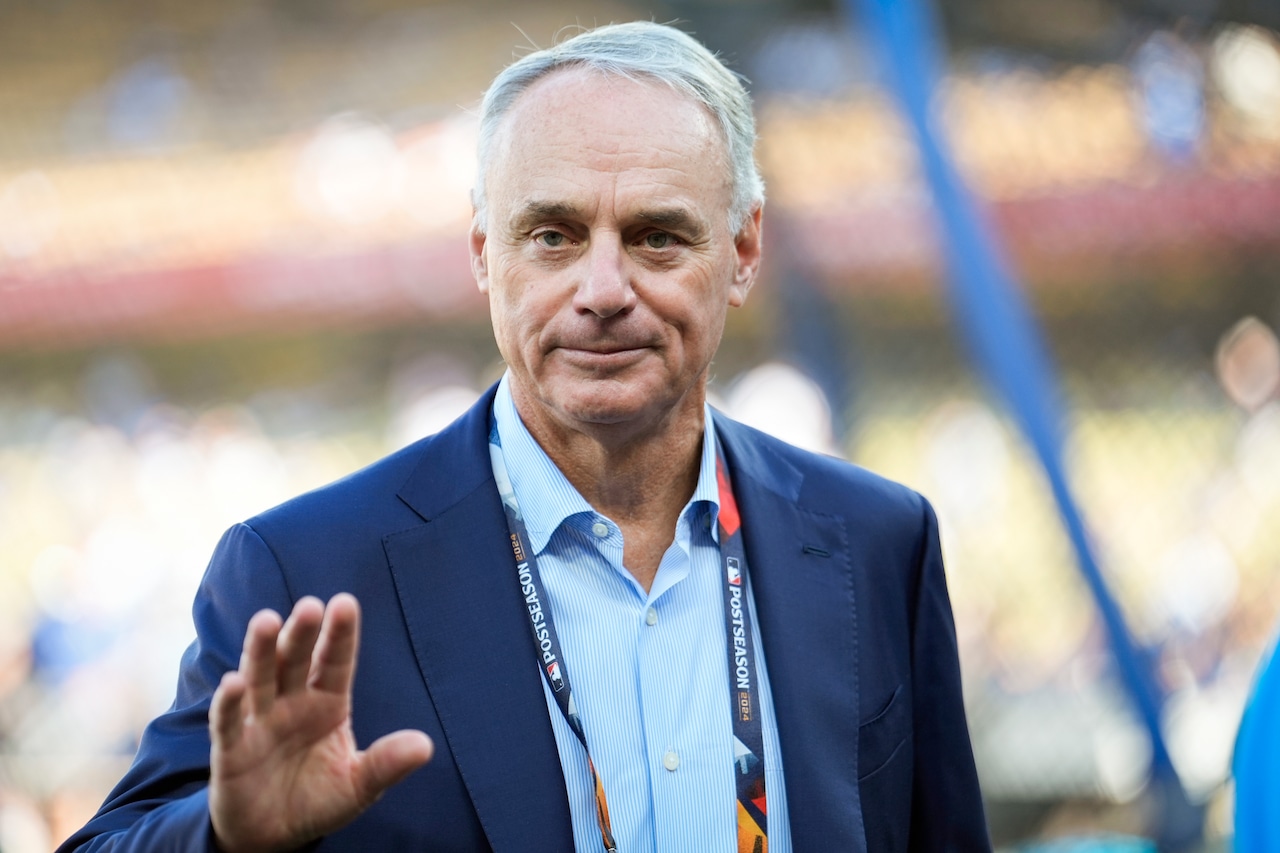
COLUMBUS, Ohio — Gov. Mike DeWine said Monday he is holding off for now on seeking a statewide ban of “microprop” bets, as Major League Baseball Commissioner Rob Manfred is working with the nation’s five other major professional sports leagues to collectively seek such a ban in all 50 states.
But DeWine, in an interview, said he’s “not going to wait much longer” for the leagues — which also include the NFL, NBA, WNBA, NHL and Major League Soccer — to take action against such bets, which have been at the center of recent MLB and NBA gambling scandals.
“Everybody who kind of looks at this objectively, I think, agrees that these (‘microprop’ bets) are just inherently a problem,” the governor said.
In early August, DeWine called for the Ohio Casino Control Commission to ban all proposition bets, or “prop” bets, which are made on individual players’ performances in specific games.
But in an interview Monday, he said he’s now focusing only on “microprop” bets, in which money is placed on the outcome of individual plays or situations in games, such as whether the first pitch of a baseball games is a ball or a strike.
The root of DeWine’s appeal
The governor’s appeal in August came after Cleveland Guardians pitchers Luis Ortiz and Emmanuel Clase were each placed on paid leave amid a still-ongoing MLB investigation into whether they violated the league’s gambling policies. The investigation started after concerns were raised about large amounts of money being wagered on specific pitches thrown by Ortiz during games.
Soon after DeWine’s call for such a ban, he met with Manfred while attending the MLB Speedway Classic in Bristol, Tenn. The governor said Manfred told him that he was trying to get a consensus with the other sports leagues and gaming industry leaders to get rid of “microprop” bets.
Having pro sports leagues spearhead the effort to ban “microprop” bets has two advantages, DeWine said: it opens the door to having such bets be outlawed in all 50 states, and it allows the Ohio Casino Control Commission to issue a statewide ban without having to go through procedural hoops, such as winning approval from the legislative Joint Committee on Agency Rule Review.
MLB request
DeWine said that an official in Manfred’s office on Monday (Oct. 27) asked the governor to hold off on seeking an Ohio “microprop” ban until after the World Series, when DeWine and Manfred could talk again.
DeWine said that was fine with him.
“But if we can’t get it done, I think as governor, I’ve got an obligation to take action,” he said.
A phone call placed Thursday to MLB’s press office seeking comment and details on Manfred’s initiative was not returned.
On Saturday, Manfred told reporters that MLB is talking about “prop” bets “with a variety of people,” though he declined to provide more details.
Lucrative returns
Manfred, MLB players’ union executive director Tony Clark, and NBA Commissioner Adam Silver, among others, have already criticized prop bets. Last year, the NBA reached a deal with betting partners such as FanDuel, DraftKings and BetMGM to prohibit “prop” bets on the league’s lowest-paid players that they will underperform.
At the same time, pro sports leagues have entered into lucrative partnerships with gambling companies, and they’re now trying to walk the line between maintaining those partnerships and preserving the integrity of their games.
The American Gaming Association, a Washington D.C.-based casino industry trade group, has pushed back on attempts to ban any type of betting, arguing that such a move would only lead to bettors turning to illegal, unregulated gambling operations.
One influential Ohio lawmaker, House Finance Committee Chair Brian Stewart, a Pickaway County Republican, has said that he would resist any attempt by DeWine to completely ban “prop” bets, including by introducing legislation to protect them.
“I don’t think it makes sense to respond to that by pulling the rug out from under Ohioans who have come to enjoy using this product,” Stewart said in August.
But while the governor in August called for a statewide ban on “prop” bets overall, he said Monday that he’s now focused only on eliminating “microprop” wagers.
“Doesn’t mean I wouldn’t do it, (but) I don’t have any plans to do anything further,” he said.
OCCC assistant general counsel Emily Berner declined comment for this story, citing the commission’s own ongoing investigation into Clase and Ortiz.
DeWine’s efforts to restrict “prop” bets predate last week’s blockbuster arrests of several current and former NBA players – most of whom have Cleveland connections – on charges they were involved in illegal gambling schemes.
Federal prosecutors say Miami Heat guard Terry Rozier, a former Shaker Heights High School basketball star, faked an injury during a March 2023 game so that his friend, former Cleveland high-school football star DeNiro Laster, could sell that information to social-media betting influencer Marves Fairley to win hundreds of thousands of dollars on “prop” bets.
Damon Jones, a former Cleveland Cavaliers player and assistant coach, was also arrested on charges including that, while an unofficial coach for the Los Angeles Lakers in 2023, he texted a gambler that Lakers (and ex-Cavs) star LeBron James would sit out that night’s game before the news became public.
‘Tip of the iceberg’
DeWine said the Guardians and NBA scandals are “the tip of the iceberg,” and that it’s “pretty obvious” there will be more scandals involving “prop” bets in the future.
“So, this thing needs to be dealt with as much as possible,” he said. “And a very good way to deal with this is, through eliminating — at least, to begin with — the ‘micro(prop’) bets.”
Sports betting has skyrocketed in the United States since a 2018 U.S. Supreme Court ruling overturned a federal ban on most state-authorized sports gambling, leaving it to individual states to decide whether to allow it. DeWine signed legislation in late 2021 legalizing sports gambling in Ohio.
Player-specific “prop” bets made up only about 1.4% of sports wagers placed in Ohio as of 2023, according to a 2024 letter from DeWine.
However, Stewart said in August that sports-betting industry officials have told him that as much as 50% of all sports bets are “prop” bets. A Siena College poll earlier this year found that 73% of Americans who gamble on sports place such wagers.
If you purchase a product or register for an account through a link on our site, we may receive compensation. By using this site, you consent to our User Agreement and agree that your clicks, interactions, and personal information may be collected, recorded, and/or stored by us and social media and other third-party partners in accordance with our Privacy Policy.