
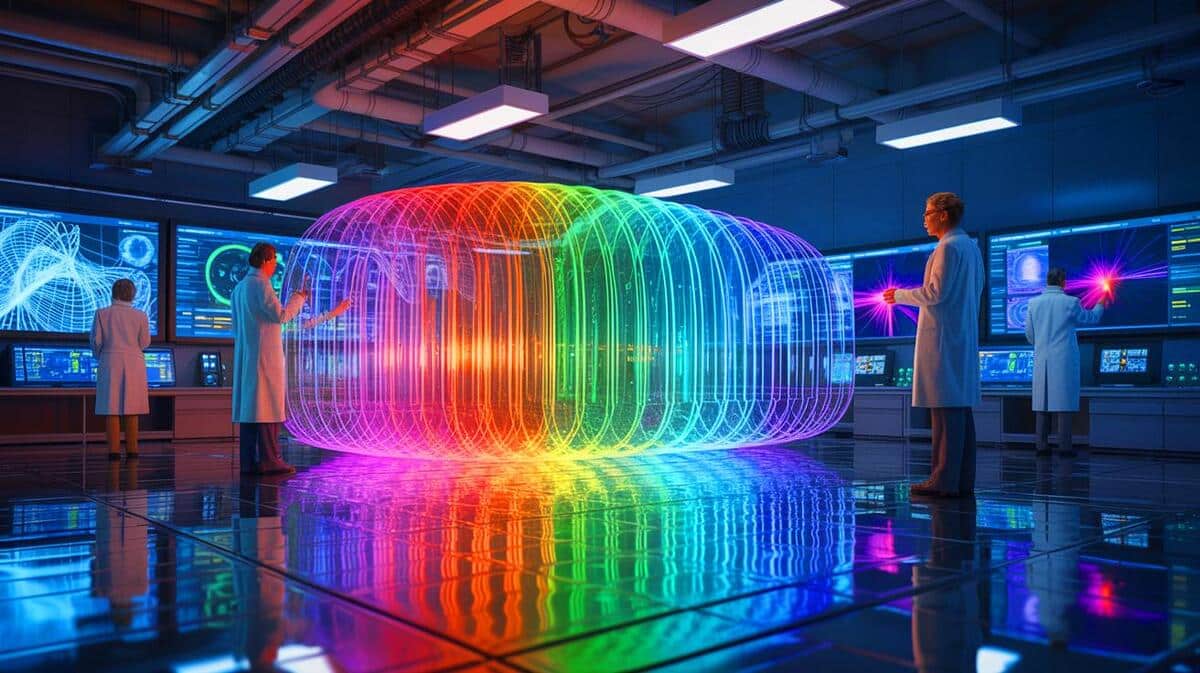
What if you could rewind the very waves that make up light or sound—not just capture them, but send them back through time? Thanks to a stunning new experiment, we’re one step closer to understanding time itself in a way that bends the rules of reality.
What on Earth Is Time Reflection?
We’ve all had that strange moment in front of the mirror, pondering what’s behind the glass—or maybe that’s just me on a Monday morning. But imagine a mirror that doesn’t bounce back your image in space, but in time. Yes, it sounds like something plucked straight from a Christopher Nolan film, but this is now a verified physical phenomenon.
To get your head around it, start with what you know: throw a tennis ball at a wall, and it rebounds. Shout in a canyon, and you hear your echo. That’s spatial reflection—waves flipping their direction. Now, time reflection is a different beast. Instead of changing where a wave goes, it flips when it goes.
Imagine light moving through a material. Now picture that material suddenly changing its internal properties—all at once. This sudden shift acts like a reset button, flipping the wave so it moves backwards in time. Think of it like rewinding an old cassette tape: the sound scrambles, pitches rise, and everything plays in reverse. That’s time reflection in action.
And here’s the kicker: it doesn’t just distort motion. It changes the frequency too—red light could shift to blue, bass notes could become sharp chirps. In short, it’s not just a quirky trick—it’s an entirely new way of manipulating waves.
A Theory 50 Years in the Waiting
Back in the 1970s, physicists imagined time reflection might be possible. But the issue? You’d need to change a material’s properties faster than a speeding wave—and do it uniformly. Easier said than done.
Fast forward (or should we say, rewind?) to a team at the CUNY Advanced Science Research Center in New York. Using a slim metal strip fitted with nimble electronic switches and energy-packed capacitors, they pulled off the near-impossible. These switches could double the strip’s electrical impedance almost instantly, providing the perfect conditions for a time-reflecting wave.
The result? A portion of the wave bounced not through space but back through time—a clean, reversed copy, captured and measured with incredible precision. After decades of sitting on the theoretical shelf, time reflection had finally been caught in the wild.
Why It Might Change Everything
This isn’t just a flashy experiment for the annals of physics journals. The ability to reflect waves in time could transform how we manage electromagnetic signals—from how we send texts to how we scan for threats.
Picture next-generation radar systems that not only detect objects with uncanny accuracy but can pierce further and deeper into the unknown. Or communications networks where time-reversed signals are so difficult to intercept, they become virtually hacker-proof.
Then there are metamaterials—engineered substances with capabilities no natural material has. With time reflection in play, we’re inching closer to devices once reserved for sci-fi: cloaking tech, hyper-sensitive medical scanners, and ultra-efficient data transmission systems.
And beyond the gadgets? This opens philosophical and scientific doors. Time and space have long been treated as siblings in physics. But could they be more alike than we thought? This work may help reframe our ideas around thermodynamics, quantum mechanics, and even how the universe processes information.
Looking Ahead: The Time-Reversed Future
For now, it’s early days. But the confirmation of time reflection isn’t just another checkbox for physics. It’s a leap—one that may rewire how we see and interact with the universe.
Whether it leads to invisibility cloaks, unbreakable encryption, or a new theory of reality, this discovery proves that wild ideas—those that once seemed laughable—can open doors to the most groundbreaking innovations.
After all, if we’ve just learned how to flip waves in time, who’s to say what’s next? Maybe time itself isn’t as untouchable as we thought.
Similar Posts:

Joe is a passionate news writer with a keen interest in current events. With over a decade of experience in journalism, he has a knack for uncovering the stories that matter most. Joe’s insightful articles and in-depth analyses have made him a trusted voice in the industry. He thrives on staying ahead of the news curve, providing readers with timely and relevant information. Whether it’s breaking news, politics, or social issues, Joe dedication to the craft ensures that his readers are always well-informed.
X (Twitter)