
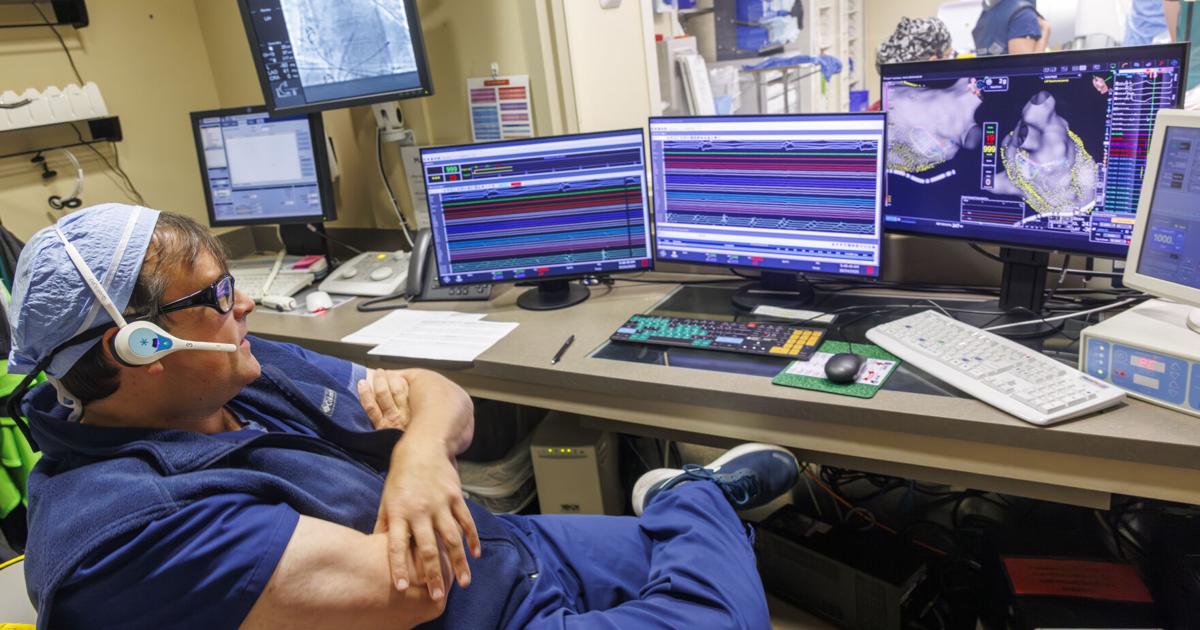
On a black screen facing an operating room, Dr. Michael Bernard watched a storm of squiggly lines flashing across the monitor: the electric chaos of a patient’s irregular heartbeat.
The patient had atrial fibrillation, a disordered heart rhythm that can cause fatigue, shortness of breath and more serious problems over time. Years ago, treating it required open-chest surgery. Now, through a vein in the leg, a thin catheter about the size of a spaghetti noodle snakes toward the heart, its tip burning tiny scars at a doctor’s command into tissue to block misfiring electrical signals and restore a steady beat.

Dr. Sammy Khatib, left, listens to Dr. Michael Bernard, section head of electrophysiology at Ochsner Hospital, as he uses AI to help with surgery on Friday, October 24, 2025. (Photo by Chris Granger, The Times-Picayune)
STAFF PHOTO BY CHRIS GRANGER
This time, Bernard wasn’t relying on instinct alone. He was using an artificial intelligence–powered mapping system designed to read the heart’s electrical patterns and highlight the precise areas driving the arrhythmia — a process that once depended largely on educated guesswork.
“Before, I’d have to look at that and say ‘maybe’ and ‘I think,'” said Bernard, an electrophysiologist at Ochsner Health in New Orleans, gesturing toward a map of the heart. “Now this gives me my best chance to say, ‘All right, this has been proven to help affect long-term outcomes.'”
The system, called Volta, uses AI trained on nearly half a million electrical tracings from heart patients across the country to spot the specific zones most likely causing rhythm disturbances.
The difference, Bernard said, is like “a smart bomb vs. a carpet bomb.” In clinical trials, patients had an 80% to 90% chance of being free from irregular rhythms a year after surgery.
Note-taking, scans and communication
His work reflects a broader shift in Louisiana hospitals, where AI tools are beginning to assist with everything from reading scans to reducing paperwork.
Nationally, investment in health care AI has surged. Venture-capital funding in the health sector climbed to about $23 billion in 2024, up from $20 billion the year before, with nearly 30 percent of that total going to AI-enabled companies, according to data from Silicon Valley Bank. In digital health, startups using AI drew about 62 percent of all venture funding in the first half of 2025, according to Rock Health, a digital advisory firm.
At LCMC Health, Chief Administrative Officer Ryan Hildebrand said the system is rolling out ambient listening AI, a program that records doctor-patient conversations and turns them into clinical notes. The goal: fewer hours spent typing and more face-to-face interaction.
“Patients love it,” Hildebrand said. “They feel like their doctor is finally looking at them again instead of a screen.”
By the end of the year, LCMC expects up to 1,000 providers to use the software. The hospital system is also testing AI that highlights suspicious scans for radiologists and alerts stroke teams if a blockage is detected before a doctor views the scan. Other tools draft responses in patient portals, freeing staff to focus on more complex cases.
“We look at AI as an assistant, not a replacement,” Hildebrand said. “People who know how to use AI will replace people who don’t.”
In Baton Rouge, hospitals are taking similar steps. At Our Lady of the Lake Health, about 500 doctors are using note-taking AI, and the system is piloting discharge summaries — which patients notoriously don’t read — that are easier for patients to understand, even testing short video summaries. Employees receiving medical procedures are serving as early test subjects.
In the future, said Chief Information Officer Will Landry, it wouldn’t be out of the question for a patient to receive medication or care instructions after leaving the hospital from a humanoid robot on a personalized screen.
The hospital is also using AI to help read scans from the emergency room, prioritizing those that look like they might be something time sensitive, such as a stroke.
“We can have 20, 30, 40 reads in a queue,” Landry said. “If it sees something significant, it is flagging it for a radiologist.”
Our Lady of the Lake is also piloting a communication system that keeps patients updated in the emergency department, where long waits often cause frustration. The system sends real-time updates predicting when lab results will be ready and alerting patients when a doctor has opened their chart.
An ethics committee of 10 clinicians, technologists and compliance officers reviews every proposed use of AI.
That same approach is used at Baton Rouge General, where Chief Information Officer Bennett Cheramie leads an interdisciplinary committee that assigns risk scores to every AI proposal — and there are many.
“Everything seems to be adding some AI feature to their package,” Cheramie said. “The ice cream vendor has an AI component,” he joked.
Health systems move slowly when adopting new technology. “We still use fax machines,” Cheramie pointed out. So part of the rollout involves training staff to understand both the power and the limits of the software.
AI for health education
While hospitals are integrating AI into daily routines to make life a little easier for doctors and patients, Louisiana researchers are looking at the bigger picture of how the technology could help address Louisiana’s deep health disparities.
At the University of Louisiana at Lafayette, Dr. Raju Gottumukkala directs the Center for Applied Artificial Intelligence and leads a new National Science Foundation–funded collaboration known as the Accessible Healthcare through AI-Augmented Decisions Center, or AHeAD. The multi-university project, which includes Tulane, Georgia Tech and the University of Florida, aims to develop safe, evidence-based AI tools to improve care delivery, especially in rural and underserved regions. In practice, that might look like a chatbot that coaches someone with diabetes or heart disease on how to better address their condition.
“As a state, we’ve had very poor health literacy,” Gottumukkala said. “That’s why our chronic disease rates are so bad — way below the national average. There are not enough resources to help patients manage.”
He sees artificial intelligence as a way to bridge that gap.
“If you want to go and educate a Spanish-speaking person about how best to manage their diabetes, language is no longer a barrier,” he said.
The pitfalls
But Gottumukkala cautioned that AI must be applied carefully. AI can easily develop bias if it’s trained on one demographic with certain characteristics. That could lead to misdiagnosis, he said.
In 2022, for example, a model developed by Google to predict acute kidney injury performed worse in women than in men because it had been trained mostly on data from male veterans.
Dr. Michael Bernard, section head of electrophysiology at Ochsner Hospital, uses AI to help with surgery on Friday, October 24, 2025. (Photo by Chris Granger, The Times-Picayune)
STAFF PHOTO BY CHRIS GRANGER
AI chatbots have also drawn concern. In February 2024, a 14-year-old Florida boy died by suicide after allegedly becoming deeply involved with a Character.AI chatbot, according to a wrongful-death lawsuit filed by his mother. The case reignited warnings about chatbots that can “hallucinate” or offer harmful advice.
“By design, they can hallucinate, which means they can go off the rails,” Gottumukkala said. That’s why they’re looking at “where things could fail” as well as where it could help, he said.
Still, physicians like Bernard see the benefits firsthand. He’s gone from feeling like he’s offering patients a coin toss to, more often than not, eliminating a condition that stole their breath, their energy and their health.
About ten patients have used the new system so far, and several more are scheduled.
“Before, we didn’t have a good guide of where to go,” Bernard said. “This gives me a fighting chance.”