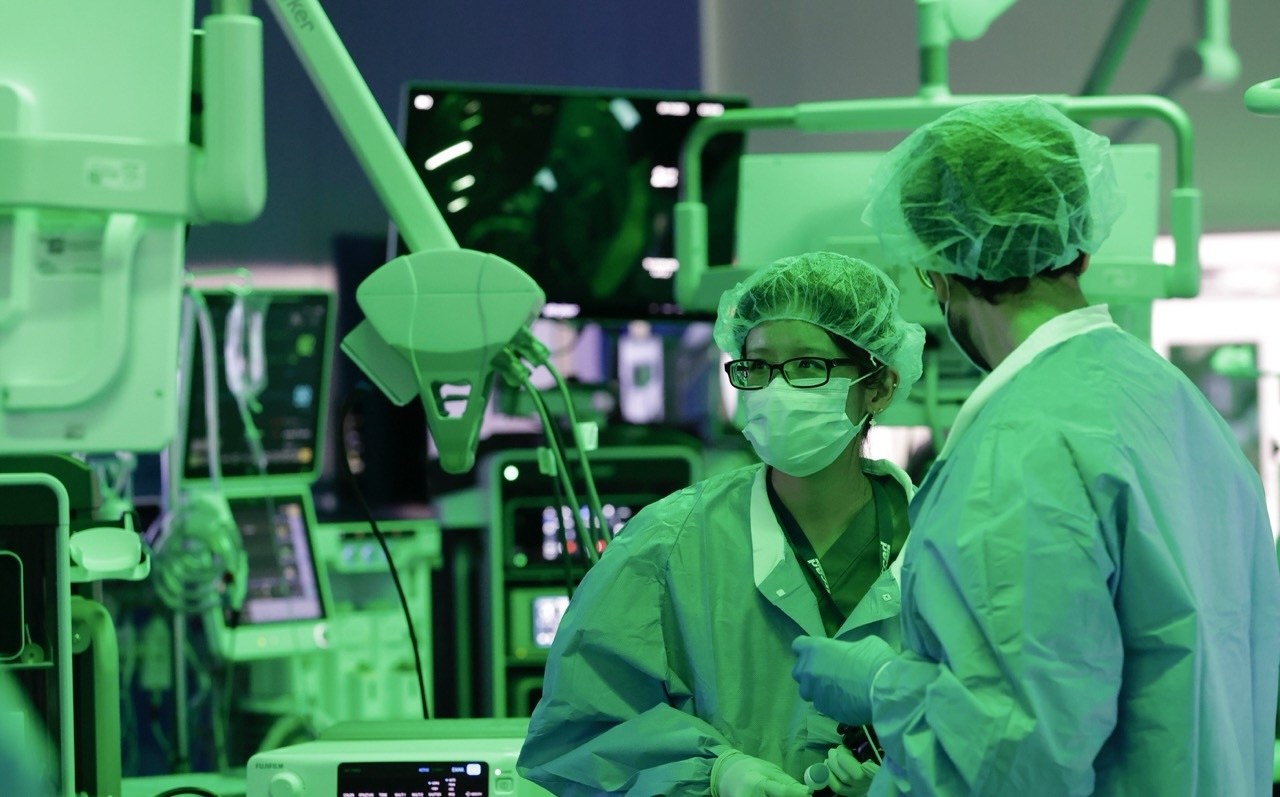
IRCAD North America began training physicians at its Charlotte location in September, and Dr. Ansley Ricker was one of the first surgeons to go through a course.
The former basketball player at Mars Hill University and an East Tennessee State medical school graduate has chosen a difficult practice path, including minimally invasive surgery on the pancreas, liver and other vital organs. The IRCAD course not only exposed Ricker to cutting-edge tools she had never even seen before, she says, but it also paired her with a surgical specialist who gave her hands-on experience.
“They were actually watching me work and making little tweaks on my operative ability,” she says. “And I took everything that I learned, and the following week was using those same things in the operating room.”
Ricker has been a surgical resident at Atrium Health’s Carolinas Medical Center since 2020. She shared her experiences at IRCAD on Wednesday as part of a tour of the facility, which is half of The Pearl Innovation District, a $1.5 billion development created in a partnership between Atrium Health, Baltimore, Maryland-based Wexford Science and Technology and Ventas, a Chicago-based real estate firm. The other half of The Pearl is the Charlotte campus of Wake Forest University School of Medicine.
The lessons learned at IRCAD could be incorporated into her future practice, says Ricker, who grew up in the east Tennessee town of Greenville. And that’s part of the goal, she added.
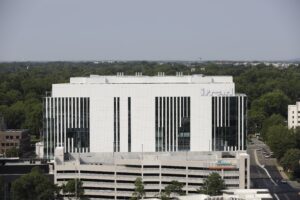 IRCAD North America is part of The Pearl Innovation District in Charlotte, which includes the Queen City’s campus of Wake Forest School of Medicine. (Photo by Garry Eller Photography)
WWW.GEPIMAGES.COM
“Kind of big picture for my career is to bring all of the training and techniques and everything that I’m learning back to my town because it is an area that really has limited access for healthcare,” she says.
In its first year, IRCAD expects to hold 40 courses for physicians, and a total of 80 by its second year. IRCAD began in 1994 in France, and there are now eight other IRCAD locations across the world. The one in Charlotte is the first U.S. location.
IRCAD has already offered 27 courses in Charlotte, but once fully operational it is expected to draw thousands of surgeons each year to the Queen City for specialized training. It has partnerships with some of the largest companies in healthcare — Johnson & Johnson, Medtech, Medtronic, Siemens Healthineers, Boston Scientific and Stryker.
Those companies provide the latest in imaging machines and robotics for surgeons to train on in a 120,000-square-foot, four-story building that overlooks the Charlotte skyline.
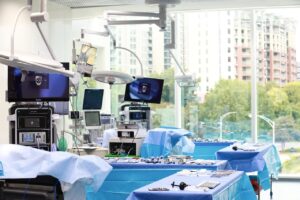 A surgical training room at IRCAD North Amerida in Charlotte.
“What’s fascinating is we brought all these partners together and this ecosystem, and we’ve started to see the magic happen,” says Dr. Rasu Shrestha, executive vice president and chief innovation and commercialization officer at Advocate Health, and board president at IRCAD North Carolina. Advocate Health is the company formed after the 2022 merger of Charlotte-based Atrium Health and Illinois-based Advocate Aurora Health.
“We’re giving exposure to emerging experts, right?” Shrestha added. “They really are the future workforce for our healthcare industry, and we’re training them on the latest and greatest of how surgeries will be practiced not as today, but tomorrow.”
IRCAD will not only train young surgeons, but also those experienced in medicine and wanting to learn the latest techniques, says Dr. Dionisios Vrochides, executive director of IRCAD North America and professor of transplant surgery at Wake Forest University School of Medicine.
“They are the ones that shape the future of surgery,” says Vrochides.
IRCAD has two “surgical ballrooms,” offering 26 lab stations for surgical training; two robotic suites, offering 24 robotic stations from industry partners; and hybrid operating rooms that integrate advanced imaging capabilities.
One surgical robot, which carries a price tag of about $2.5 million, can not yet be used for training because it still awaits FDA approval, although it is being used successfully in Europe, says Vrochides.
Dr. Brent Matthew, professor and chair of surgery at Carolinas Medical Center, and president of the 8,000-member Society of American Gastrointestinal and Endoscopic Surgeons, serves as the scientific committee chair at IRCAD North America.
He says the collaboration of healthcare experts will add to innovation in healthcare and determine the value it brings to patients.
“I think many times technology and innovation have a specific role that they’re trying to fulfill because there’s a gap in the way that we take care of patients,” says Matthews. “But 10 years later, that technology is actually being used in a very different way than it was actually intended to be utilized, when it was developed. And so being in a community of thought leaders as it relates to that, allows us to understand not just the first application of a technology, but what’s the second, third, fourth application of this technology.”