
The IEA has halved its forecast for renewables growth by 2030 in the US to around 250 GW as a result of Trump’s policies. Analysts at Carbon Brief estimate the country will emit 7 billion tonnes more CO₂ equivalent by 2030 under Trump’s policies than if the country had met its obligations under the 2015 Paris agreement, which he is withdrawing from.
The reduction in renewables growth comes as the country’s electricity demand is rising due to the growth of data centers, many of which are looking to gas-fired or nuclear power stations because they need constant, steady power.
Gas turbine makers are struggling to keep up with demand, while new nuclear power plants are often delayed.
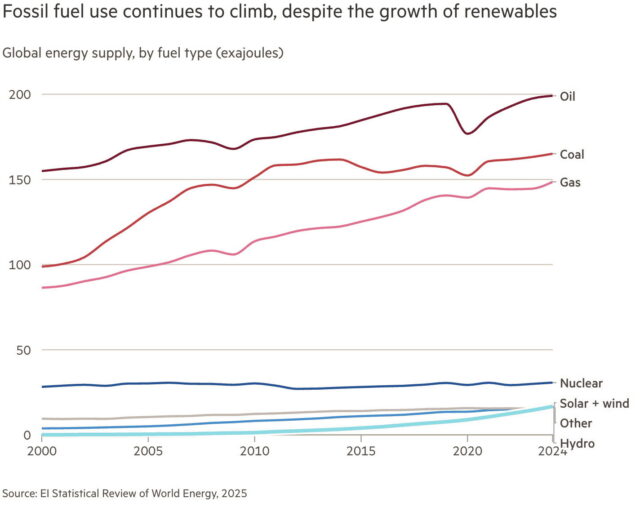
Retail electricity prices have already risen by 5 percent since July, according to the Energy Information Administration, and some experts caution they could rise further if supplies are constrained. “The writing is on the wall,” says Pol Lezcano, director of energy and renewables at the CBRE real estate group.
Supporters of renewable electricity argue that the US is missing out on a revolution in cleaner, cheaper technology sweeping the world, with some likening it to the aging cars on Cuba’s roads.
But the relationship between renewable generation and consumer energy bills is complicated. The free energy from the sun or the wind means that the wholesale price of renewable-generated power is lower, but developers still need to make a return on their investment, and grid operators may need to step in to ensure continuity of supply when the wind and the sun are low.
“Even as the cost of producing electricity from renewables falls, consumers may not see immediate or proportional reductions in their bills, raising questions over the impact of renewables on power affordability,” the IEA said in its latest report.
More broadly, the US’s focus on fossil fuels and pullback of support for clean energy further cedes influence over the future global energy system to China.
The US is trying to tie its trading partners into fossil fuels, pressing the EU to buy $750 billion of American oil, natural gas, and nuclear technologies during his presidency as part of a trade deal, scuppering an initiative to begin decarbonizing world shipping and pressuring others to reduce their reliance on Chinese technology.
But the collapsing cost of solar panels in particular has spoken for itself in many parts of the world. Experts caution that the US’s attacks on renewables could cause lasting damage to its competitiveness against China, even if an administration more favorable to renewables were to follow Trump’s.
“China has run far away in terms of competitiveness,” says Antonio Cammisecra, chief executive of ContourGlobal, an independent power producer.
“The US is capable of rebuilding, but it will take time.”
Additional reporting by Ahmed Al Omran and David Pilling. Data visualization by Jana Tauschinski.
© 2025 The Financial Times Ltd. All rights reserved. Not to be redistributed, copied, or modified in any way.