
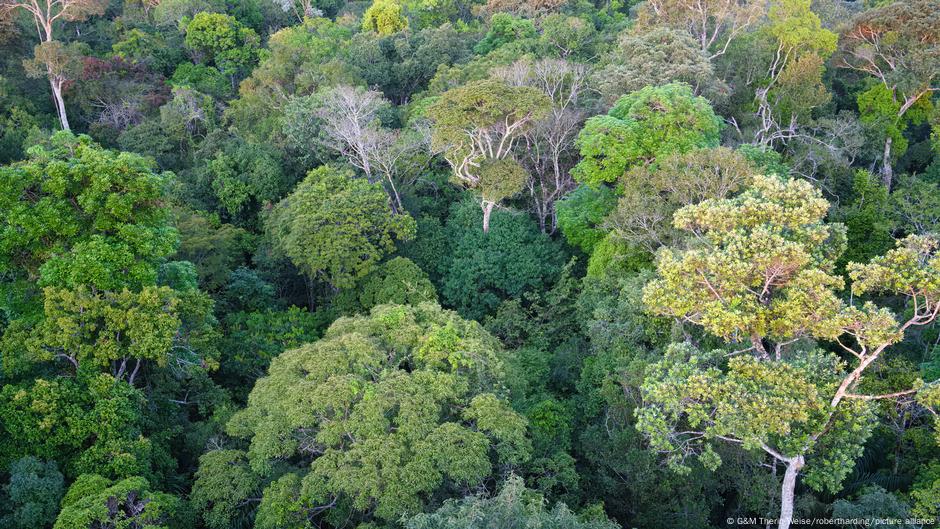
The Brazilian government said on Thursday that deforestation in its portion of the Amazon rainforest has fallen for the fourth consecutive year.
Brazil is home to the largest part of the Amazon River system, which spans nine countries and is considered crucial in the fight against climate change.
According to the National Institute for Space Research (INPE), which uses satellites to track forest cover, 5,796 square kilometers (2,238 square miles) — an area nearly four times the size of Greater London — was destroyed between August 2024 and July 2025. This was 11% less deforestation than the previous year.
The announcement comes just days before Brazil is set to host the UN climate summit known as COP30, where President Luiz Inacio Lula da Silva will be looking to tout his government’s environmental achievements.
Deforestation contributes to emissions
Lula has vowed to end all deforestation in the country by 2030, and since the beginning of his term in 2023, Amazon deforestation has been cut in half.
“Even in my best-laid plans I would never have imagined that we would reach this point with a 50% reduction in deforestation,” Brazilian Environment Minister Marina Silva told a press conference.
“When we achieve a good result, we have to move on to the next challenge. We cannot rest on our laurels. Our challenge is to reduce deforestation to zero by 2030,” she added.
Marina Silva — Brazil’s voice for the climate
To view this video please enable JavaScript, and consider upgrading to a web browser that supports HTML5 video
Brazil is the world’s sixth-largest emitter of greenhouse gases. Deforestation, rather than burning fossil fuels, is the main cause of these emissions.
The Amazon rainforest stores vast amounts of carbon, which becomes carbon dioxide when large quantities of trees and soil are burned.
Experts have said that the destruction of the rainforest is mainly driven by agriculture. Agriculture is also the second-largest contributor to greenhouse gas emissions in Brazil, which is the world’s largest exporter of beef.
Edited by: Dmytro Hubenko