


Assistant research professor of medical and molecular genetics Dr. Fang Fang gave P12 educators a tour through the Center for Medical Genomics lab at the IU School of Medicine as part of the Medical Research Education Project. Photo by Liz Kaye, Indiana UniversityWhen science educators across Indiana and the country seek guidance on creating robust biology and environmental science lesson plans, they can connect with Indiana University experts through professional development programs led by the P12 Engagement team to help reconceptualize their curriculum using the latest scientific discoveries.
The P12 Engagement team, within the IU School of Education in Bloomington, oversees six programs; two of them — Medical Research Education Project and Educating for Environmental Change — recently hosted weeklong summer institutes.
Billie Carlton, a middle school teacher at Danville Community Middle School, attended her second Medical Research Education Project summer institute this year. Last year, she gained the tools to teach the seventh-grade standard review of the human body and cells. Now that she is going to teach eighth grade, she signed up again to prep science lessons ahead of the upcoming school year.
The National Cancer Institute-funded project is part of the Educational Pathways in Cancer Research Program, a joint effort between the IU School of Education in Bloomington and the IU Melvin and Bren Simon Comprehensive Cancer Center, the only National Cancer Institute-designated comprehensive cancer center in Indiana. Participating teachers learn how to introduce middle and high school students to medical research with the help of renowned cancer researchers at an institution that is home to the world’s only healthy breast tissue biobank.
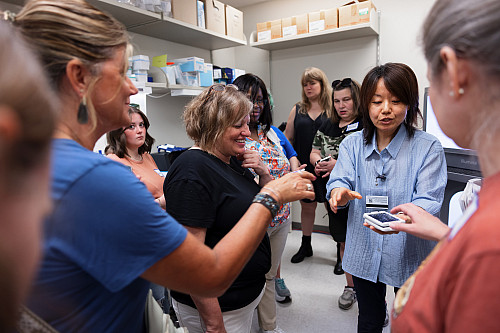
P12 science educators get a first-hand look at DNA sequencing equipment. Photo by Liz Kaye, Indiana University“When it comes to science lessons, some students wonder why it is important to learn about something,” Carlton said. “But after spending time with IU researchers and hearing how different scientific applications help with diagnostics, therapeutics and understanding cancer biology, I could tell my students how it’s used in labs. All the things that we’re doing in class are used in these labs to figure out how to treat cancer and save lives.”
This year, Carlton and 10 other participants toured the Flow Cytometry Core and Center for Proteome Analysis labs and learned about biomedical engineering and medical research career pathways. They also participated in educational games, like medical vocabulary Jenga, that they could bring back to their classrooms.
After the weeklong event, teachers spend the rest of the summer in virtual groups creating lesson plans about cancer and the local environment, biomedical engineering and cancer research, as well as game-based medical communication.
“When we ask students about big scientific problems they would like to solve, they often talk about cancer,” said Lori Baker, another Danville Middle School teacher. “They want to live longer and healthier lives. They also want to be safe from natural disasters and be proactive about environmental issues. Verbalizing their aspirations connects the skills we impart to problem-solving, which has made a big impact on student involvement.”
Carlton and Baker also participated in the IU School of Education’s Educating for Environmental Change, which provides year-round professional development in environmental science. Director of STEM Education Initiatives Adam Scribner leads that program and supports others, like the Medical Research Project. During the school year, he organized the first IU K12 Student Geoengineering Summit, which Carlton’s and Baker’s classes attended.
“That was our students’ favorite field trip,” Carlton said. “They had all of these wild ideas about how to solve problems and developed their own engineering standards, which was really powerful.”

Monroe County educator Abigail Brim examines a rock sample during a workshop at Griffey Woods Research and Teaching Preserve at IU Bloomington. Photo by Chris Meyer, Indiana UniversityAbigail Brim, a fourth- to sixth-grade inclusion teacher at Grandview Elementary School in Monroe County, heard about Educating for Environmental Change from peers who praised the program. Brim teaches students with special needs due to conditions such as autism and other learning disabilities.
“Many of my kids struggle in a traditional classroom setting,” Brim said. “They are much more engaged in hands-on activities that relate to their life outside of school. My hope is the lessons will inspire them to see themselves in a position to impact their communities, the country and the world.”
Brim wanted to be better equipped to guide students through the complexities of climate science. Every year, her fifth-grade class goes to Bradford Woods, and she hoped the Educating for Environmental Change Summer Institute could help her feel more prepared to answer questions and plan meaningful activities.
Throughout the week, Brim and 22 other teachers from across the state and the country learned from IU experts such as geologists, nuclear physicists, engineers, professional educators and chemists. They had hands-on experiences in nature collecting soil samples, observing bedrock and taking notes on land formations.
The cohort also toured the Department of Earth and Atmospheric Sciences within the College of Arts and Sciences and viewed the seismograph. Now Brim is developing a new lesson plan around local water quality and how it can impact community health.
“I had some misconceptions in the field of environmental science that I never would’ve known if I hadn’t done this training,” Brim said. “I made meaningful professional connections with IU faculty, and I’m grateful to know I can reach out to them for support or to enrich my students’ learning through guest lessons or lectures.”
The work of the School of Education is made possible in part by generous donors. You can support initiatives like this by making a gift to the School of Education Opportunity Fund.