
October 30, 2025• Physics 18, s137
Researchers have proposed that exotic particles emitted by the Large Hadron Collider’s relativistic beams might reveal themselves in collisions of their own.

Peter Ginter
Peter Ginter
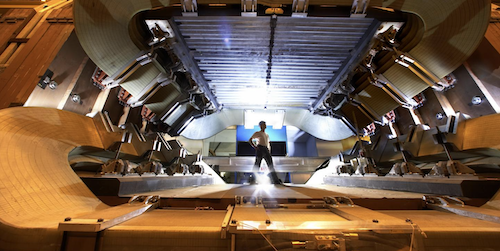
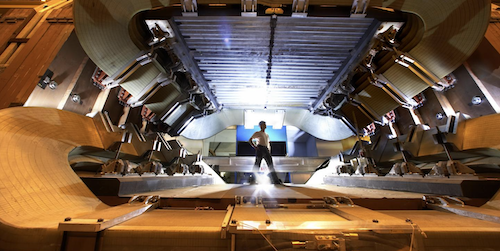
True to its name, CERN’s Large Hadron Collider (LHC) smashes together relativistic beams of hadrons, usually protons, and atomic nuclei made up of hadrons, such as oxygen, xenon, and lead. Physicists hope that the energy concentrated in these collisions will generate never-before-seen particles and interactions. But according to some beyond-the-standard-model theories, relativistic hadron beams might already include exotic particles even before any collisions take place. Sergio Barbosa at the Federal University of ABC in Brazil and colleagues have now suggested that evidence of these particles—in particular, lightweight dark matter candidates known as axion-like particles (ALPs)—could be awaiting discovery in collision data gathered at the LHC nearly a decade ago [1].
ALPs show up in string theory and other theories that assume extra spatial dimensions. Physicists have searched fruitlessly for ALPs in microwave cavities, in liquid scintillators, and in the subatomic debris of particle collisions. If they exist, they should be generated along with photons when charged particles are accelerated nearly to the speed of light. As Barbosa and his colleagues point out, when hadrons collide at the LHC, any ALPs along for the ride could also suffer collisions—with each other and with photons.
The researchers calculated that the strongest indication of ALPs should be found for ALP–photon collisions during LHC runs involving both protons and lead nuclei. Such a run was conducted in 2016, but nobody has yet sifted the data for the characteristic signature.
–Marric Stephens
Marric Stephens is a Corresponding Editor for Physics Magazine based in Bristol, UK.
ReferencesS. Barbosa et al., “LHC as an axion-photon collider,” Phys. Rev. Lett. 135, 181801 (2025).Subject AreasRelated Articles
 More Articles