
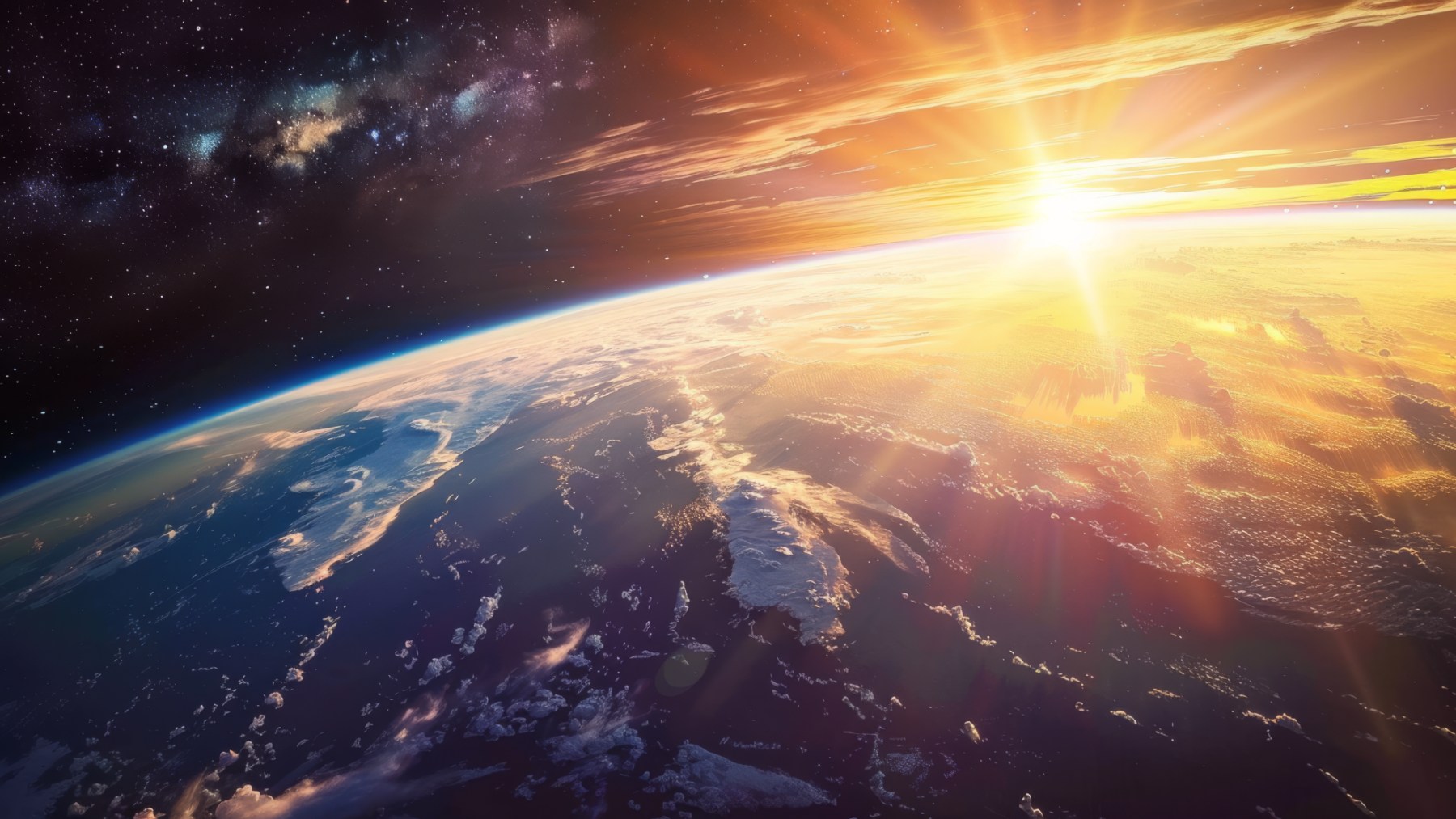
Chemistry has a reputation for filling high‑school notebooks with equations, yet in astrophysics it can overturn planetary origin stories. A fresh quantum‑chemistry analysis published in The Astrophysical Journal Letters argues that the blue blanket covering 70 percent of our world condensed locally, bonded to dust grains that helped assemble Earth itself .
The classical picture that’s cracking
For three decades, textbooks taught a tidy division: inside the Solar System’s “snow line”, water ice could not survive early sunlight, rendering inner planets bone‑dry. Oceans therefore arrived later, courtesy of icy comets and carbonaceous chondrite asteroids —a scenario dubbed the late veneer.
Classical models assumed a single condensation temperature where water flips from vapor to ice. The new study uses quantum‑chemistry to calculate binding energies between water molecules and amorphous silicate dust at the atomic level. Those energies spread over a broad Gaussian curve, meaning some surfaces grip water far more tightly than others. The snow line, it turns out, is not a razor but a fog.
Water rides shotgun at 1 AU
Running the binding‑energy distribution through protoplanetary‑disk simulations, the team found that between 145 K and 200 K—temperatures plausible near Earth’s orbit early on—up to 2.5 weight‑percent water clings stubbornly to dust.
Even the low‑end figure of 0.04 percent suffices to account for all terrestrial oceans once those grains aggregate into a planet. In other words, the chemistry of sticking beats the physics of simple sublimation.
Critics often point to the deuterium‑to‑hydrogen ratio (D/H) as a cosmic fingerprint. Comet water carries about twice Earth’s D/H value; many meteorites match better but still diverge. Deeper ice layers formed at higher temperatures show lower D/H, exactly the level seawater exhibits today. The model also reproduces the signature in enstatite chondrites (meteorites believed to have formed close to the proto‑Earth). That isotopic harmony weakens the case for distant ice couriers.
Dust grains and planetesimals
The study’s authors extend their framework to aggregation. Hydrated grains collide, stick, and form kilometre‑scale planetesimals whose interiors never exceed water’s liberation energy. Accreting such wet rocks layer upon layer can loft Earth‑size bodies already loaded with oceans. Because those grains share a common local origin, they preserve a unified isotopic profile.
What about the numbers?
Earth’s oceans weigh roughly 1.4 × 10²¹ kg. The team estimates that if just 0.05 percent of dust mass within Earth’s feeding zone retained water, the total supply would match modern seas. Their calculations derived maximum of 2.5 percent offers a comfortable margin. In short, there was more than enough water locked in local dust to flood early basins.
No paradigm shift in planetary science survives without scrutiny. Future JWST mid‑infrared spectra can map snow‑line gradients in young star systems, testing whether binding‑energy spread indeed blurs condensation fronts. In the lab, surface‑science teams plan to measure adsorption energies of water on realistic dust analogues, cross‑checking the calculations grain by grain.
A shift in exoplanet expectations
If water can survive close to a star thanks to nuanced adsorption chemistry, then habitable worlds need not rely on late bombardment. That widens the search radius for exoplanet life but also raises caution: oceans alone no longer prove cometary input. Researchers must now decode surface and atmospheric chemistry to tell a planet’s true hydration history.
Every glass of water may carry a memory older than comets, etched by quantum‑scale chemistry in the disk that birthed Earth. The late‑veneer hypothesis is not dead, but the chemistry‑first alternative stakes a compelling claim. As theory, observation, and laboratory chemistry converge, we edge closer to solving one of geology’s most enduring riddles: not just how Earth got wet, but how its very dust knew the recipe all along.
The new model doesn’t merely tweak the timeline; it invites us to imagine a newborn Earth already swathed in vapor, its oceans seeded by stubborn molecules gripping dust in defiance of stellar heat.