
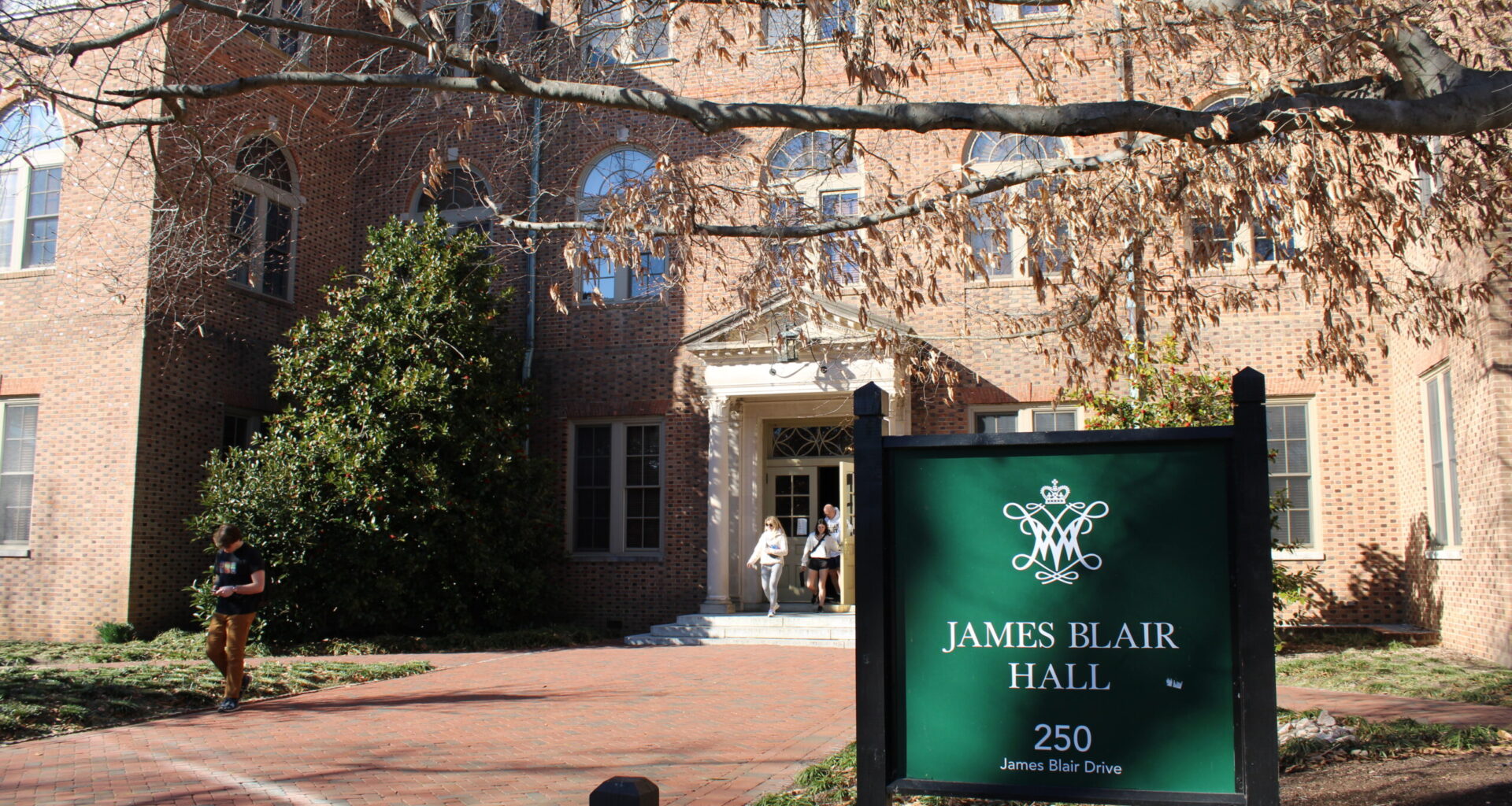
Monday, Oct. 27, three political organizations at the College of William and Mary went head-to-head in a mock debate about public violence in the United States. The College Republicans and Young Independents hosted the event at 6:30 p.m. in James Blair Hall for their semesterly debate. This semester, they also invited the Liberal Student League and the Young Democrats, although the Young Democrats declined to participate.
The debate was organized into four initial rounds of speeches, with one speaker from each organization per round. Each speaker got three minutes to make their argument, then they could answer up to three questions from the audience.
Traditionally, a fifth round comprised of resolutions, or finishing statements, from each organization closes the debate; however, a room occupancy time constraint cut the debate short at 8 p.m. No official resolutions came from the night.
A coin toss determined that an LSL member would speak first. He, like several others, first tried to define public violence within the context of American society. Throughout the night, public violence was used interchangeably with political violence.
Unfortunately, incidents of recent public violence were not difficult to find. Speakers frequently referenced the shooting of Charlie Kirk, nationwide United States Immigration and Customs Enforcement raids, the Jan. 6 Capitol attack, the Charlottesville white supremacist riots and the 2021 Black Lives Matter protests in their arguments.
Attendees generally agreed on three principal factors contributing to the cause and rise of public violence: mixed reactions to violence from the current presidential administration, the influence of the Internet and the role of foreign actors in encouraging polarization.
Another LSL speaker criticized inconsistent responses to political violence from the White House and the way in which President Donald Trump seems to play to his own agenda.
“For example, President Trump blamed the dangerous rhetoric of the radical left for the death of Charlie Kirk, but we also saw him pardon the January 6th rioters, which establishes a precedent that violence is only worth condemning if it goes against one’s own agenda,” YI member Vanessa Walrath ’27 said.
Abigail Bennett ’27 instead argued that violence in America transcends politics altogether and is rather a cultural issue.
“So, ultimately, my argument tonight is that violence in the United States is not a policy issue, and, more importantly, not a partisan issue,” Bennett said. “This is built into the very fabric of American culture.”
Bennett framed the United States as a world outlier for its high public violence rate relative to its national income classification. She explained that, compared to other high-income countries, the United States has a grossly high incident rate and has made minimal progress over the decades. She attributed this stagnation to the country’s foundational values.
“I propose that we abandon the foundation,” Bennett said. “If the foundation is individualism and personal liberties over the prioritization of people, then I think it’s worth abandoning.”
Regardless of political affiliation, almost every participant at the debate expressed grave disdain for the vast majority of public violence acts. One speaker advocated that the individuals committing political violence are oddballs at the outskirts of their party and are not the norm in the United States, nor are they necessary for a functioning democracy.
“That’s what’s so great about democracy,” LSL member Joseph Favale ’26 said. “We don’t need violence to change our leadership.”
While the discussion remained largely respectful, occasional partisan jabs were thrown. The LSL and the YI tended to blame the right for extremist violence, while the WMCR debaters pointed to the left.
“No one on the right has ever, in terms of a broad culture, celebrated anything like this,” WMCR member Philip Vayntrub ’26 said regarding national reactions to Charlie Kirk’s death. “[Public violence] has a source, and that source is, regrettably, the left.”
The debate also revealed the enduring gender gap in political organizations on campus. While one-third of the audience was female, only one-sixth of the speakers were women. Additionally, some felt that questions from female students were more likely to be dismissed or even challenged.
“I would have liked to participate, and I wasn’t given the opportunity to do so,” Natasha Haynes ’27 said.
Bennett and Walrath expressed their goal to retain more female members this year in the male-dominated space.
“This is true in LSL, and this is my understanding of other political groups on campus as well, is that women are definitely a minority, which is something that we don’t see basically anywhere else on campus,” Bennett said.
Despite some tension and a lack of resolution, LSL chairman and treasurer Aiden Corrigen ’26 believed the night was successful in terms of having a cordial discussion between diverse political associations.
“People were able to speak openly and freely and not get interrupted, which, honestly, with the kind of diversity of political viewpoints on display, was the main concern when drawing up the plans,” Corrigen said.