
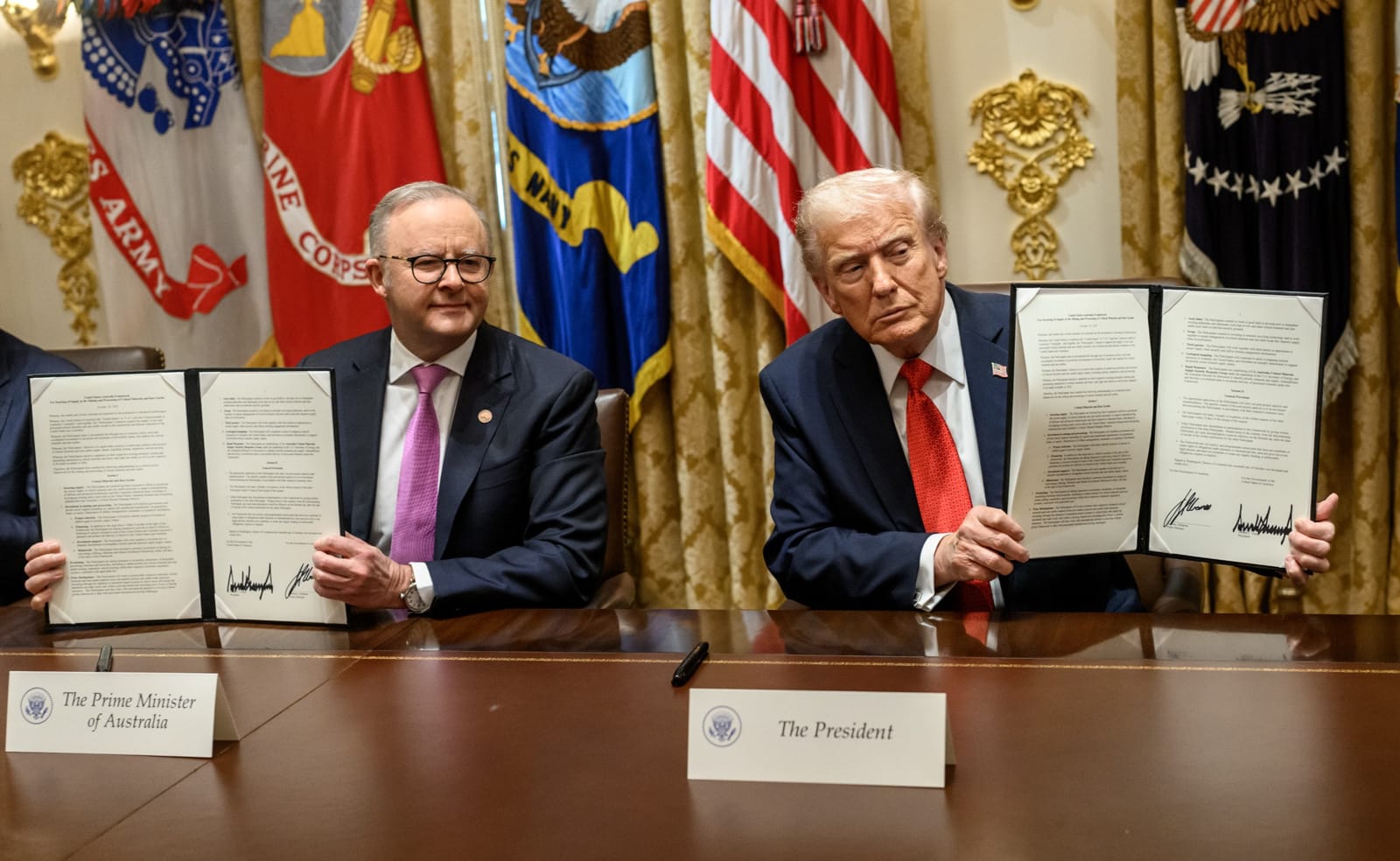
The Trump administration spent much of October responding to China’s explosive rare earth export and technology controls by clinching agreements with Australia, Malaysia, Cambodia and Japan on critical minerals, then convincing China back from the edge of a full-blown rare earth trade war.
As the dust settles, the agreement with Australia stands out in good ways and bad.
The long awaited deal to formalise critical mineral cooperation with the United States was secured by the Australian Prime Minister Anthony Albanese alongside Trump’s shining endorsement of the AUKUS submarine pact. Grinning proudly, Albanese stated the rare earth deal amounted to “an $8.5 billion pipeline that we have ready to go”. The agreement immediately locks in around US$1 billion in financing and identifies potential joint ventures and foreign investments across both economies for mining and refining projects.
Japan has committed to invest US$2 billion in a copper refinery in the United States, and Australian firm Lynas announced a new US$117 million rare earth refinery in Malaysia in the wake of these agreements. But the extent of US interest in Australia’s critical minerals for now appears unmatched.
The timing of the deal couldn’t have been better.
Beijing’s new raft of controls potentially severed US military and defence industrial base from global supplies of rare earth materials. Rare earth materials are essential for several US weapons platforms including the Virginia class nuclear-powered submarines at the heart of AUKUS Pillar 1.
The Future Made in Australia policy has struggled to live up to the government’s refining ambitions. Competing against China’s vertically integrated and heavily subsidised industries amid a strong downturn in global prices is hard. Threatened closures across different refining facilities are mounting and state and federal governments have stepped in multiple times to support otherwise unviable projects, costing tax payers hundreds of millions on top of the billions in industrial policy support already targeting the sector.
The deal between Austral and the United States is a win for two countries who needed one.
Pre-emptively rejecting China’s participation, something already happening, will impede Australia’s critical mineral ambitions.
What is less likely to be said is that deep US engagement in Australia’s domestic industry is coming with a price that others such as Malaysia and Thailand won’t face.
It is notable, and predictable, that a clause binding Australia and the United States to “review and deter critical minerals and rare earths asset sales on national security grounds” made its way in. In other words, assume the exclusion of Chinese firms from critical mineral projects. The same clause appears in Japan’s agreement.
Allies wanting deep US cooperation are expected to forgo any involvement with China.
It need not be this way.
Even with the negotiated one-year reprieve, cooperation in rare earths is unlikely. Beijing has signalled for some time that transfer of processing and production technologies for rare earths, and some other minerals including gallium, was off the cards. However, there are dozens of other critical mineral reserves Australia possesses.
Australian lithium is a case in point. The US firm Albermarle reduced output at its lithium refining facility at Kemerton in Australia last year, a project reliant on 23,000 tonnes of steel and equipment shipped from China. Worse, Australian firm IGO is looking to abandon a joint venture lithium refining project at Kwinana. Its Chinese partner, Tianqi, meanwhile has signalled its resolve to continue the project.
Participation from China in some capacity would better serve Australia’s critical mineral ambitions. Indonesia embraced China and became the largest refined nickel producer. Initial capital costs for mining and refining projects outside of the top producing country are on average 50% higher. China is the leading refiner for most critical minerals. Therefore, Australia’s exclusion of China writ large comes at a high price.
Any downsides to allowing Chinese investment across other projects could surely be mitigated. Compulsory technological and skills transfer can be made the condition of entry into the Australian market and could offset any risks. Then, in any worst-case scenario, scuppered assets within Australia could be revamped using Australia’s own mining and industrial acumen.
If those terms are unacceptable to China, so be it.
For rare earths, Lynas is clear eyed about the additional costs if China denies them access to strategic inputs. As Australia’s foreign minister regularly emphasises, the government should be exploring cooperation with China where it can.
There is no contradiction in doing so alongside cooperation with the United States where China has been restrictive. But pre-emptively rejecting China’s participation, something already happening, will impede Australia’s critical mineral ambitions.
The facile nature of America policymaking also reinforces the need for an “all of the above” approach. The fear China could disrupt rare earths supply has been recognised since 2010, yet only in September did the US Export-Import Bank make the first investment in an Australian rare earth project and first mineral investment in over a decade.
At the signing, Trump quipped that Australia is an “amazing ally”. That is certainly true. And it comes with a price.
State support to many of these projects will be necessary for some time, including for those projects with US involvement.
The Pacific is characterised as a zone of “permanent contest” between Australia and China. The same can now be said for Australia’s critical minerals industry.