
It’s been a fast, fun start to the season for the Detroit Red Wings.
At 9-5-0, the Red Wings are second in the Atlantic Division as they begin a four-game homestand. Their captain, Dylan Larkin, is among the league’s scoring leaders. And the energy is accordingly high in Hockeytown.
It felt like a good time to open up the mailbag and see what was on readers’ minds.
Note: Questions have been lightly edited for clarity and length.
What will it take for Moritz Seider to be at least a Norris candidate? I know the offensive numbers aren’t the best, but he’s becoming a shut-down D-man and playing some of the toughest minutes in the league. — Chris F.
I’ve been impressed by Seider’s start to the season, and the numbers back it up. He’s carrying a 55.96 percent expected goals share against tough competition, and his actual goals share isn’t too far behind that number. His expected goals against per 60 is quite strong at 2.26. That gives statistical backing to what those who watch him nightly have long believed: that Seider can be one of the league’s best defensemen.
His play is getting national attention already, and with the Red Wings looking improved, that helps too. But points do tend to matter in awards voting, so I took a look at Norris voting over the last decade to see who finished top-five while scoring less than 60 points (or below a 60-point pace, in shortened seasons).
Norris top-5, under 60 points
PlayerYearNorris finishPoints (per game)xGF%xGA/60
2023
4
53 (.66)
56.58
2.28
2022
4
56 (.72)
63.18
1.78
2021
5
30 (.59)
57.71
1.91
2020
5
36 (.53)
55.11
2.31
2019
3
54 (.77)
53.49
2.34
2018
3
59 (.72)
51.43
2.36
2018
4
57 (.73)
52.8
2.4
2017
4
53 (.66)
48.14
2.45
2017
5
40 (.49)
59.79
1.78
2016
1
51 (.62)
55.57
1.98
There are a few things to note here. Not all seasons are created equal, and we’re living in the modern golden age of high-producing defensemen, led by Cale Makar and Quinn Hughes. That makes the competition stiff right now. Miro Heiskanen has never finished top-five, for example, and you’ll note that recent examples of this profile finishing top-five are more scarce.
Additionally, P.K. Subban, Victor Hedman and Duncan Keith had also already won Norris trophies at the time of these finishes, and (right or wrong) reputation can be a factor with voters. It’s not as simple as just crossing a certain threshold.
But this group still paints a picture of what it takes to finish top-five for the Norris without monster offensive numbers, and that range feels plausible for Seider. His underlying numbers are already right in line with this group.
Points do matter to voters, though, and right now Seider’s .43 points per game (six in 14 games) stand out as the main flaw in his case. History says he doesn’t need to get to 60 points if he can keep his underlying numbers as strong as they’ve been, but he probably does need to get above the half-point per game mark, and ideally above 0.6.
Seider’s career high so far is 50, and if he could get there again, while keeping up his excellent defense, it would make his resume look extremely similar to Lindholm — the most recent player to finish top-five without scoring 60 points.
What kind of odds would you currently give Detroit to make the playoffs? More or less than 50 percent? And have things changed much since the season started? — Super M.
I thought they’d be close before the season, but I picked them to come up just short, and I’d probably flip that based on these first 14 games.
Interestingly, though, that’s not because I view this Red Wings team much differently than I did a month ago. They’re pretty much exactly what I expected them to be: an improved, motivated team that still has flaws and makes youthful mistakes.
Instead, I’m starting to think the playoff cut line will be low once again, based on the unbelievable parity we’re seeing in the Eastern Conference. There really aren’t many doormats in the East this year — and there aren’t many sure things either. I’d still call Carolina, New Jersey and Tampa virtual locks, and I do think Florida and Washington will be there in the end. But beyond that, there aren’t many teams that have been clearly better than Detroit.
Montreal is off to a great start, but their opening schedule has been light so far — they’ve beaten only one playoff team from last season. I think the Rangers are better than their record indicates and would expect them to give Detroit some trouble Friday, but they’re not exactly humming along. Ottawa would probably be my pick to really come on strong in the second half, when they get Brady Tkachuk back (and assuming Linus Ullmark returns to form), but they might also have a hole to dig out of by then.
The Red Wings have a lot to prove still, so I certainly wouldn’t feel confident calling them a playoff team right now. But they have banked some big early points, have some key pieces who have more to give, and the competition could really beat each other up along the way.
I think Detroit has as good a shot as any of those other teams outside that top five.
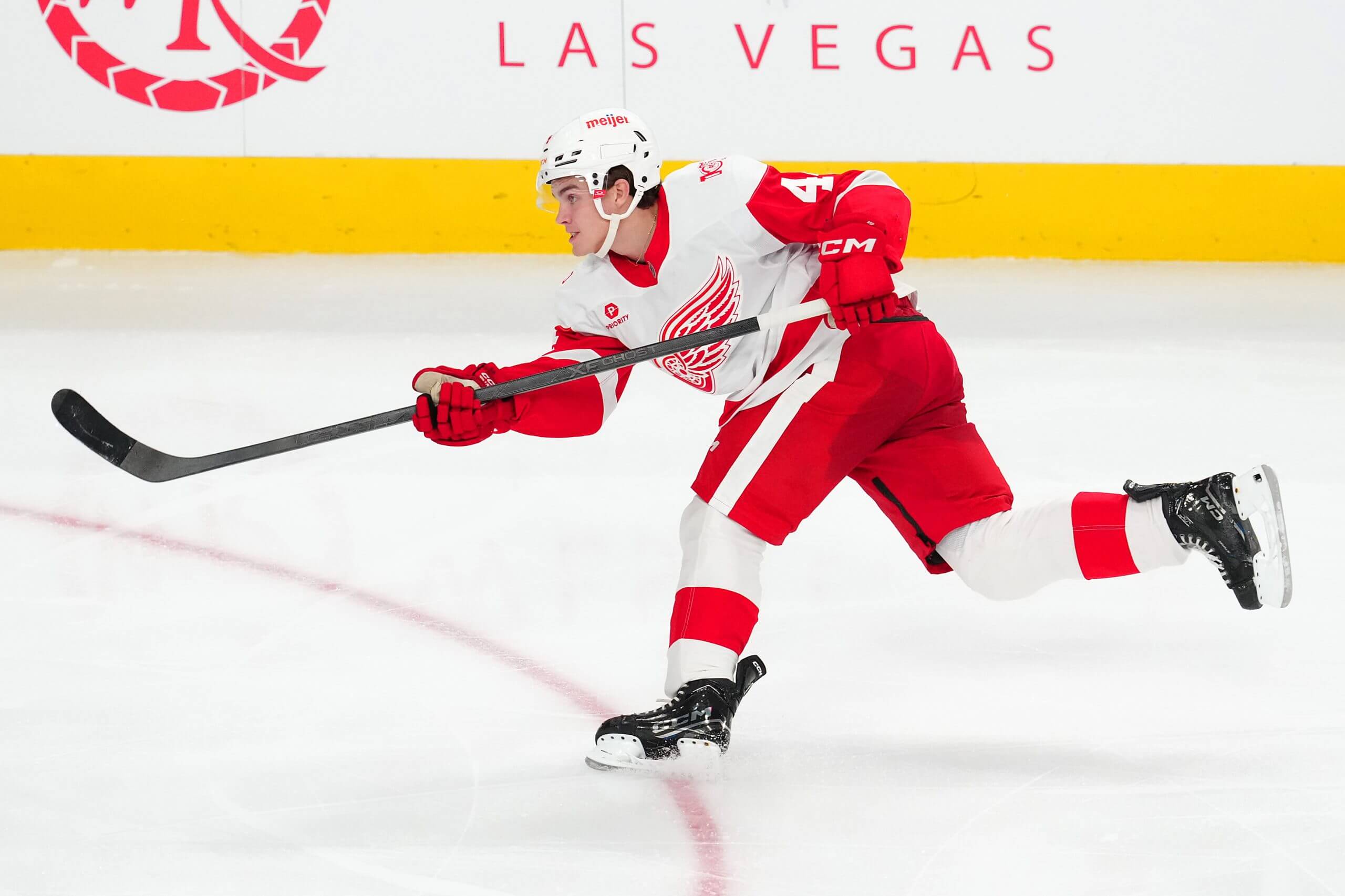
I think it’s been a mixed bag for Axel Sandin-Pellikka to start the year. (Stephen R. Sylvanie / Imagn Images)
I’m wondering what you think of Axel Sandin-Pellikka as an NHLer. His offensive numbers, which made him such an exciting and valuable prospect, haven’t jumped off the page: four points. And his TOI is dropping from the start of the season, but he’s still playing like a reliable second-pair defenseman. Just looking for a deep dive on the kid and curious to see how that changes over the course of the season. — Andrew C.
Would you say Adam Fox is the best long-term comparable for Sandin-Pellikka? — Connor I.
I think it’s been a mixed bag for Sandin-Pellikka to start the year. At a base level, it’s encouraging for the big picture that he’s up at all, and I’m impressed with the way he’s competed, as well as the way he walks the blue line in the offensive zone.
To your point, though, the ice time has gone down of late, and the offense (a big part of his profile) has been more solid than eye-catching. I’d like to see him get his shot through more often, and I definitely think that will come in time.
For now, the big key is getting him to be as effective and confident as possible. His smarts and elusiveness should help Detroit on exits and in the offensive zone — as long as his defense and game management can hold up.
“Young players, they ride that high wave of emotion and making the team, and then all of the sudden they make it and it settles in and becomes a grind,” Todd McLellan said recently. “And as it becomes a grind for the youth, the older veterans are really hitting stride right now. They’re finding their games, they become more confident, they become more physical. And Axe is at that crossroads right now where he’s dealing with it. There’s so much good on the offensive side. The defensive side I think there’s room for improvement.”
As for a comparison, Fox feels lofty for me. I get the thinking with the intelligence in a smaller defender, but Fox would be at a different level in my eyes. I’ve said Brandon Montour in the past, and while Sandin-Pellikka isn’t quite as thick as Montour, I do think he has the kind of competitiveness to play a two-way game, and have real offense too.
Based on his skating and defensive game, does Emmitt Finnie project as a center long-term? If so, how do you envision the utilization of Marco Kasper, Nate Danielson and Emmitt Finnie in a contention window? — Nate K.
Part of Finnie’s appeal is his versatility. I don’t know if he has the offensive profile to be a top-six center, but it’s very easy to see him as either a bottom-six center or on the wing anywhere in the lineup because of his speed and tenacity.
Personally, I think the way they’ve deployed him so far makes a lot of sense, as a puck retriever on the wing next to skilled players in the top six. Over time, as Michael Brandsegg-Nygård and Carter Bear move into Detroit’s lineup full-time, both will also be candidates to play that kind of role high in the lineup, but it really wouldn’t shock me if Finnie sticks there because of his skating. If not, I could see him being an excellent third-line player as well.
That kind of versatility is an asset, and the Red Wings have a lot of time to figure it all out.
What do you think the Red Wings’ bottom six looks like in January? — Philip M.
This is a great question, because I do think Nate Danielson will get a look at some point this season — especially if he keeps up like he has been so far in Grand Rapids. He has five points in his first four games with the Griffins.
I’d be intrigued to see Danielson between Andrew Copp and Mason Appleton as a third line that can check, skate and move the puck, with Appleton showing some finishing ability too. That would leave J.T. Compher centering the fourth line, and there are some great debates to be had around who would make the most sense next to him in that scenario.
James van Riemsdyk has been better than his numbers show, especially in terms of his poise with the puck, so I’m inclined to say him on one side. And then I would imagine Michael Rasmussen’s length and defensive impact (particularly on the resurgent penalty kill) would give him the inside track over Elmer Söderblom and Jonatan Berggren for the other spot — though both of the latter two have had some nice games of late
I could also see an argument to put van Riemsdyk with Copp and Danielson, and Appleton with Compher and Rasmussen as a true checking line.
Maybe the Red Wings will leave Danielson down for a longer run. But I’m inclined to think he’ll be up at some point, and that will create some interesting options (and decisions) for Todd McLellan.
What has gotten into Eddie Genborg? — Matt S.
I don’t think anyone saw Genborg’s start in the SHL coming. I can’t say I’ve had much time to watch Timrå yet this season — though I will make time soon — but the 18-year-old has seven goals and 13 points in 18 games in the SHL, producing at the same rate as last year’s No. 3 pick, Anton Frondell.
Now, that doesn’t mean Genborg — a second-round pick in 2025 — projects to be at the same level as Frondell when in the NHL. But the SHL is a hard league to produce in as an 18-year-old. Kasper had 23 points in 52 games at the same age.
It’s still early, and we’ll have to see how Genborg’s production holds up as the year goes on. But it’s encouraging what he’s been able to do so far.
Is Max Plante just on an early-season heater, or is he one of the top offensive talents in the NCAA? — Matt R.
Considering Plante also had 28 points in 23 games as a freshman last season, I think it’d be hard to write it off as just an early-season heater. He’s been one of the top NCAA scorers for close to a full year now. Currently, he leads the nation with 19 points (nine goals, 10 assists) in 10 games.
Plante has been a featured offensive piece at the NTDP previously, and his hockey sense is legit. I also find him to be an impressive competitor, and while he’s not the tallest, he has some good weight to him. For me, that tool kit makes him one of the most projectable playmaking wingers Detroit has in its system (ahead of, for example, Dmitri Buchelnikov).
He’ll need to stay healthy, but I’m a believer in Plante as a potential middle-six playmaker.
Are you a “big hall” or “small hall” when it comes to the Hall of Fame? And does Henrik Zetterberg belong in the hall in your opinion? The main argument I’ve heard for him is more about who’s already made it rather than his own resume. — Chris N.
It’s not so much that I believe in a “big hall” in the abstract — I’m not saying they should induct 10 players a year, every year — but I do think there are a healthy number of deserving players who aren’t in, and Zetterberg would absolutely be one of those.
He was an era-defining player for one of the best teams of his era. I hear what you’re saying about his own resume vs. those who have already made it in, but aren’t the two related? Zetterberg’s career spanned from 2002-2018, and in those years, only five players scored more points than him: Joe Thornton, Sidney Crosby, Alex Ovechkin and the Sedin twins.
The Sedins are already in. Thornton will go in on Monday. Crosby and Ovechkin are borderline Mount Rushmore players — guaranteed to go in unanimously on their first ballot. And the next two players behind Zetterberg on that list are Martin St. Louis and Jarome Iginla, both of whom are already in.
So, if that’s the company Zetterberg was keeping as a player, why should he be left out when it comes to the Hall? He may not have as much individual hardware as some of those names, but he does have five top-10 finishes for the Selke, a Stanley Cup and a Conn Smythe Trophy as playoff MVP in 2008.
And, by the way, he’s one of just 30 players who have won a Stanley Cup, a gold medal at the World Championship and Olympic gold.
Zetterberg may not have been a statistical compiler, but he was an all-time winner and one of the very best players of his era — both in the NHL and internationally. He belongs in the Hall of Fame.