
July 10, 2025• Physics 18, s91
An arrangement of spins known as a meron turns out to be easier to make in momentum space than in real space.
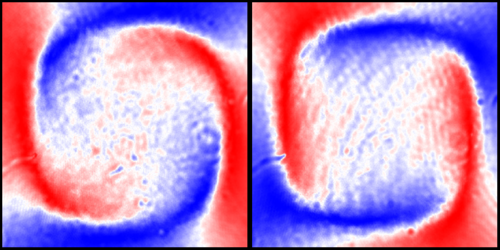
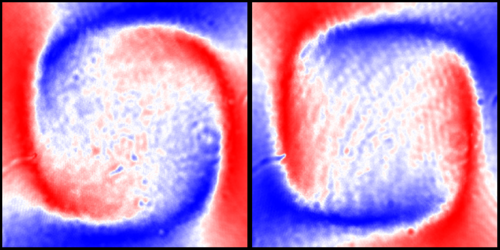
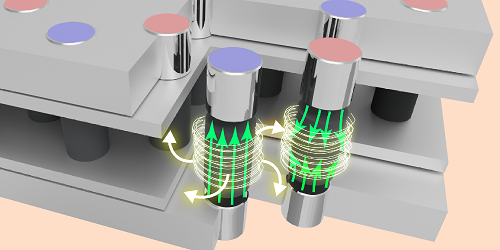
A skyrmion is a region where the orientation of a vector field—such as a magnet’s spin texture—locally adopts a vortex-like configuration. Originally conceived as a mathematical description of protons and neutrons, skyrmions have since been realized in magnetic materials, Bose-Einstein condensates, and optical devices. Now Lei Shi of Fudan University in China and his collaborators have made half-skyrmions, or merons, by shining polarized light through a photonic crystal [1]. A meron’s or skyrmion’s integrity depends on how many times the orientation of the field rotates within it. This property is usually hard to change, making these features potential channels for information storage.
Merons and skyrmions are typically made in real space, and their characteristic vortex textures are mapped in x, y, and z. But creating optical merons in real space—typically using the polarization orientation of light in a photonic crystal—requires complex, finicky setups. Shi and his collaborators worked instead in momentum space.
Their photonic crystal is a dielectric slab patterned with a rectangular grid of cylindrical holes. Thanks to its symmetries, the photonic crystal can host a so-called bound state in the continuum (BIC)—a trapped, localized wave state, which in this case takes the form of a vortex state centered on the origin in 2D momentum space. The researchers found that illuminating the crystal with either left or right circularly polarized light transformed the BIC into one of two different types of meron. The researchers say the simplicity of their system offers promising avenues for photonic applications.
–Charles Day
Charles Day is a Senior Editor for Physics Magazine.
ReferencesL. Rao et al., “Meron spin textures in momentum space spawning from bound states in the continuum,” Phys. Rev. Lett. 135, 026203 (2025).Meron Spin Textures in Momentum Space Spawning from Bound States in the Continuum
Lixi Rao, Jiajun Wang, Xinhao Wang, Shunben Wu, Xingqi Zhao, Wenzhe Liu, Rensheng Xie, Yijie Shen, Lei Shi, and Jian Zi
Phys. Rev. Lett. 135, 026203 (2025)
Published July 10, 2025
Subject AreasRelated Articles

 More Articles