
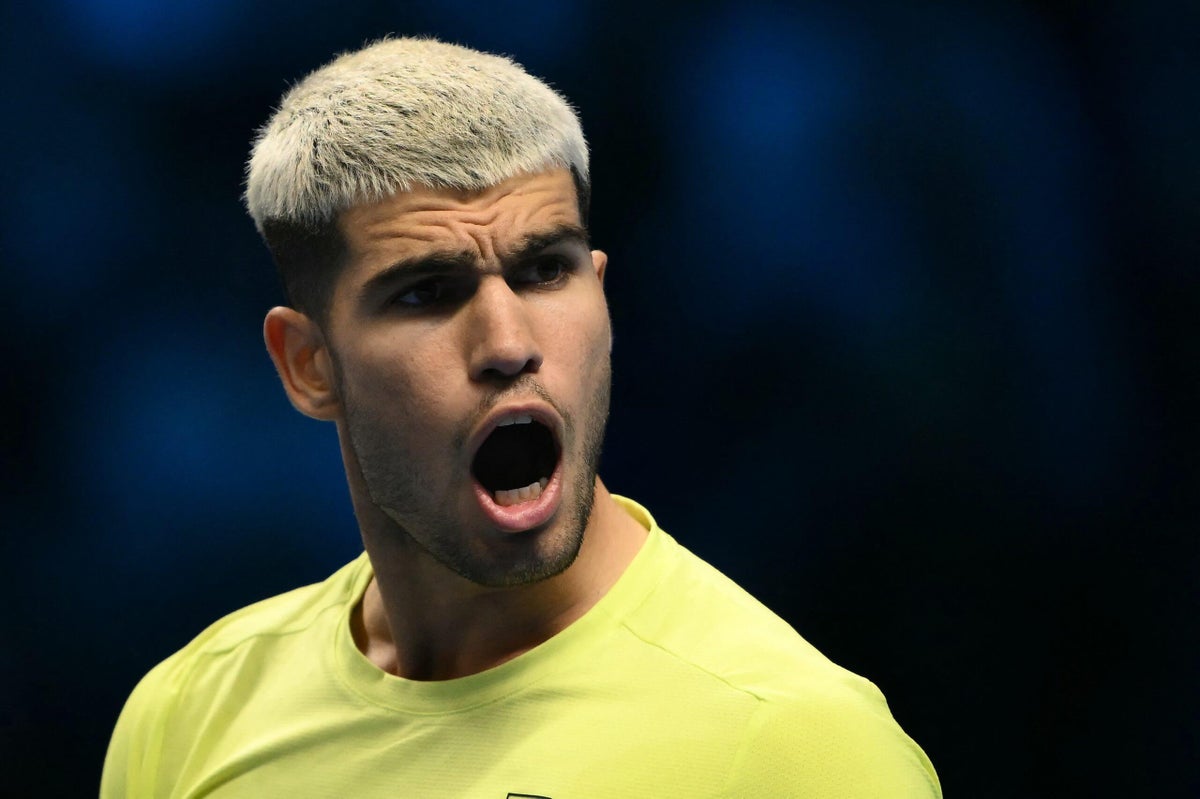
The ATP Tour Finals plays host to Carlos Alcaraz and Jannik Sinner’s fight for year-end world No. 1, and the runaway best men’s tennis players in the world are playing their first matches of the round-robin stage.
Alcaraz went 4-1, 0-40 up on Alex de Minaur’s serve in his first match, before the Australian — and some errors from the Spaniard — dragged the world No. 1 into a first-set tiebreak. Alcaraz won it and cruised from there, winning 7-6(5), 6-2 to move two matches from securing year-end top spot.
Sinner’s group opens with Alexander Zverev’s match against Ben Shelton Sunday, before Sinner plays Félix Auger-Aliassime and, in Alcaraz’s group, Taylor Fritz meets Lorenzo Musetti.
Musetti arrives fresh — or perhaps tired — from the Hellenic Championship in Athens, where he lost the final to Novak Djokovic, which eliminated him from the ATP Tour Finals. Briefly. Djokovic promptly withdrew with a shoulder injury, granting the Italian a first appearance at the season-ending event.
‘Another Sinner vs. Alcaraz final looks likely’
Analysis by tennis writer Charlie Eccleshare
This draw was particularly bad news for Lorenzo Musetti — at first.
The strange contortions of the ATP Race to Turin meant that Musetti was still toiling away trying to claim the eighth and final spot when the draw was made, even knowing that he may have been fine finishing 9th.
Musetti, who hadn’t won an ATP Tour title in three years, knew that he would likely have to beat Djokovic in Athens to secure his place in Turin. And on the face of it, the draw gave Djokovic plenty of encouragement. He was not put in the same group as Sinner, his kryptonite and the world’s most in-form player, and he boasts a combined 14-1 winning record against the two players intially drawn against him, Taylor Fritz and Alex de Minaur.
The other member of the group, world No. 1 Alcaraz, presented a more formidable challenge, but Djokovic also knows he can get inside the Spaniard’s head.
Djokovic said earlier in the week that he would only make a decision on playing Turin once his involvement in Athens is over, and so the waiting for Musetti went all the way to his handshake with Djokovic after defeat at the Hellenic Championship, during which the 24-time Grand Slam champion told Musetti that he would not participate.
Either way, it felt unsatisfactory still having so much uncertainty on the eve of the event, and so it’s good news that from 2026 points from events in this equivalent week of the season will not be included in player’s totals for that year.
Another Sinner vs. Alcaraz final looks likely, but that would have been the case whatever draw had been served up.
How does the ATP Tour Finals draw work?
The eight players who qualified were split into four pots for the draw. Pot 1 is No. 1 and No. 2, Pot 2 is No. 3 and No. 4, and so on.
These seedings follow the players’ rankings in the ATP Tour Race to Turin, the table which only counts ranking points earned in 2025.
Each player then plays three round-robin matches. The top two players from each group contest the semifinals, with first in one group playing second in the other, before the winners meet in the final.
What happened because Djokovic did not play?
With Djokovic choosing not to play, the No. 9 in the Race to Turin would take his place. Musetti took that spot.
What do Sinner and Alcaraz have to do to finish year-end world No. 1?
Going into the ATP Tour Finals, Alcaraz has a healthy lead over Sinner in the race to finish 2025 on top of the world rankings:
Because of the rankings points structure at the ATP Tour Finals, Alcaraz will end the year as world No. 1 if he goes undefeated in his three round-robin matches, or if he reaches the final with at least one round-robin win, no matter what Sinner does.
Who won last year’s tournament?
Sinner won the 2024 ATP Tour Finals, also in Turin. He beat Fritz 6-4, 6-4 in the final, after going unbeaten through the event.
What is the prize money for the ATP Tour Finals?
The total prize money is $15.5 million (£11.85 million), which is a record for the event. Prize money is allocated per match win, and is structured so that the champion will take home just over $5 million if they go through the event undefeated with five wins (three round-robin wins, a semifinal win, and then victory in the final).
The winner of the final will receive $2.37 million, while the winner of each semifinal will receive just under $1.2 million; the prize for a round-robin match win is $396,500 and each player receives $331,000 just for appearing at the event.
The prize for the winner is larger than any of the four Grand Slams, the largest of which is the U.S. Open at $5 million. It is also the same size as the pool for the WTA Tour Finals in Riyadh, Saudi Arabia, but is structured slightly differently: the winner there will take home over $5.2 million.