
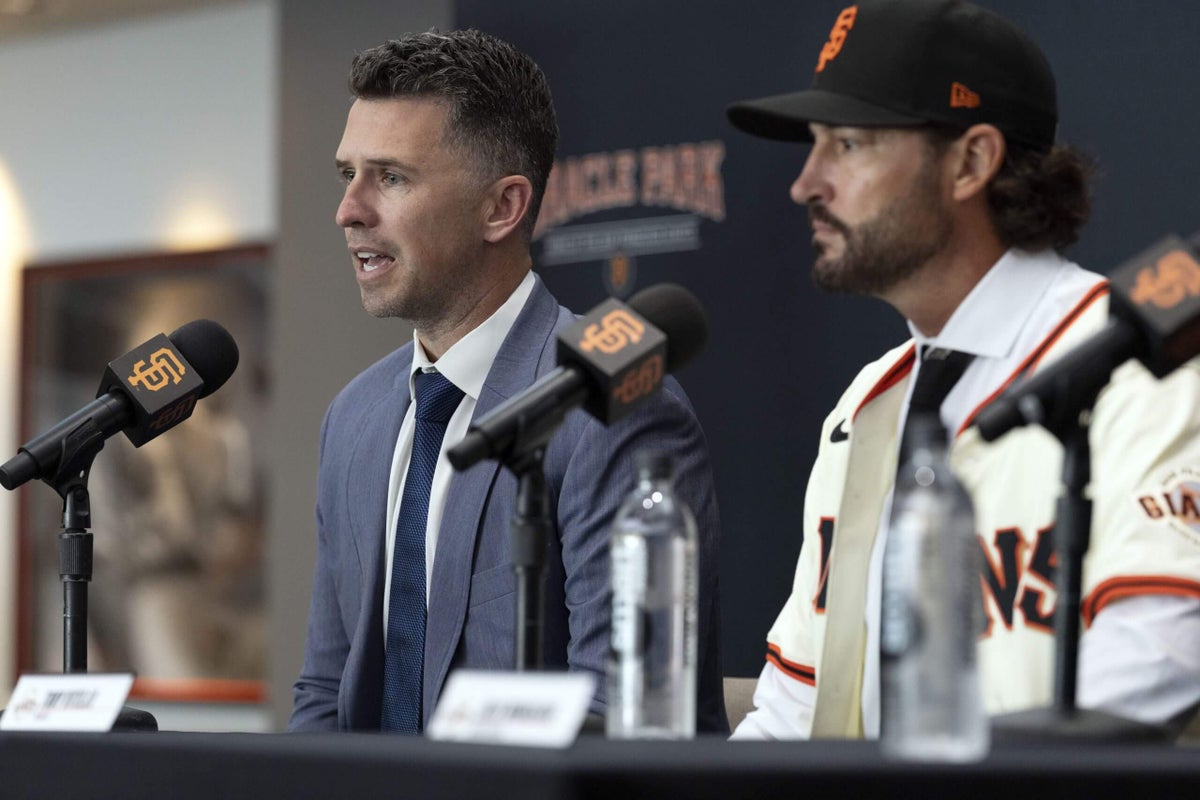
LAS VEGAS — Buster Posey has been a major-league executive long enough to understand that his cohort is a polite society. You keep more hidden with collegiality than with confrontation. The general managers’ meetings, which began Tuesday at the Cosmopolitan of Las Vegas, are about setting agendas, surveying the transactional landscape and making nice.
It’s not the best forum for Posey to gather industry opinions about his unconventional managerial choice of University of Tennessee coach Tony Vitello.
“The only feedback I’ve gotten (from) people I’ve heard from is they think it’s a good hire,” Posey said. “So I’m guessing that there’s people that think it’s not a good hire. They’re just not saying it.”
Former major-league manager Joe Maddon wasn’t so shy. In an interview with KNBR on Tuesday, Maddon called the hiring “insulting” while citing Vitello’s lack of professional coaching experience. There are bound to be others who will express a similar opinion that Vitello hasn’t paid his dues or that he leapfrogged many minor-league coaches who have paid theirs. It’s an opinion Vitello acknowledged in his introductory news conference Oct. 30, saying he hopes those people will consider that he met the grind in a different way while spending more than two decades on the recruiting trail and in the dugout as a college coach, and that he further hopes to earn respect on the major-league level through his relentlessness and hard work.
The surest way Vitello will earn that respect is with a successful season. And for that, he’ll need the most important and universal managerial attribute of all: a talented roster.
For the San Francisco Giants, that means acquiring multiple starting pitchers. And multiple late-inning relievers. They must improve their outfield defense and base running. Then there are the roster crevices that could do with a bit of sealant: a veteran backup catcher with some sock, a versatile hitter in the Wilmer Flores/Dom Smith mold who can ensure that 21-year-old prospect Bryce Eldridge can matriculate at the proper pace, and in a perfect world, an upgrade over Casey Schmitt at second base. Mostly, though, it’s pitching the Giants need. A lot of it.
Yet the dialogue during Posey’s media availability Tuesday had a lot more to do with vibes than offseason goals. Posey cited players such as Heliot Ramos and Jung Hoo Lee and Luis Matos while saying “there’s more in the tank” and “meat on the bone.” Posey made it clear the Giants will augment their roster from the outside world this winter. He made it even clearer that a successful return to the postseason will require internal improvements under the leadership of Vitello and a coaching staff with some assembly still required.
“The reality is we’re gonna need … I mean, I looked at it like this is a player and I think I look at it even more so now: The successful teams are going to have players within their system that make an impact,” said Posey, citing developing pitchers such as Blade Tidwell, Carson Whisenhunt, Carson Seymour and Kai-Wei Teng as key contributors in 2026. “I think for us to get where we want to go — and certainly don’t read between the lines and say that we’re not going to make additions, because we’ll most certainly do our best to improve pitching like always — but we’re going to need some of the Tidwells, the Whisenhunts of the world, the Tengs, the Seymours, and I’m probably leaving one or two out there, to take that next step and really contribute on the pitching side of things.”
Posey’s uninspiring remarks appeared in stride with wet-blanket comments that Giants chairman Greg Johnson made earlier this month when the San Francisco Standard asked him about competing at the top of the starting pitching market, where Framber Valdez, Dylan Cease, Tatsuya Imai and perhaps Ranger Suarez will command contracts in excess of $100 million. Johnson’s reply: “I’d say we’re going to be very cautious about those kinds of signings.”
Johnson expressed the usual caveats that the Giants were open to any contract that made sense while acknowledging that big-ticket contracts would have to be balanced with a five-year horizon that already includes major commitments to Rafael Devers, Matt Chapman, Willy Adames and Lee. Then Johnson circled back to the Vitello hiring as a cause for optimism.
“I think we feel like we could be an improved organization with this kind of leader,” Johnson told The Standard. “That’s really the end game.”
Is it though? When the Giants rotation ranked 21st out of 30 teams with minus-0.7 Wins Above Average despite receiving healthy and load-bearing seasons from Logan Webb and Robbie Ray? For all the scripts an organization can use to reach the postseason or win a World Series, it’s impossible to imagine the Giants returning to October baseball or reaching a satisfying endgame without a starting staff that leverages its home-field advantage.
The good news is the Giants are guaranteed to invest $17 million in an All-Star starting pitcher Jan. 15. They’re going to pay an All-Star closer, too. The bad news is the money is a deferred signing bonus owed to Los Angeles Dodgers left-hander Blake Snell, who contributed 20 starts in 2023 before opting out of the remainder of his two-year, $62 million contract. And the accomplished closer who’ll be cut a check is retired right-hander Mark Melancon, who will get $1 million every Jan. 15 through 2027 in deferred signing bonus from the four-year, $62 million contract he signed before the 2017 season.
Folding in those deferrals, the Giants project to have more than $193 million in payroll commitments on a cash basis. Their payroll calculation relative to the luxury tax is slightly less. The Giants could spend roughly $57 million before they’d bump up against the first tax threshold of $244 million.
Here’s the vibe they’re giving off: This free-agent class isn’t worth the splurge.
The cautionary tales shouldn’t be too easily dismissed. The Giants hampered themselves after the 2015 season when they committed more than a quarter of a billion dollars to pitchers Johnny Cueto and Jeff Samardzija. The current hot stove will have several high-profile closers, including Edwin Díaz, Devin Williams and Robert Suarez, but you couldn’t blame the Giants for being scarred by the disastrous deals they gave out to Melancon, and before that, to Armando Benitez.
Perhaps Posey, in his second season as the Giants’ chief baseball officer, is adopting a new public policy to underpromise and overdeliver. Or perhaps the Giants really did use up their largesse, or at least as much as they are comfortable allocating, while taking on more than $250 million when acquiring Devers from the Boston Red Sox in June.
Either way, the Giants are setting high expectations that Vitello will make an immediate impact. And he’ll need a savvy coaching staff to help with that.
“He’s very in tune with the types of personalities he wants,” Posey said of Vitello. “When he’s thinking about skill sets or attributes for certain coaches, he’s measuring their personality traits almost equally. I think it’s a very smart way to go about things because you’re hoping to get buy-in from the players for whatever messages are coming over from the coaches.”
The Giants are close to announcing that Jayce Tingler, the former San Diego Padres manager and Vitello’s one-time teammate at the University of Missouri, will be hired as bench coach or with an associate manager title. Posey confirmed that assistant hitting coach Oscar Bernard, a Spanish speaker who hails from the Dominican Republic, will return. So will assistant coach Taira Uematsu. Special assistant Ron Wotus, the longest-tenured coach in franchise history, will return in a similar role.
But bullpen coach Garvin Alston will not return. Neither will former bench coach Ryan Christenson, who caught on with the A’s as their first-base coach, or assistant hitting coach Damon Minor, who left for a position with the Chicago Cubs’ Triple-A club. And the pitching coach situation is wide open after J.P. Martinez, despite being under contract for 2026, received no assurances and took a bullpen coach position with the Atlanta Braves. Even first-base coach Mark Hallberg, who was Posey’s roommate at Florida State and considered a shoo-in to return, has been “popular with other teams as well,” Posey said.
“With nothing being a guarantee for J.P., I think he took the bird in the hand,” Posey said. “I’m a J.P. fan and had a good talk with him after he took the job.”
It’s anyone’s guess where the Giants go with such a pivotal hire. They were rebuffed when they requested permission to speak to San Diego Padres bullpen coach Ben Fritz. They spoke with former New York Mets pitching coach Jeremy Hefner before he agreed to join the Braves. Vitello, a former infielder who served as a pitching coach as a college assistant, is sure to have his own preferences for the role, especially after leading a Tennessee program that fast-tracked velocity monsters such as Garrett Crochet, Ben Joyce and Chase Dollander to the big leagues. But he’ll also need an experienced hand to help him manage workloads over the uncharted novelty of a 162-game season.
“Ultimately, it’s about establishing trust and a relationship with your pitchers,” Posey said. “There’s no question that there’s a different language that’s spoken nowadays, and I think it’s helpful to have somebody that can have those conversations … and not necessarily with just the younger players.”
On the hitting side, with Pat Burrell expected to be reassigned within the organization, industry speculation is widespread that the Giants are targeting Toronto Blue Jays assistant hitting coach Hunter Mense, who played under Vitello along with right-hander (and potential Giants free-agent target) Max Scherzer at the University of Missouri. Mense worked in Toronto under hitting coach David Popkins, who was credited for instilling the kind of contact-oriented, grinder mentality that Posey has cited as a characteristic he hopes to instill in San Francisco.
“I think a lot of it when these groups get going, there’s a confidence that happens, too,” Posey said. “It’s hard to measure how much that comes into play. When you’re confident, you’re going to take close pitches easier than you will when you’re searching. So it all adds up to that final piece.”
Good vibes are good. They can be the final piece. They are also difficult to maintain when you don’t have enough talent.