

Here at Top Comments we strive to nourish community by rounding up some of the site’s best, funniest, most mojo’d & most informative commentary, and we depend on your help!! If you see a comment by another Kossack that deserves wider recognition, please send it either to topcomments at gmail or to the Top Comments group mailbox by 9:30pm Eastern. Please please please include a few words about why you sent it in as well as your user name (even if you think we know it already :-)), so we can credit you with the find!
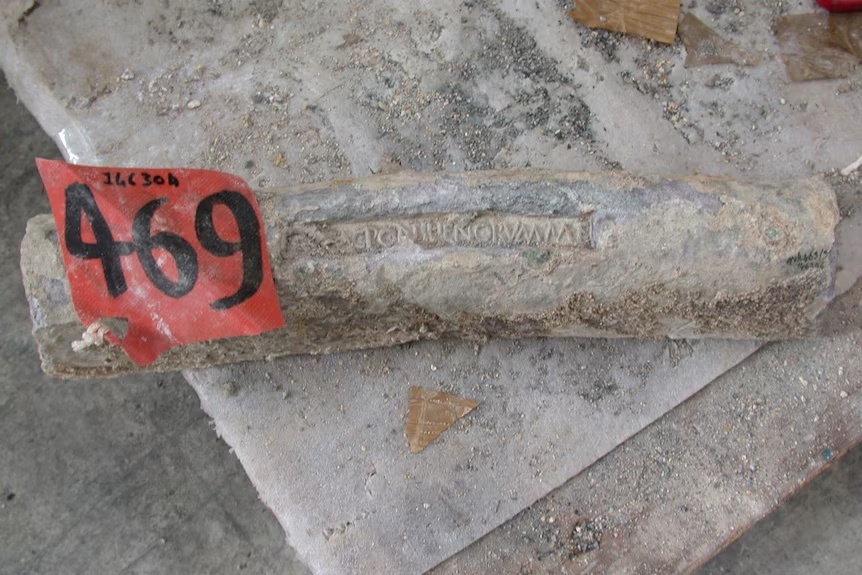
Between 50 and 80 BCE, a Roman ship carrying approximately 1000 lead ingots, weighing approximately 33 kg each, sank off the coast of Sardinia. The shipwreck was discovered in 1988, and a physicist named Ettore Fiorini from Italy’s Institute for Nuclear Physics (INFN), made a deal with archeologists: He would help fund the recovery of the lead if a portion of it could be used to make a shield for physics experiments looking for rare events.
There is a conflict of interests here. The use that the physicists had in mind was to melt down the ingots to create the shield needed for these sensitive experiments, but the aim of the archeologists was to preserve these ancient artifact in order to study them for clues about life and commerce in ancient Rome. Ultimately, the archeologists agreed to the deal because what do you do with a thousand 33 kg ancient lead ingots besides storing them in a warehouse?
Why do physicists want ancient lead? For physicists running experiments that may be interfered with by stray radiation, lead is a good substance to use as a shield as virtually no such radiation can make it through due to its density. However, freshly mined lead has a troublesome isotope, lead-210, which is itself radioactive, and can thus interfere with sensitive experiments. Lead-210 has a half-life of about 20 years, so if you wait a few hundred years, this radioactivity will die out, and the remaining lead will make a shield that provides an exceptionally quiet environment. Lead that has been lying on the floor of the Mediterranean Sea for 2000 years is perfect for this purpose.
So what experiment are the physicists pursuing? Interestingly, the article I originally
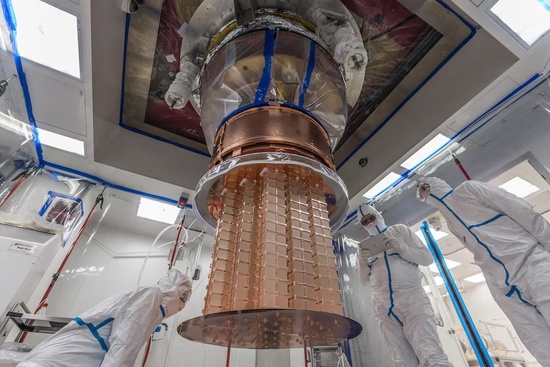
The CUORE experiment
found (From the Australian Broadcasting Corporation, I think) said one thing while the website for INFN said another, though both of these need complete shielding from any kind of interfering radiation. The experiment itself goes by the acronym CUORE (Italian for “heart’), which stands for Cryogenic Underground Observatory for Rare Events. It is located under Gran Sasso mountain, which provides the primary shielding from cosmic rays. According to the INFN website, the experiment consists of tellurium oxide crystals cooled to very near absolute zero Kelvin (temperature measured in milliKelvin). If a detectable event occurs, there will be a release of energy that will be observed as an increase in the temperature of one of the crystals. The experiment described by the INFN website, however, described seeking to observe the phenomenon of double-beta decay, where two neutrons in the nucleus of an atom are simultaneously transformed into protons, simultaneously spitting out two electrons. The isotope Tellurium-130 is known to be a possible candidate for double beta decay. The question being sought to answer is whether or not any neutrinos are emitted. If not, then this is evidence supporting the hypothesis that the neutrino is its own antiparticle.
The experiment described in the article, on the other hand, described looking for collisions with dark matter particles, which, if they happen at all, are expected to be very low energy events that are hard to detect. It is actually possible for both of these experiments to run simultaneously, as the double beta decay of tellurium-130 has a known energy that can be focused on, while any dark energy event is likely to be well outside that energy range.
Comments are below the fold.
P. S. My electricity is scheduled to be shut off about an hour after this diary is published, so I won’t be around for long tonight.
Top Comments (November 13, 2025):
No nominations or highlights tonight.
Top Mojo (November 12, 2025):
Top Mojo is courtesy of mik! Click here for more on how Top Mojo works.