
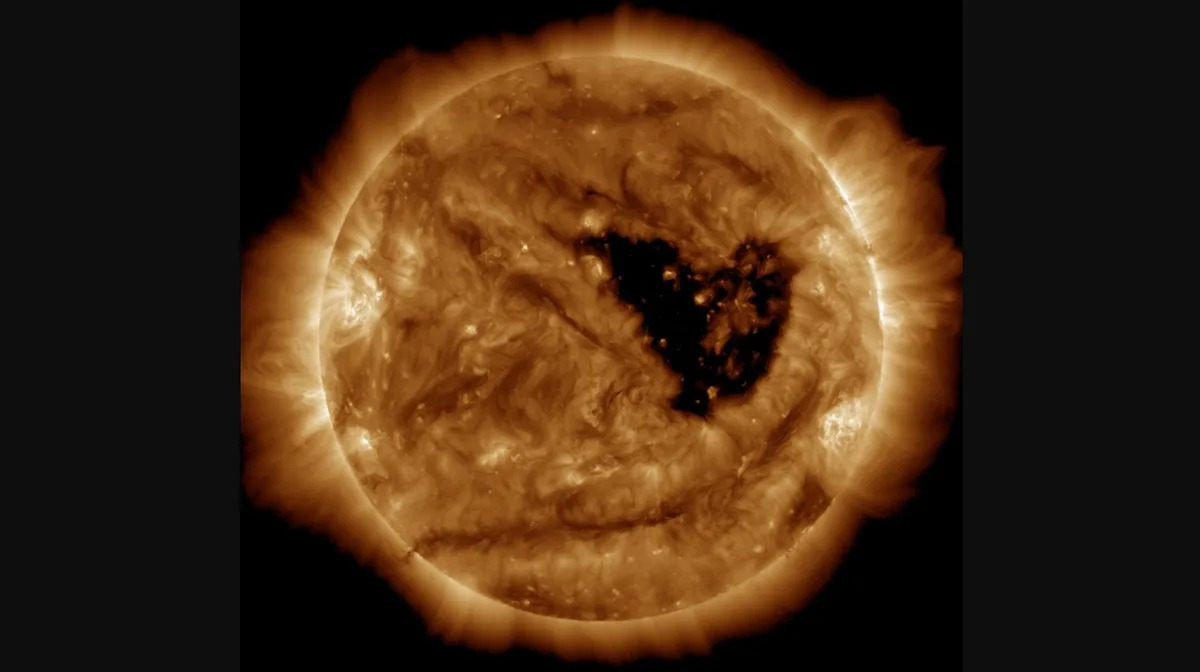
NASA images of a striking butterfly-shaped coronal hole on the sun have been circulating widely on social media this week, drawing attention to a phenomenon that scientists first observed in September.
The feature, captured by NASA’s Solar Dynamics Observatory, stretches close to 300,000 miles across, more than thirty times Earth’s width. Images caught people off guard because of the unusual shape: wide, uneven edges spreading out like wings.
Coronal holes show up often. They are gaps in the sun’s magnetic field where fast streams of particles escape into space. When the September hole faced Earth, it triggered geomagnetic activity that produced brighter aurora in the usual places in the north.
Alaska and much of northern Canada were set up well for it. The farther south you go, the slimmer the chances get, though the Upper Peninsula of Michigan and parts of northern New England have seen surprises during events like this before.
Images of the massive opening went viral on social media, sparking a wide range of reactions and speculation about its potential impact on Earth and satellites. The responses ranged from humorous to deeply concerned.
Many users found comedy in the situation, with one joking, “Stranger things promotion is getting out of hand, they opened the upside down there,” while another quipped, “Now that’s what I call a butterfly effect.” In contrast, others struck a more ominous tone, with one commenter asking, “Why doesn’t this sound apocalyptic enough?”
Another Instagrammer countered with local reassurance, adding, “Don’t worry down here in San Mo we got our own Sun God he’ll clutch up.” One commenter offered their take on the cosmic time scale: “This happened 10 million light years ago btw.”
Nothing unusual is happening with the sun itself. These holes rotate across the surface from time to time, then fade out as new ones form. The shape is the only reason this one is making the rounds online — a quick, strange pattern on a star that rarely gives us anything recognizable.
The renewed interest comes as the sun remains active, with major solar flares this week producing auroras as far south as Florida.
Source: AccuWeather
Read the original article on GEEKSPIN.
Affiliate links on GEEKSPIN may earn us and our partners a commission.