
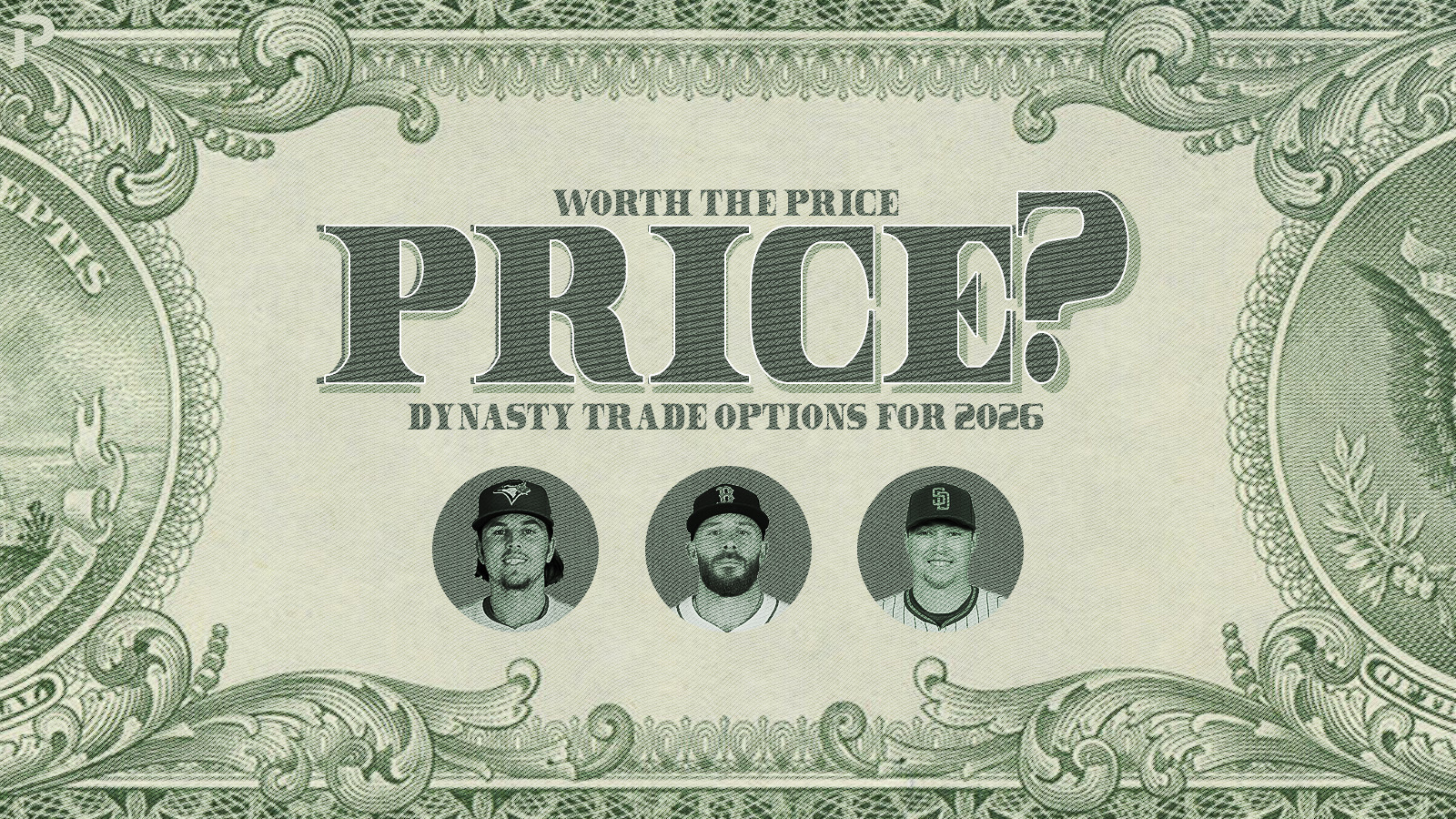
The stove continues to heat up, and the push notifications for updates from baseball’s top reporters have been turned back on. This offseason is already shaping up to be an unorthodox one. The federal charges brought against two Guardians pitchers, with one being one of the best closers in all of baseball, have already plunged this offseason news cycle into uncharted territory. Oh, and there’s a potential work stoppage looming in the not-so-distant future. With everything going on in the baseball world, each team’s decision makers’ jobs have become even more important. The moves that MLB franchises make this offseason could shape their future as the sport moves into a new era.
With that in mind, fantasy managers should be scouring the market looking for opportunities to make their rosters better in the coming months. Unlike my previous article, these players’ values are already high, and are safer bets in comparison to the “more risky” buys from last week. This article aims to address whether the level of production they’ve reached in the past is sustainable, and if they are worth the price of acquiring them. For the major league players, these are trade options for competing managers looking to add immense upside to their rosters for a high price. The prospects are potential targets for managers to ask for on the other side of those types of trades. There are many ways to go about acquiring these players, and many others, but those types of deals were the framework for finding players to highlight.
As always, this is not an exclusive list, and there are undoubtedly going to be others who fall into these categories as the offseason continues. With all that in mind, here are 10 players fantasy managers should “check the price of” in trade deals this offseason.
Major League Trade Options
High Price, Volatile Production
These players are both in the top 100 in current ADP per NFBC, but there are red flags to be wary of. Both players have established track records of fantasy value, but will they hold their price this year?
2025 Stats: 61.2 IP | 2.63 ERA | 44.4% K% | 12% BB%
The Padres’ plans for Mason Miller will be a headline to follow throughout the offseason. The debate rages on: is Miller more valuable as a lights-out closer, or as an electric starting pitcher? There’s no way to know for sure. Either way, Miller is going to leverage his 100+ mile an hour fastball and ridiculously good slider to give hitters nightmares again in 2026.
Miller’s dominance needs no introduction. He led the major leagues in whiff rate (45.2%) and strikeout rate (44.4%), holding hitters to a .249 xwOBA. As good as the fastball is, and it’s really good (.163 BAA), the slider is the true crown jewel of Miller’s game. The high-80s breaker generated a .191 xSLG, .112 wOBA, and 54.6% whiff rate. Those are numbers that would be hard to put up in a video game. However, outside of those two pitches, Miller doesn’t have any other tricks up his sleeve. He only went to his changeup 2% of the time. To be a long-term starter in the game’ current climate, two pitches aren’t going to be enough.
He had a third offering in 2023, when he debuted with the A’s as a starter. Miller tried a cutter at around 95 miles an hour, but it was ineffective (.429 BAA). Hitters struggled to generate extra bases on it, but a whiff rate of 17.5% and .376 xBA was enough evidence to scrap the pitch. I’m not suggesting bringing it back, but the Padres have to do something. Whether it’s a more refined form of the cutter, a splitter, or even a sinker, Miller will need another weapon to be a threat as a starter. Or the Padres could opt to keep Miller’s game the same and use him as a lockdown closer. Robert Suarez’s free agency has left the ninth inning open, and Miller seems in pole position to take the spot. In a vacuum, Miller’s numbers would be more valuable out of the rotation, but once you consider the extra factors, the bullpen makes a compelling case to be Miller’s home.
Am I suggesting giving the same package that the Padres did in real life to acquire Miller in fantasy? Absolutely not. However, there’s reason to open a dialogue regarding acquiring him if you can. Miller’s price is already sky-high as one of the top relievers in the sport. It could go even higher if the Padres pursue him as a rotation option. His brief stint in the rotation for the A’s suggests he can get through the order more than once, as does his playoff dominance of the Cubs this season. If San Diego can find a way to optimize his electric repertoire to maximize his effectiveness as a starter, he’d become one of the most exciting arms in the sport, as if he wasn’t already.
2025 Stats: .263 AVG | .741 OPS | 25 HR | 31 SB | 26.9% K% | 5.0% BB%
Only two (primary) shortstops reached 25 home runs and 30 steals last year, Francisco Lindor and Trevor Story. For the former, this season is just par for the course. For the latter, it’s the culmination of three years of hard work to provide Boston fans with the production they expected when the Red Sox signed him in 2022. Story bounced back from three unremarkable years with Boston in style, posting his best season by power output since he was a Rockie in 2019.
Given that return to form, Story now finds himself in the mid-90s range in terms of ADP, ahead of other shortstops like Bo Bichette, Jacob Wilson, and Jeremy Peña. It could be argued that Story’s combination of elite power and solid speed makes him a more valuable asset, but he also had a 49 wRC+ just two years ago. Again, there were injuries, but who’s to say that the injury bug won’t strike again? In comparison to some of the other names in his range, especially at other positions, there are safer bets. ADP means little in terms of dynasty, but if that’s how Story is being valued, it’s at least worth seeing what other managers would offer for him.
Despite the lofty comparison to Lindor, Story underperformed the former MVP by 25 wRC+ points. That’s largely due to the swing-and-miss issues that Story’s had for most of his career. Story’s 35.3% chase rate and 29.3% whiff rate were both in the 20th percentile last season. There’s room for it to go up, too. His 27% strikeout rate this season is his lowest since his final year with the Rockies in 2021. It’s not impossible to be productive while having swing-and-miss issues, but that ceiling is lowered when you also have a 22% Squared-Up rate and below-average bat speed (71.1 miles an hour). That bat speed might be Story’s saving grace, though. It’s below average, but he made significant strides to improve it in 2025, boosting his swing speed by over two miles an hour. That could be injury-related, as he battled with staying on the field in 2023 and 2024, but it’s an encouraging development either way.
My argument here is not that Story is a productive player. He still poses a legitimate power threat. If the bat speed gains are sustainable, he’ll hit another 20-25 home runs next season. However, he’ll be in his age-33 season as a high-strikeout, low upside shortstop with bad range at the position (-9 OAA). His contract will be hard to or impossible to move, so he’s a safe bet for playing time, but his production in that time is a question mark. Story is a major regression candidate for me. I’d cash in on the top-100 player hype while he’s still marketable.
Value-For-Money with Name Brand Recognition
Both options have made themselves household names in the dynasty community due to breakout seasons in 2025. Should fantasy managers buy in on the hype?
2025 Stats: .243 AVG | .756 OPS | 21 HR | 4 SB | 24.1% K% | 7.2% BB%
Barger’s name-brand value has never been higher after making himself a World Series hero with a pinch-hit Grand Slam in Game 1. Does that mean he’s automatically going to have a bigger role with the organization next season? No, but he put together a solid regular season before becoming a household name, which should be enough to keep him in the Blue Jays’ plans for the immediate future.
After a disappointing 2024 season (.197 AVG, 69 wRC+), Barger found his form as a regular contributor in 2025. He finished third on the roster in home runs, fifth in RBI (74), and seventh in fWAR (2.2) for the Blue Jays team that surprised everyone by winning the AL East. On a roster that included stars like George Springer, Vladimir Guerrero Jr., and Bo Bichette, Barger emerged as a key cog in the offensive machine in Toronto. His effectiveness was limited to the left side of the plate, though. Barger struggled mightily with lefties (69 wRC+) in comparison to his performance against righties (115 wRC+). That platoon possibility undoubtedly will play a role in Barger’s projection for 2026.
Barger’s splits are concerning, which could be a contributing factor to the Blue Jays exploring other options to take his spot in the lineup. The problem is going to be figuring out which position those options have to play. Barger can handle third base and the two corner outfield spots, but is much better as an infielder (2 DRS at 3B vs. -4 DRS in OF). The Blue Jays have been big spenders in past free agencies, and could be even more aggressive to try and get over the hump in 2026. Barger should still have a starting spot next season, but his splits issues and the Blue Jays’ aggressiveness could affect his value in the immediate future.
Out of the four MLB players featured, Barger’s role is the most “insecure” in terms of regular playing time. He’s played well enough to warrant starting him, but it’s not too far-fetched to imagine the Blue Jays coughing up serious money to fill the void left by Bo Bichette in their lineup. Should that replacement play third or in the outfield, Barger’s role could change drastically. Managers who want to target Barger should keep a close eye on the Blue Jays’ actions this offseason before making a move.
2025 Stats: .261 AVG | .866 OPS | 34 HR | 4 SB | 23.5% K% | 9.5% BB%
Depending on which Cubs fan you ask, the 2025 season was either an exciting one that ended in disappointment or a resounding failure. What cannot be debated is that Michael Busch emerged as a key contributor to a team that won 92 regular-season games and four playoff games. Busch finished second in the majors with a 140 wRC+, and was top five in fWAR (3.5), OPS (.866), and wOBA (.369). His 34 homers trailed only Pete Alonso (38) for most at his position.
The underlying numbers show that the production is sustainable. His plate discipline (23.1% chase, 23.5% strikeout) allows him to hunt for pitches he can drive. Once he gets one and makes contact, he does damage. His 17.1% barrel rate is elite (95th percentile), as is his average exit velocity (92.2 miles per hour), and he excels at pulling the ball in the air (22.2% AirPull). He’s not without flaws, though, as his 11% swinging-strike rate leads to a 25% whiff rate despite good discipline. His bat speed is also lower than one would expect from a player with his power (69.8 miles per hour). The Cubs will address that in the offseason, but should be cautious not to compromise the plate approach or bat-to-ball ability in developing swing speed.
Busch is going to be in the middle of a Cubs batting order that’s looking to build on their 31.1 fWAR (3rd in MLB) and 110 wRC+ (6th in MLB). Without Kyle Tucker, that’s going to be a challenge, but players like Busch, Pete Crow-Armstrong, Seiya Suzuki, and more could pick up the slack. Given Busch’s production and the Cubs’ roster situation, he should be treated like a top-10 (arguably top five) first baseman. If you can find a manager with him who doesn’t agree, capitalize on it.
Minor League Trade Options
Set-In-Stone 2026 Contributors
These minor leaguers will be called up to their respective major league teams at some point in 2026. Each player’s value varies, given their organization’s roster build and track record of development. Are they worth trading for despite their high proximity, which increases their value?
2025 Stats: .270 AVG | .804 OPS | 12 HR | 14 SB | 25.1% K% | 11% BB%
Let me preface this right away. Braden Montgomery’s dynasty value is high. However, it’s not as high as some of the other prospects he’s on par with. That might be changing after his impressive Fall League stint, but dynasty managers should consider adding him before it goes even higher.
Montgomery excelled in his first full season of professional baseball. After missing the end of his collegiate career with an injury, he proved he was back to full health. Montgomery posted a 136 wRC+ with 12 home runs and 14 steals between three levels of the minors this year. The key flaw in Montgomery’s game is his whiff rates (14.8% SwStr, 69.8% contact), but the power he’s able to generate with his lefty swing is immense and outweighs those concerns (for now). His glove is solid and should allow him to stick in a corner outfield spot for the foreseeable future, which is beneficial for him given the White Sox’s roster.
The White Sox’s outfield is the team’s oldest position group by far. Andrew Benintendi (31) and Luis Robert Jr. (28) are both back, and Mike Tauchman (35 on Opening Day) is projected to retain his spot. For a team looking to build around a young core, these players simply do not fit into the franchise’s competitive window. Moving Benintendi will be a challenge given his contract, but the other two should have some trade value either this offseason or during the deadline. Should the White Sox make a move, the door is wide open for Montgomery to step into the fray.
Montgomery didn’t generate as much hype as other members of his draft class, but he could prove to be another member of the 2024 first round to be a significant contributor at the major-league level. Montgomery has the tools to be a 25-25 threat, even with the strikeout volatility. Fantasy managers looking to get younger should keep an eye on Montgomery as an underrated dynasty asset.
2025 Stats: 9.1 IP | 10.61 ERA | 26.5% K% | 6.1% BB%
Injury and potential crowding in the rotation have led to some post-prospect diminishment for Lowder. With Hunter Greene and Chase Burns dominating headlines for Cincinnati, it’s easy to forget that Lowder posted a 1.17 ERA in his first six career starts in 2024. He only managed 9.1 innings in 2025, and the results were not pretty.
That sample size is not indicative of the talent Lowder has, though. His BABIP in those appearances was an astounding .448. That mark will undoubtedly regress, and his walk and strikeout rates indicate his arsenal was effective. He’s continuing to work his way back in the Arizona Fall League, where he’s allowed five runs in nine innings, striking out eight, and allowing just two walks. There’s still a long way to go until he’s back to full health and game sharpness, and having a full, healthy offseason will undoubtedly help with that process.
There’s no doubt that Lowder’s arsenal will continue to translate in the majors. All four of his pitches are refined and effective, even if they didn’t generate ideal results in 2025. The fastball/sinker deviation between lefties and righties limits hard contact, and his slider/changeup usage will add to the uneasiness that he’s able to generate from hitters. Health will be Lowder’s biggest issue. If his velocity or stuff takes a step back due to arm issues, then his value as a starter may be diminished. However, if he can fight back, he will showcase the talent he flashed at Wake Forest in Cincinnati’s rotation.
Hunter Greene is still a Red, for now. He’s been floated in trade rumors since the start of the offseason as the Reds continue to avoid big contracts. Should a trade happen, the rotation will have a gaping hole for the Reds to address. There are other options in-house, but none with the upside of Lowder. The 23-year-old is a great “buy-low” option to stash with his middle-of-the-rotation upside.
2025 Stats: .257 AVG | .813 OPS | 21 HR | 9 SB | 27.1% K% | 9.6% BB%
For a player in MLB’s Top-100 prospects, and in the Marlins’ top five, Joe Mack has not received the amount of press and fanfare that exciting young players close to the majors usually get. Mack flew under the radar in 2025, but still posted solid numbers between AA and AAA. For a catcher, Mack hits the ball incredibly hard (93.3 mph EV50) at a consistent rate (9.4% Barrel, 43.1% HardHit). The batted ball data indicate he’s making productive contact (27.3% AirPull), and he has a good understanding of the plate (71.8% Z-Swing). The one area he could be faulted for is his swing-and-miss tendency. Mack’s 32% whiff rate and low walk rate limit the ceiling on an otherwise exciting profile.
Mack has some competition in-house to battle it out with for the everyday catcher spot. Agustín Ramírez mashed 21 home runs last year, but his woeful performance defensively will likely relegate him to a full-time DH role or first base next year. Liam Hicks is a slight upgrade defensively from Ramirez, but Mack’s bat has more upside, and he will likely prove to be better with the glove. He cut down almost 28 base-stealers last year, while posting a .361 wOBA at the plate. With a productive offseason and a strong spring, Mack could be in the fight to break camp as the Marlins’ big league catcher.
Should that reality materialize, Mack could be a viable second backstop in two-catcher leagues from the jump. He has the offensive upside to jump into the top-20 fantasy catchers immediately, and with some refining to his approach, he could get even higher.
Long(er)-Term, High-Upside Options
These players won’t debut in 2026, but their stock could skyrocket this year if they build on their solid performances last season. Are they worth trading for despite the volatility that comes with their stock?
2025 Stats: .333 AVG | 1.096 OPS | 13 HR | 5 SB | 21.9% K% | 17.8% BB%
This is the easiest “yes” to that question I’m going to give in this section. Sirota is going to be a contributor at the big league level. The only questions that remain are when and with whom.
Before injury shut his season down prematurely, Sirota was on pace to be one of the most productive prospects in the sport. He posted a 190 wRC+ with a 1.068 OPS in 59 games between Single-A and High-A. Sirota’s plate discipline was just as impressive as his production. He had a 17.8% walk rate with a 37% swing percentage, while keeping his in-zone whiffs at an acceptable mark (9.4%). He played center field in college, but will likely transition to a corner spot as he continues to develop. If Sirota were with any other big-league organization, he’d be a shoo-in to debut in 2027 at the very latest. However, he’s with the Dodgers.
The Dodgers’ track record with prospects, as stated in previous write-ups I’ve done, is shaky at best. Only six (projected) members of their 26-man roster are homegrown. With another active offseason expected, that number could be even lower by Opening Day. Sirota is among a talented class of outfielders in the minors, but the Dodgers simply do not have room for all of them. At least two will have to be traded, which could be a blessing in disguise, given how the Dodgers have handled other top prospects in the past.
Despite the Dodgers’ track record, Sirota has every chance to prove he’s worth his price. The combination of speed and power, with growing maturity at the plate, sets him up to build off of his breakout 2025 campaign with another impressive season.
2025 Stats: .231 AVG | .853 OPS | 11 HR | 10 SB | 20.3% K% | 16.5% BB%
Six minor league players under the age of 22 posted at least a 140 wRC+ and a .200 ISO while keeping their SwStr% under 10%. Breakout star Sal Stewart is on that list, as are top prospects JJ Wetherholt and Kevin McGonigle. The only other player in that group who has reached AA is the Brewers’ #8 prospect, Luke Adams. Since being drafted in the 12th round in 2022 out of high school, Adams has flat-out mashed at every level of the minors.
Adams’ lowest wRC+ since being drafted was in Single-A in 2023, where he posted a 130. Since then, he’s had a .400+ wOBA and .830+ OPS at every level he spent significant time (excluding an eight-game stint in High-A this year). At Adams’ size (6’4″, 210), it’s easy to see where the power comes from. Adams’ swing generates easy power to the pull side, and he could tap into even more with more development. That power doesn’t compromise his bat-to-ball either, as his 78.6% contact rate and 7.5% SwStr are both positive signs. Adams’ overall game is poised and mature. He’ll take walks, but he still has the ability to put the bat on the baseball and drive it for extra-base hits and home runs.
He also comes with the bonus of being a plus baserunner. Despite his size, Adams can catch people by surprise and steal 90 feet. He has 77 career steals in three-plus professional seasons. Adams won’t threaten that mark in the majors, but it’s a sign that he has good instincts on the bases despite his frame. On defense, he won’t win any Gold Gloves, but he should fit in comfortably at first base. Adams is another exciting prospect in the Brewers’ pipeline of young talent. Given the track record of the organization and the production he’s shown already, Adams is a prime candidate for a breakout 2026.
2025 Stats: 122.1 IP | 3.38 ERA | 29.3% K% | 4.2% BB%
If you vaguely remember this name, it’s because Bratt was the starter for Canada against Team USA in the 2023 World Baseball Classic. That day, he got just one out at allowed six earned runs in a 12-1 win for the Americans, but Bratt’s come a long way since then.
Only six (qualified) pitchers had a better walk rate than Bratt’s 4.2% in 2025. Among the top 25 in that category, Bratt’s 29.3% strikeout rate is an anomaly. It’s over 4% better than the next-best mark, held by Diustin Mayorquin, a 17-year-old in the DSL (not relevant to this piece, but keep an eye on Mayorquin next season —he’s got some filthy stuff from a very over-the-top release point). Since being drafted as a 17-year-old in 2021, Bratt has handled every challenge thrown at him in the minors. He has a 3.27 ERA in 87 professional appearances (78 starts), striking out 450 batters in just over 380 innings. His worst stop was when he posted a 5.45 ERA in his first taste of AA action, and even then, his FIP indicated he was a victim of bad luck (4.26).
The first thing that stands out when watching Bratt is his mechanics. He doesn’t possess elite velocity on his fastball (~93-95 mph), but he extends well, which makes his high-3/4 arm slot hard to pick up. Alongside the heater, he has a mature mix of pitches to work with. His curveball and slider have been tapped as his best offerings, but his changeup has good tunneling action and could force itself into that conversation soon. Overall, Bratt’s simply a strike thrower with good enough movement and deception to get whiffs without compromising control of the zone.
The Diamondbacks will be forced to make moves this offseason. Fourteen members of their projected AAA roster are Rule-5 eligible this winter, and the 40-man roster already stands at 38. Will all of them be selected? No. However, among them is former college standout Ivan Melendez, who has a .821 MiLB OPS and 74 homers in 328 career games (equivalent to 33 HR per 150 games). Bratt and left-handed pitcher Kohl Drake (Arizona’s #6 prospect) are also available. Again, there’s no guarantee they’ll be selected or protected, and Bratt has the upside to contribute to an MLB rotation sooner rather than later.
Should Bratt be selected, his value will undoubtedly be adjusted by the team that selects him. Even if he stays in Arizona, the back half of that rotation has some question marks. Bratt could debut in 2026, and his high-whiff, low-walk profile should entice fantasy managers. He doesn’t have elite stuff, but he’s managed to get outs at every level. He’s worth a flyer in your minor league spots if you can acquire him for cheap.
Bonus: Luis De La Torre
2025 Stats: 74.1 IP | 2.78 ERA | 36.1% K% | 8.9% BB%
De La Torre is a late bloomer, but he dominated in his first taste of professional baseball in the United States. After spending two years in the Dominican Summer League, De La Torre made his way to the Giants Complex League team before dominating the competition in Single-A. In eight starts, he held hitters to a .173 batting average with a 39 ERA-. Among pitchers with at least 70 innings in 2025, he is one of six 22 or under with a strikeout rate above 35%. Trey Yesavage, Payton Tolle, and Jonah Tong are some of the other names in that group.
De La Torre’s fastball will be his calling card as he progresses through the minors. It sits comfortably in the mid-to-high 90s with good life up in the zone. De La Torre’s smaller size (6’0″) and extension make it tough for hitters to pick it up, but it could come undone against better competition. His offspeed offerings will be the key for him to remain as a starter. His changeup is not worth trusting yet, while the slider has good movement if he dials in the control. De La Torre is far from a sure thing, but he has the building blocks to be a fast riser through the Giants’ system next season.
The reason De La Torre falls into the bonus category is that you likely won’t have to trade for him. Depending on your league size/depth, De La Torre could still be on your waiver wire. There is a reason for that, though. His performance in the DSL could be a result of his being over a full year older than the average age of the competition. While he still dominated stateside, it’s a small sample size, which could scare managers off. De La Torre will likely start 2026 in High-A, and a quick promotion to AA could be in order depending on performance. If that materializes, then De La Torre’s hype train will start to pick up steam. Managers with deep minor league roster spots should seriously consider using one on De La Torre before that train leaves the station.