
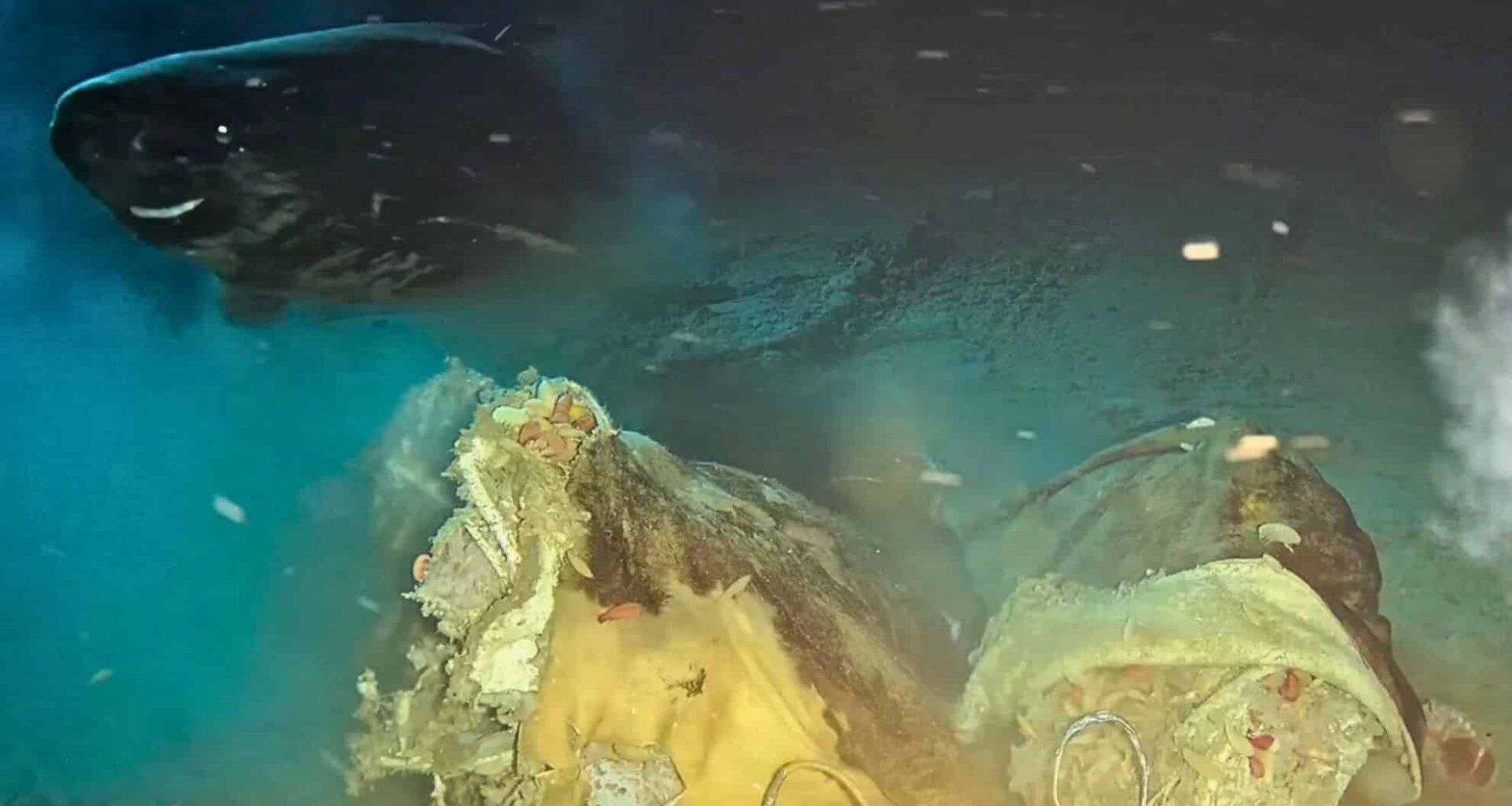
In the shadowy abyss more than a mile beneath the South China Sea, a team of Chinese scientists has recorded something no one has seen before: a Pacific sleeper shark tearing into a cow carcass 1,629 meters below the surface. The event marks the first-ever documentation of this species in the region—an oceanic twist that is already rewriting assumptions about deep-sea ecology.
The footage, captured during a scavenging experiment off the coast of Hainan Island, shows multiple sharks—some over 2.7 meters in length—arriving to feed in coordinated fashion. These predators, typically confined to the cold northern reaches of the Pacific Ocean, had never before been recorded in the subtropical South China Sea. Their appearance suggests a significant shift in range, ecology, and possibly climate adaptability.
But the revelations didn’t stop at geography. Researchers observed distinct competitive behaviors, including queuing, dominance displays, and even eye-retraction reflexes likely evolved to protect the sharks during aggressive feeding. According to the scientists, this behavior suggests a more complex social dynamic than previously understood for deep-sea scavengers.
Sharks Far From Home
The Pacific sleeper shark (Somniosus pacificus) is typically found in cold, deep waters ranging from the Bering Sea to the Gulf of Alaska, and occasionally as far south as Baja California. Its sudden emergence in tropical deep waters represents a remarkable expansion of its known distribution.
To study how large scavengers behave in extreme depths, researchers lowered a cow carcass to a depth of 1,629 meters (5,344 feet) using a submersible camera system. The goal: to attract whatever apex scavengers might be operating at those depths. What they found were not only multiple sleeper sharks, but coordinated behavior and surprising physiological adaptations.
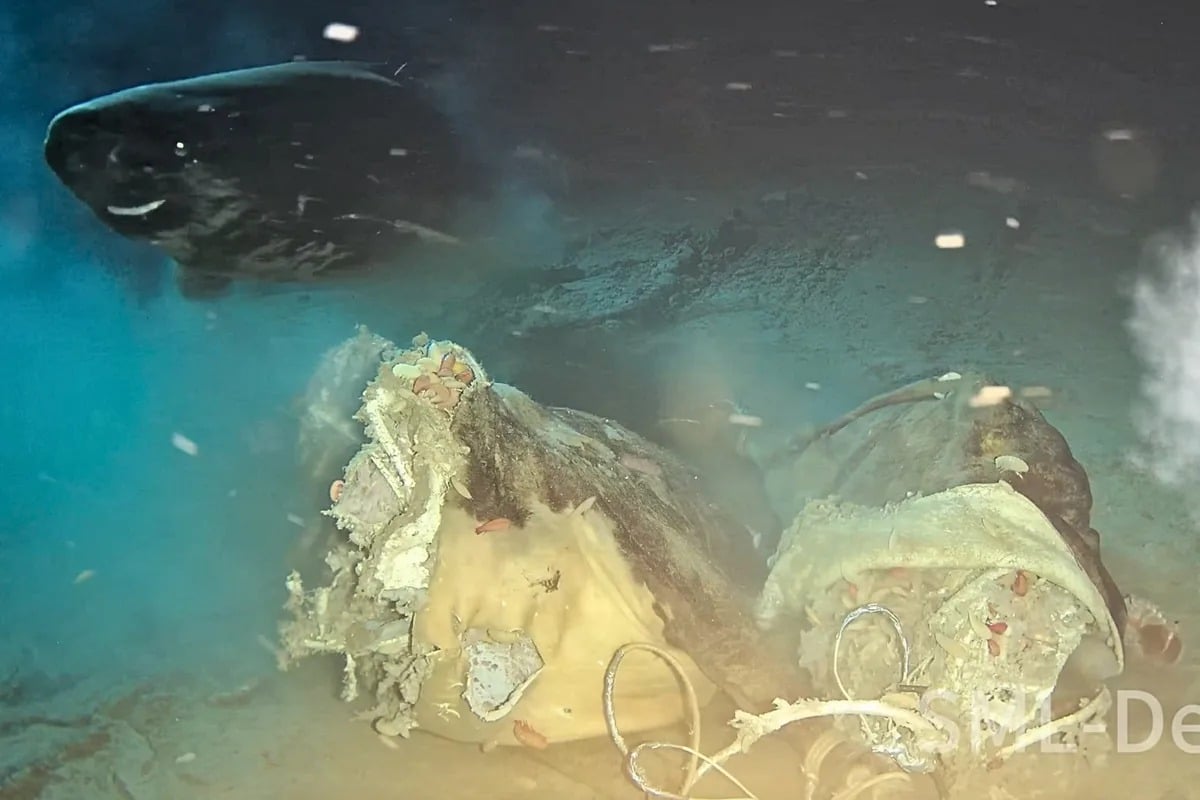 The enormous deep-sea creature, which can grow up to seven metres in length, has never been filmed in this part of the world before. Credit: Ocean-Land-Atmosphere Research
“This behaviour suggests that feeding priority is determined by individual competitive intensity, even in deep-water environments, reflecting a survival strategy suitable for non-solitary foraging among Pacific sleeper sharks,” said Han Tian, one of the lead researchers from Sun Yat-sen University, quoted in Discover Wildlife.
One particularly unusual finding: sharks that arrived later seemed to take precedence over those already feeding. This counterintuitive behavior points to social or energetic hierarchies that remain poorly understood in deep-sea species.
Deep-Sea Predators Show Surprising Aggression
Long thought to be slow, lumbering, and passive scavengers, these Pacific sleeper sharks showed markedly different behavior in the footage. Larger individuals were seen ripping at the carcass, while smaller ones circled more cautiously. Researchers described the feeding as highly aggressive, suggesting the presence of substantial competition even in these extreme environments.
See Pacific sleeper sharks feasting on a cow carcass in the South China Sea. Credit: Ocean-Land-Atmosphere Research
Another standout detail: the sharks displayed a distinct eye-retraction reflex while feeding—an apparent defensive motion to protect their eyes. Unlike many other shark species, sleeper sharks lack a nictitating membrane, a protective eyelid common among more active predators. The retraction may serve as a functional alternative during intense feeding.
These findings challenge widely held assumptions that apex predators in the deep sea are behaviorally simple due to limited energy input. Instead, they point to evolved complexity and even competition-driven aggression at depths where food is scarce and risks are high.
A separate, previously documented observation of a Pacific sleeper shark in the Tonga Trench also showed one individual biting the camera—a reminder of how little we know about their behavior. Watch the Tonga footage.
All-Female Presence Points to Hidden Nursery Zones
Perhaps the most puzzling detail in the South China Sea footage: every shark observed was female. This echoes similar findings involving other deep-sea sharks, including the megamouth shark, which also appears to exhibit a female-biased presence in the region.
Researchers suggest the South China Sea may serve as a nursery ground for some deep-sea species, though more data is needed to confirm this. The discovery of an exclusively female group in such a remote and isolated location raises questions about reproductive migration, regional fidelity, or sex-specific habitat preferences.
Tian added: “The highly aggressive behaviour of sharks observed in the South China Sea suggests that this region still harbours abundant food sources in the deep sea. But what exactly are they? This question is intriguing for both animal distribution and behavioural research.”
In a region better known for geopolitical tension than biological exploration, the idea of hidden reproductive zones for deep-sea sharks may open an entirely new frontier in conservation biology and ocean governance.