

After nearly 11 months of shadowing, sparring, one-upping, and obsessing over one another, year two of the Sinnercaraz era has come to a close. Back and forth Carlos Alcaraz and Jannik Sinner go, using tennis’ most important trophies as batons in a relay race. They have won eight Grand Slams in a row, with two ATP Tour Finals for Sinner and the world No. 1 ranking back in Alcaraz’s lap in their game of pass-the-parcel.
But for a one-legged Novak Djokovic’s climbing inside Alcaraz’s brain to scramble it at the Australian Open in January, he and Sinner likely would have faced off for all four of the biggest titles in the sport in 2025. Instead, they played for three of them, and took turns winning.
After Sinner’s 7-6(4), 7-5 win on home soil in Turin Sunday, the ball is back in Alcaraz’s court for the off-season. Alcaraz played a brilliant match, but Sinner was better than he had been two months ago, at the U.S. Open final in New York — just as Alcaraz was the better player at the U.S. Open, following his loss against Sinner at Wimbledon. And just as Sinner was the better player at Wimbledon, following his loss to Alcaraz at the French Open.
By an hour after the ATP Tour Finals’ end, Alcaraz sounded like he had already begun figuring out with his coaching staff what he needs to topple Sinner the next time they meet, to keep this pattern of victory trades going.
“They will tell me how they saw the match, my weaknesses, my good points, my good things,” he said in his news conference. “I have a few in mind already, which I already told them. The season is almost over, so we have the pre-season already in the corner. I will try to put everything to be better on that pre-season to start the season even stronger.”
As for Sinner, he took a moment to pat himself on the back for showing up better than the last time he looked across the net, but also sounded determined to disrupt the pattern.
“The work we have done was very positive,” he said in his news conference. “If not, you don’t reach these results. December is very important for me.”
Therein lies the ongoing psychodrama at the heart of this rivalry between two players who are friendly but not necessarily friends. Their rivalry has become a game of tennis cat-and-mouse. One of them wins something big; the other figures out why and searches for the edge. Just when tennis thought it was moving into uncharted territory after the dominance of the Big Three, it is back where it was from roughly 2005 to 2010.
Then, Roger Federer and Rafael Nadal were the dominant characters, constantly taking the measure of the other, hunting for the slightest tweak that could provide a one-percent better chance of beating the other.
That rivalry was slightly different from this one, especially in its early years, when Federer was so superior on grass and hard courts and Nadal was nearly unbeatable on clay. There was a distinct similarity, though. Then, as now, Federer, first alone, and then along with Nadal, shouldered the burden of carrying a sport.
During a recent interview, Federer said the position brings a particular, sweeping responsibility.
“You also carry the sports outside of your sport,” he said. “You’re talking to all the sports fans around the world trying to put tennis up on the global stage.”
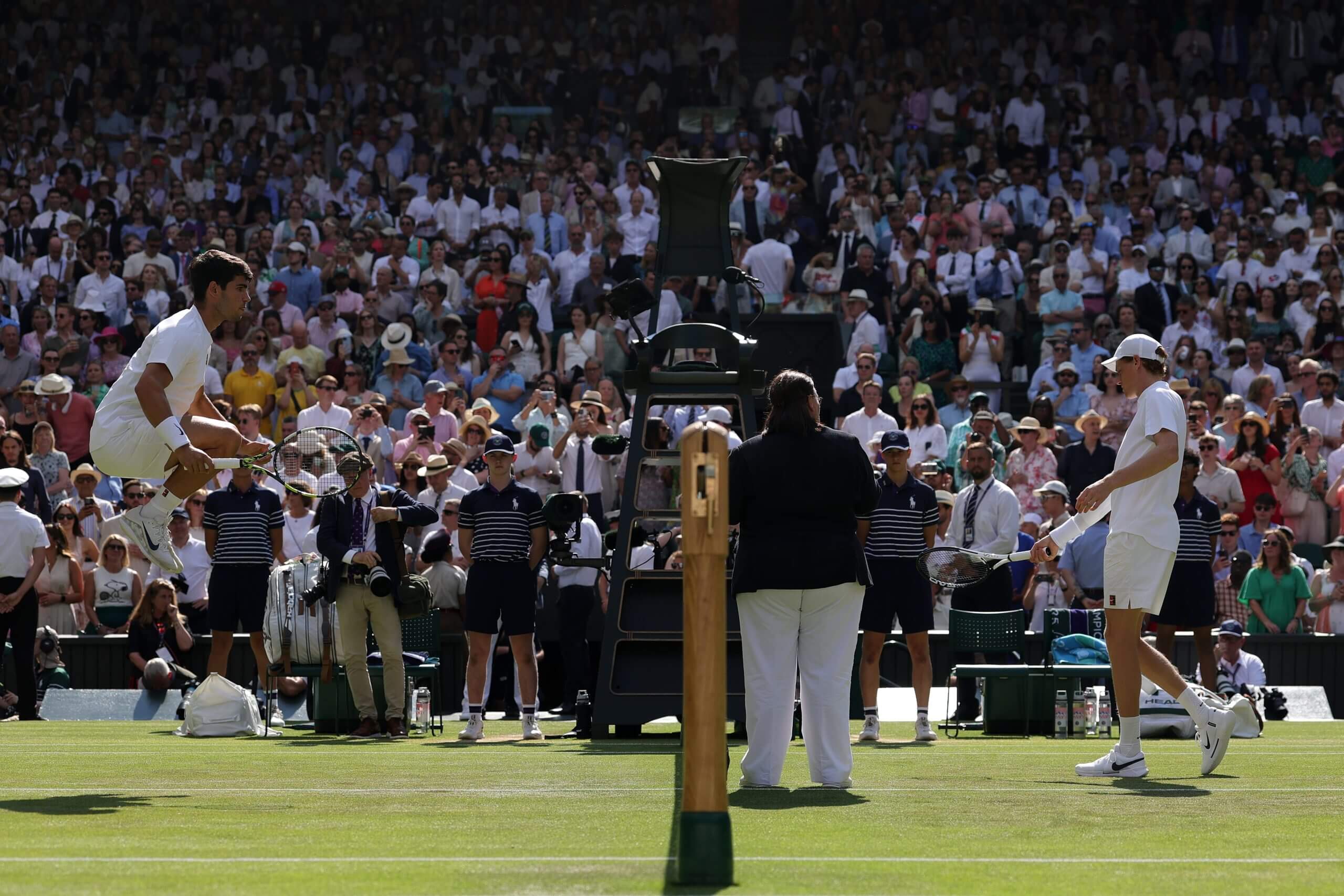
Carlos Alcaraz and Jannik Sinner limber up for the Wimbledon final. (Julian Finney / Getty Images)
As startling as their six matches this year have been, in both good ways and bad, the seeds of those plot twists lie in their interregnums, going back more than a year ago to the China Open final, when Alcaraz obliterated a 3-0 deficit in a final-set tiebreak with seven irrepressible points that left Sinner helpless.
They didn’t play the rest of the year, but Sinner blazed to his first ATP Tour Finals title, and led Italy to the Davis Cup. In January, he won his second consecutive Australian Open. He didn’t play Alcaraz there, but he’d seen in Beijing what he would have to do to get the better of his rival, who had beaten him in all three of their matches in 2024.
For the foreseeable future, Sinner and Alcaraz will factor the other one into nearly every tennis-related move they make. It will happen on the macro level, in terms of tactics and strategy, maybe even scheduling outside of the mandatory tournaments. But it all pales in comparison to how they process the data from the six matches they played against each other this year, especially the three Grand Slam finals and the most recent showdown in Turin.
The final at the Italian Open in Rome came at Sinner’s first tournament after his three-month anti-doping suspension. Alcaraz won another tiebreak with a surge, this time on one point rather than six, and then cruised through the second set. He took brutal advantage of an ailing Sinner early in the Cincinnati Open final, who ultimately retired after five games played and zero won due to illness.
More so than those two, the other four matches hold all the high-value data that two players seemingly fated to circle one another during this first phase of their dominance could want. And their teams acted as one might expect.
“We always make some adjustments because they’re really close,” Simone Vagnozzi, Sinner’s day-to-day coach, said during an interview in Cincinnati in August, “They change something and we have to adjust.”
The first of those matches was the all-timer, standing out arguably beyond every match that has come before. Decades from now, people will still be talking about where they were and what they felt during the five-set, five-and-a-half-hour marathon that unfolded on Court Philippe-Chatrier in Paris through a June afternoon and evening at the French Open.
It will always serve as the ultimate tennis mind-bender, how Alcaraz climbed out of a two-set hole and escaped three match points to prevail in a championship-deciding tiebreak against a seemingly unassailable foe.
Sinner and his team thought they knew. Sinner needed to be bolder and better on the run. When Alcaraz sent him running into the corners, especially on his forehand side, Sinner had to find a way to turn defense into offense.
Five weeks later, Sinner got a measure of revenge, beating Alcaraz in the Wimbledon final. In a tight four-set duel, Sinner was the better player from the baseline, imposing his percussive groundstrokes and throttling Alcaraz’s improvizations.
That sent Alcaraz back into the lab. After months of searching, and some improvement, he finally found true rhythm and a lethal edge on his serve. He tweaked its motion, as well as his forehand and backhand setup, iterating on all three shots to make them as devastating and secure as they could be.
Eight weeks after the Wimbledon loss, Alcaraz duly struck back with a mostly dominant win in the U.S. Open final.
And then it was Sinner’s turn. He made it clear after the loss in New York that he had to be more surprising, both on his serve and off the ground.
He did both of those in Turin. He spot-served as effectively as anyone has all year on break points, and sprinkled in just enough variety, including some nifty lobs in key moments Sunday, to make Alcaraz start guessing about him again.
“All the losses I had, I tried to see the positive thing,” Sinner said, using them as opportunities to force him to evolve. “This happened in a very good way.”
Now he needs to break this budding pattern, and become the player to evolve after a win, rather than a loss. Alcaraz has done that plenty in this rivalry, which is why he has won seven of the last nine meetings and leads it 10-6. The Spaniard will surely bring some innovation to Melbourne, where he has never been past the quarterfinals, and where he goes in search of the career Grand Slam.
“A player like him always comes back stronger from the losses. He always learns from the losses,” Alcaraz said of Sinner. “Once again, he has shown everybody that he did it. Especially in the serve, putting so much pressure on you. It’s really difficult to play against him.”
Enter 2026, the next chapter in this rivalry of evolution and adjustment. And enter Alcaraz, the latest to have the chance to learn from a loss.