
Remember when time capsules were a thing?
For the uninitiated, groups of people nationwide would accrue the items they felt best represented their era, stow said items in a container of some sort, and hide said container to be one day discovered by future generations as evidence of how we once did things on planet Earth.
Think of our SAVE THE CULTURE series as a modernized version of the time capsule. In 2025, a quarter of the way into this pivotal century and nearly 100 years since the iconic Harlem Renaissance — an era that profoundly shaped Black artistic expression and cultural identity — this project feels especially urgent. There is no doubt that many people feel that there are very deliberate attempts by some to erase the contributions of Blacks from history. Whether those sentiments are unfortunate misperceptions or turn out to very legitimate based on very real actions, we felt the need to do our part to ensure that the legacy of Black influence on global culture never fades.
Throughout the summer and fall, our editorial team will be highlighting elements of culture essential to understanding the Black American experience, in genres ranging from film and television to music and literature, and so much more in-between. By spotlighting landmark cultural creativity, we aim not only to preserve and honor the rich legacy of Black culture, but also to inspire ongoing dialogue, foster greater appreciation, and provide future generations with a vibrant record of how our culture thrived at this defining moment in history.
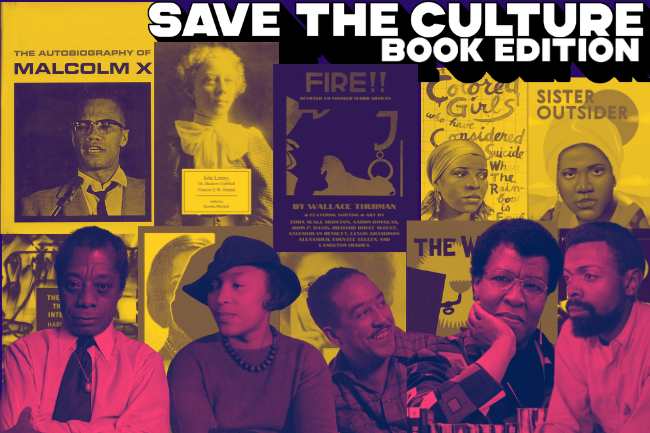
For this issue of the SAVE THE CULTURE series, we reached out to Dr. Tony Medina, director of the Howard creative writing program, to compile a list of 20 essential works of Black literature. Spanning from before the civil war to today and from novels to poetry to plays to critiques, these works are only a few examples of how monumental African American writers have been, from giving voice to the enslaved and oppressed to radically shifting all of literature and inspiring new ways of approaching what it means to be Black.
What books are missing from the list? For example, many would add (BFA ’53), acclaimed author of such books as “The Bluest Eye” and “Beloved” to this list. A renowned author, Morrison was also an accomplished editor at Random House; Dean Dana Williams’ new biography of Morrison, “Toni at Random” details this side of the Howard alumna.
Which books would you add? Send us your essential pieces of literature to magazine@howard.edu.
Fire!! Harlem Renaissance journal (1926)
This communally self-published, literary and arts journal, only published once, announced the major voices and concerns of the writers of the New Negro Movement (known as the Harlem Renaissance). The name, according to co-founder Langston Hughes, was “to burn up a lot of the old, dead conventional Negro-white ideas of the past … into a realization of the existence of the younger Negro writers and artists and provide us with an outlet for publication not available in the limited pages of the small Negro magazines then existing.” With pieces focusing on homosexuality, bisexuality, prostitution, and colorism, it managed to rustle the feathers of its main patrons: the Black bourgeoisie who were concerned with respectability politics rather the independent free thinking of young Black artists. Even W.E.B. DuBois had a problem with the likes of Hughes, Zora Neale Hurston and Wallace Thurman, et al.
For Colored Girls who Considered Suicide / when the rainbow is enuf by Ntozake Shange (1975)
This literary piece, consisting of poetry structured into a theater piece, was groundbreaking in form as well as content. Centering the struggles of Black women, this is a performance piece that has inspired generations of poets, playwrights, and students alike. Weaving stories of seven nameless women, the piece was the second play by a Black woman to reach Broadway and is performed to this day, including a 2022 Tony-nominated revival.
The Weary Blues and The Best of Simple by Langston Hughes (1925, 1961)
These two seminal works mark the work of Langston Hughes, one of the first American poets to successfully integrate the blues musical form into poetry. Langston’s poetry speak to the concerns of Black people historically in a wide range of aesthetic turns, while the stories of Jess B. Semple portray an everyman figure in Black literature able to successfully satirize the major social, political, and historical zeitgeist of the times, which still resonates today.
“The Best of Simple” is available from Macmillan publishers. “The Weary Blues” is in the public domain and can be read for free at Project Gutenberg.
Reflex & Bone Structure by Clarence Major (1996)
Another Black experimental narrative fictional work that stretches the imagination and reality itself. Major takes cinematic, jazz improvisational, surrealistic narrative leaps to examine a love triangle interrupted by a death or murder. Through 433 nonlinear fragments, the unreliable narrator weaves poetry, prose, and even just lists of Black artists, challenging readers notions of genre, character, and African American life.
Originally published by the Fiction Collective, “Reflex & Bone Structure” is available through Major’s website.
Furious Flower anthologies (1999, 2004, 2020)
These anthologies, produced by the Furious Flower Poetry Center, named after a metaphor from Gwendolyn Brooks, encompass three to four generations of Black poetry predating the Black Arts Movement to the present. Housed at James Madison University, since the 90s the center has been a vital space for cultivating and preserving Black poetry. The most recent collection of over 100 poets — accompanied by essays by leading scholars — provides not only a thorough look at the past, but a guide toward the future of Black poetry.
All of the anthologies, along with the publishers, are available on the Furious Flower Poetry Center website.
Cane by Jean Toomer (1923)
Quiet as it has been kept, Cane is a modernist, experimental novel that is frequently overshadowed by white American and European literary modernists. It stands as a major achievement in American literature in general and African American literature in particular, representing a hybrid text (incorporating poetry, prose, and drama) decades before the recent appropriation of the term hybrid. Cane examines the beauty and complexity of Black life in the American South post enslavement.
Originally published by Boni & Liveright, “Cane” is in the public domain and available online.