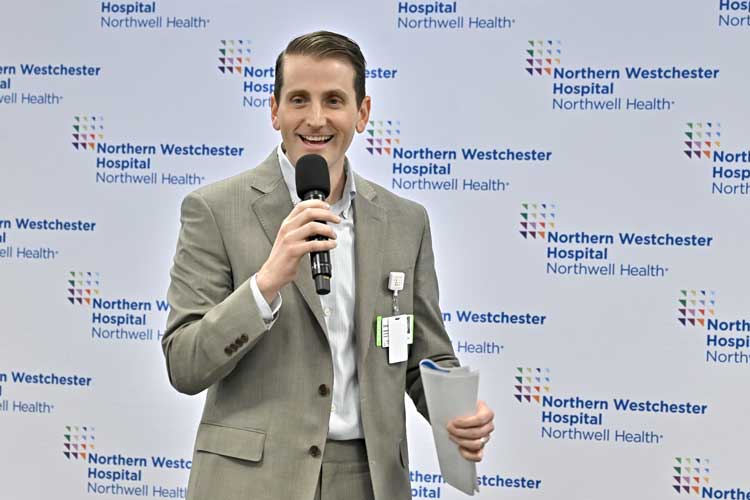
 Derek Anderson, president of Northwell’s Northern Westchester Hospital, discussed the hospital’s relationship with local Optum physicians in a Local Matters Westchester podcast back in May.
This is the 23rd installment in a series launched in December 2022 examining Optum and UnitedHealth, as well as broader issues surrounding corporate medical care.
By Adam Stone
After nearly three years of following Optum’s erratic local adventures – the beleaguered phone system, the alleged upcoding, the patient billing complaints, the doctor exodus, and much more – the organization appears to be approaching an inflection point.
Local physician sources told me last week that Northwell Health is in discussions to assume control of several Optum specialty departments, including urology, surgery and orthopedics.
I contacted both organizations on Tuesday with a list of written questions, and neither took the opportunity to deny what the doctors are telling me. One question I posed was whether there are broader partnership or restructuring discussions underway beyond those three specialties.
“We are committed to providing the best possible and most affordable care for our patients,” an Optum spokesperson replied Wednesday morning to my various questions in an email. “As part of that commitment, we continuously evaluate and work to improve our business to ensure we are delivering high-quality care for people in the communities we serve.”
A Northwell spokesperson initially said he would look into my inquiry and ultimately declined to provide answers. My questions had sought clarity on the scope of any potential Northwell-Optum arrangement, the timeline for the conversations, and what, if anything, patients and the wider community should expect in the coming months.
“Northwell has no comment at this time,” spokesperson Brian Donnelly said in an email late Tuesday. A separate top area Northwell official, asked about the Optum doctor claims, also did not refute the story while declining to comment.
Northwell Health, with more than 104,000 employees, is New York’s largest health‑care system and private employer. Locally, it runs Northern Westchester Hospital, Phelps Hospital and a network of physician‑group practices including Northwell Health Physician Partners and Westchester Health Associates.
LOCAL MATTERS WESTCHESTER
The reported arrangement between Northwell and Optum comes as Optum announced early this month that it is closing roughly 90 medical offices and laying off 572 employees across New Jersey, a contraction that has left thousands of patients deeply unsettled.
Optum patients and providers have recently taken to social media to report sudden layoffs and office consolidations. A post on the Optum Pediatrics Reddit page, for example, claims the company is letting go of part-time pediatricians and nurse practitioners on Dec. 21, giving providers little notice.
“What a horrible company,” the commenter concluded.
Given the cloak of secrecy under which the company operates, and its refusal to answer specific questions, patients and even insiders are left to hunt for digital clues about the future of local care.
Local Northwell, for its part, has been generally more open in its public communication than Optum. Back in the spring, in Examiner Media’s Local Matters Westchester podcast, Derek Anderson, president of Northwell’s Northern Westchester Hospital, described the hospital’s relationship with area Optum physicians.
He acknowledged in the May 15 podcast episode how the two organizations have vastly different cultures, citing Northwell’s nonprofit status and describing Northwell as “fundamentally different than a for-profit entity,” while also praising Optum and the partnership his organization has with it.
He noted that Northwell and Optum share medical staff and patients, which unites the two organizations despite structural differences.
“Optum is a remarkable partner to us,” he said at the time, adding that both groups work to ensure local providers are satisfied and that patient care improves.
Anderson acknowledged that finding a middle ground can sometimes be difficult given the cultural differences and emphasized how many Optum physicians are pleased with Northwell.
“They appreciate the value here and they, I think they would say largely like they’re happy in their profession,” he also said in the episode.
‘FREE TO GO’
But when I had asked Anderson to specify an example of what some of the differences can be between Northwell and Optum, in terms of cultural tension, he made reference to noncompete contracts.
About two years ago, I obtained portions of a contract 264 local CareMount doctors signed in 2020 when the practice was sold to Optum in a deal sources said was valued at roughly $2 billion.
The noncompete was highly restrictive, barring local physicians from practicing within a 20‑mile radius of their primary office for three years if they resigned, a restriction many doctors described as “onerous.” While noncompetes are common, not all health care organizations bind doctors this way, and few impose such suffocating time‑and‑distance constraints.
“If a physician is not happy working at Northwell, they’re of course…free to go anywhere they choose,” Anderson diplomatically pointed out about his organization, in contrast to operators like Optum.
In fact, Anderson also indicated in our conversation that Northwell is keenly aware of and intentional about its role as an employer, a community leader, and as a driver of local economic activity.
“It’s very humbling to consider the fact that we’re typically the largest employer in most communities,” the hospital president said in our May podcast interview. “We take that very seriously.”
THE GOOD DOCTOR
An Optum doctor source of mine, speaking on condition of anonymity through an intermediary given the sensitivity of the internal business matters, expressed enthusiasm about Northwell’s apparent entry into Optum’s local operations.
“Only a matter of time until they take over the entire group, which would be a terrific thing,” the physician said.
The doctor, a veteran of the former Mount Kisco‑headquartered CareMount now owned by Optum, is one of many local health care staff who have said that morale is in the toilet, with operations increasingly strained under corporate ownership, given the all-consuming prioritization of metrics, brief appointments, and the financial bottom line, and the wider profits-over-patients culture that engenders.
As for the intermediary, she said the arrangement between Northwell and Optum is all but certain.
“I’m quite sure it’s a done deal,” the local source said.
If and when confirmed, the Northwell-Optum deal would mark the latest shift in a rapidly consolidating regional health care landscape.
MAN ON A MISSION
While we don’t yet know what the latest news will mean for area patient care, Anderson’s local leadership is well-established.
A Utah native who performed missionary work as a young man in Cambodia and spent four years working in a trauma hospital operating room, Anderson has led Mount Kisco’s Northern Westchester Hospital since 2019, rising through Northwell Health’s ranks and often emphasizing his desire to put patient considerations first.
“Assisting in surgery and learning logistics in a hospital early in my career allows me today to understand the frontline challenges the team faces, and how to empathize and support them better,” Anderson said during a sit-down interview in his office last February.
And on May 7, about a week before Anderson appeared on our Local Matters Westchester podcast, Northwell and Nuvance, a nonprofit regional health system serving New York and Connecticut, formalized a mega-merger, creating a 28-hospital network and a $22.6 billion budget.
“Joining forces with Northwell Health strengthens our ability to meet the evolving needs of patients and ensures we can provide exceptional care for generations to come,” Nuvance Health President and CEO Dr. John M. Murphy stated at the time.
In the May 15 episode of our Local Matters Westchester podcast, I asked Anderson to elaborate on his system’s culture and approach to patient care. He offered insight on why Northern Westchester Hospital patients can often feel far better about their health care experiences than when they visit for-profit, corporate operators.
“We live in this community and we have a very personal interest in doing the right thing and that is the culture that distinguishes us from a lot of entities,” he said.
While many worry about a consolidation of medical power, whether in the hands of a corporation or a nonprofit, few speak more thoughtfully than Anderson about the real benefits of what a large organization can deliver, when run right.
‘FUNDAMENTALLY DIFFERENT’
He highlighted the Nuvance merger as an example, describing it as a move to integrate care across New York and Connecticut. He talked about the benefits of having specialists under one roof, streamlined communication, and coordinated care from diagnosis through treatment.
“Unless you have an integrated system that can manage the complexities of all of that for you, it feels really hard and really clunky for a patient to manage that,” he observed.
And unlike the Optums of the world, he said Northwell’s nonprofit approach allows local health care leaders like him to operate under an incentive structure where service remains the top priority, while also keeping sustainability in mind.
“The only incentive I have is…to improve quality, make it an amazing place to work so we attract the best talent and fill the gaps of clinical needs in our community,” Anderson said. “That’s what I’m held to as a CEO in Northwell, as a president of a hospital in this community. So I think that’s just fundamentally different than a for-profit entity.”
STRAYING
As for Optum’s parent company, UnitedHealth Group, it is a roughly $300 billion insurance and health‑services giant headquartered in Minnesota.
The revolting assassination of UnitedHealthcare CEO Brian Thompson last December (and the vile celebration of the murder in far too many quarters, along with the steep collapse in UnitedHealth’s stock price) became a watershed moment in the industry.
And notably, Optum’s recent retrenchment in several areas has drawn widespread attention.
A report from Becker’s last week said Optum Health is scaling back its rapid expansion to refocus on its core “value-based care model,” a system meant to reward doctors and hospitals for keeping patients healthy rather than just for the number of tests and procedures they perform.
The company’s strategy has “strayed from the initial intent of the model,” CEO Patrick Conway acknowledged late last month, on an Oct. 29 earnings call.
As for our neck of the Westchester woods, I reported late last year on the fallout of the region’s Optum‑run lab services being sold to Quest Diagnostics on Sept. 30, 2024.
SHH…
Northwell certainly isn’t without its critics either.
For instance, the organization has drawn criticism from some nurses and union officials for staffing shortages, heavy administrative demands, and what workers see as an overemphasis on metrics and centralization, even as tight margins squeeze hospitals statewide.
“Despite the increase in demands, Northwell has refused to hire more nurses and work to retain the experienced nurses that are already here,” a Long Island union president, Joanne DeAntonio, stated in a Feb. 26 press release.
The New Hyde Park-headquartered organization generated $18.6 billion in revenue last year, operating with just a 1.6 percent margin, and now faces Medicaid cuts under President Donald Trump’s so-called “Big Beautiful Bill,” which threatens hospital financial health across New York and the country.
Northwell also just enacted a major leadership change. The organization named Dr. John D’Angelo, a longtime system executive and emergency‑medicine physician, its new CEO on Oct. 1, succeeding Michael Dowling, now CEO emeritus.
A local physician I recently spoke with said that while Northwell has largely done a good job preserving Northern Westchester Hospital’s local feel and culture, smaller doctor groups now under Northwell complain about administrative pressures and limited autonomy.
Separately, some Phelps Hospital workers in Sleepy Hollow have told me they’ve lost the old sense of being a community hospital.
While experts note that large groups have become necessary to handle tight margins, regulations, and tech demands, their size often creates major patient problems, making it harder to ensure careful, attentive care.
There’s also just a lot of general mystery and uncertainty for patients around what’s unfolding.
Here locally, Halston Media recently reported how the Optum multi-specialty center in Somers was set to close this month, with physicians and staff relocating to the Optum Medical Care facility in Mount Kisco.
“As part of our routine business, we evaluate our operational footprint to ensure it reflects how and where care better serves our patients,” a spokesperson told editor Tom Walogorsky in an Oct. 31 article.
LAST WORD
As for recent headlines, the latest developments all add weight to what we’ve been hearing in the area, and the growing bipartisan backlash against medical care being run by corporations instead of doctors.
Optum’s New Jersey closures weren’t just another news item. They wiped out about 90 clinics, abruptly ending mental- and behavioral-health services across the state, along with pediatric and many specialty-care offerings. Thousands upon thousands of patients were left confused and frantic by the sudden, head-spinning change.
“Our doctor isn’t being placed anywhere else, so it’s really frustrating ‘cause we’ve developed this relationship with her and we love her,” patient Niki Westra told CBS News for a Nov. 7 report.
When it comes to the Northwell Health-Nuvance merger, the significance can’t be overstated. The deal united two large nonprofit systems, with proponents saying it will improve coordinated care, backed by a $1 billion commitment by Northwell to invest further in Nuvance services.
Anderson, who was not made available to comment for this column, sounded a hopeful note in our May podcast interview.
“You look at the market as a whole,” the hospital president said, “and health care continues to be more fragmented in general. This is a complete counterbalance to that.”
And at least some local Optum doctors feel like something of a cavalry has arrived. If Northwell steps in, those physicians see real potential for an upgrade.
From a distance, it strikes me that even just a boost in health care worker morale would ultimately benefit us patients.
That said, we don’t yet know what widening consolidation will lead to, for better or worse.
Yet one thing is definitely clear: all of this requires our close attention.
I’ve given up predicting exactly when new Sick Care episodes will be ready – they’re in our producers’ capable (and overloaded) hands – but you can still listen to Episode 1 here, in case you haven’t yet heard the fast-moving first 20 minutes.