
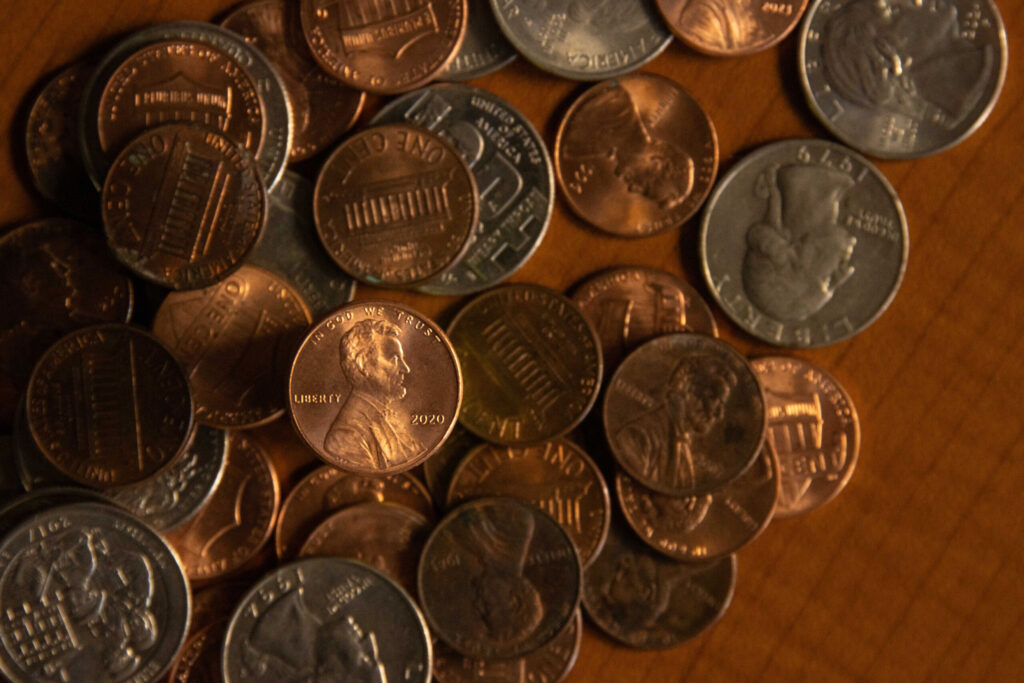
The U.S. Mint ceased production of the penny on Nov. 12, although experts expect the coin still will be in your mix of change for years to come. (Photo by Sam Cohen/Capital News Service)
By Mary Burke
WASHINGTON – Earlier this month, the last-ever penny was minted in Philadelphia. Here’s what this means for Maryland consumers, businesses and collectors.
The Nov. 12 end to production of the penny had been in motion since February, when President Donald Trump announced he had met with Treasury Secretary Scott Bessent to discuss the cancellation.
“For far too long the United States has minted pennies which literally cost us more than 2 cents,” Trump posted on Truth Social. “This is so wasteful!”
Rising costs in the production of one-cent coins played a large role in the decision, the U.S. Mint said. Over the past 10 years, the cost to produce a penny has risen from 1.42 cents to 3.69 cents per coin.
“Economic and production factors, combined with evolving consumer behavior, have made its continued production unsustainable,” the U.S. Mint said in a statement.
Around half of consumers agree, according to a February survey from the National Association of Convenience Stores.
Although the idea has been circulating for decades, this marks the first time that the Treasury Department has made that final call in discontinuing the one-cent coin.
The end of penny production is expected to save the Mint around $56 million a year.
What happens now?
The penny still will remain in circulation and be accepted as legal tender for the foreseeable future. Stores are expected to round cash transactions to the closest 5 cents, but this may ultimately prove unnecessary, given that enough pennies still remain in circulation.
The U.S. Mint produced over 3 billion pennies in 2024, adding to the 300 billion pennies currently in circulation.
SUBSCRIBE: GET THE MORNING HEADLINES DELIVERED TO YOUR INBOX
Legislation has been introduced in the House to help ease the transition by codifying guidelines for businesses, but the bill has yet to be voted on. The Common Cents Act was introduced in April by Rep. Lisa McClain (R-Mich.) and is eligible for House consideration within the next few months.
The law would “provide the guidance and regulations needed to help stores, banks, and consumers make a smooth transition while modernizing our currency policy,” McClain told Capital News Service in a statement.
Canada implemented similar rounding recommendations after discontinuing its penny in 2012, also maintaining the coin as legal tender despite halting production.
Among the 21 countries in the European Union sharing the euro as the common currency, the minting of one-cent coins (and two-cent coins) has been discontinued in eight nations: Belgium, Estonia, Finland, Ireland, Italy, Lithuania, the Netherlands and Slovakia.
Getting rid of pennies or their equivalents has been a global trend.
Australia hasn’t had one-cent and two-cent coins since 1992. New Zealand jettisoned both coins in 1990. Mexico stopped minting the one-centavo coin in 1992. South Africa ended one-cent and two-cent coin production in 2002. Brazil said farewell to its one-centavo coin in 2005.
The United Kingdom, meanwhile, hasn’t given up yet on its one-pence coins.
Impact on local businesses
Maryland Local Businesses, an organization supporting small businesses across the state, maintains that the end of the penny will have minimal impact on owner and customer experiences.
“Consumer transactions are predominantly credit card-driven … so they can still price things that way,” said Connor Edwards, marketing director of Maryland Local Businesses.
Cindy Calhoun, owner of a Washington-area souvenir penny machine company, known to collectors as “elongateds,” is not very concerned about the impact on her business.
“As with all things, we learn to adapt to changes and I expect the hobby of collecting elongateds will continue to grow and adapt,” Calhoun told CNS in a statement. She theorizes that many machines will transition to pre-loaded blank copper, or convert to stamping dimes or quarters.
Others, however, are more skeptical about the policy’s implementation.
“The way the U.S. went about it was thoughtless and without consideration,” said Chris Russotti, a Virginia coin collector. “The government did not pass any legislation or provide any guidance for how to handle transactions going forward.”
A group of national trade associations wrote to congressional finance committees in September about the lack of federal guidance.
Stores across the country are hoping for guidelines on rounding, handling Supplemental Nutrition Assistance Program (SNAP) purchases and check-cashing.
“If these remedies are not addressed in short order, it will be challenging to legally engage in cash transactions with customers in growing swaths of the country,” the letter warned.
Impact on penny’s value
“I do not think the value of the penny will rise” among collectors, Russotti said, citing the massive supply of coins already available.
Edward Van Wesep, a professor at the Leeds School of Business at the University of Colorado Boulder, shares this opinion.
“I doubt that they will ever be worth anything more than a penny, and the value of a penny goes down every day due to inflation,” he said.
However, some collectors mourn the penny’s demise.
“I enjoyed buying boxes to go through,” Russotti said. “I’m saddened that I can no longer buy them from a bank.”
“It’s a strange feeling after well over 200 years for it to be over,” said “Twosheds” Gabbard, a Louisville, Kentucky, collector.
– Capital News Service is a student-staffed reporting service operated by the University of Maryland’s Phillip Merrill College of Journalism. Stories are available at the CNS site and may be reprinted as long as credit is given to Capital News Service and, most importantly, to the students who produced the work.