
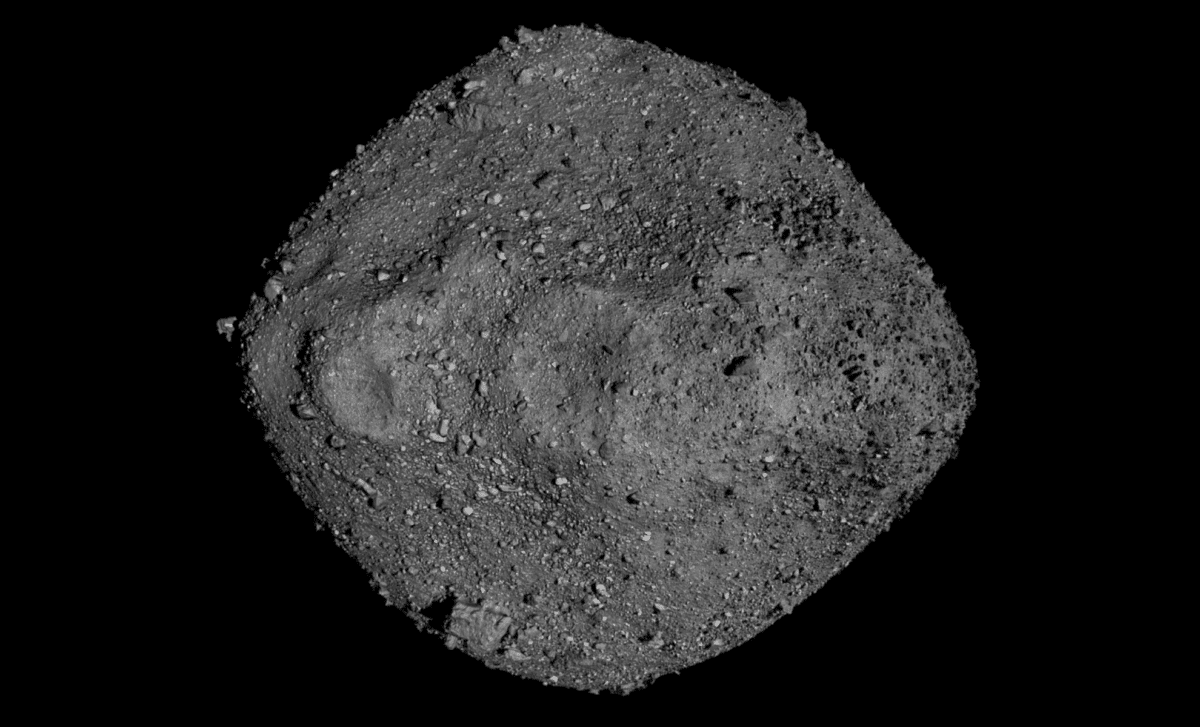
NASA’s OSIRIS-REx mission has revealed a striking new clue in the puzzle of life’s origins. A small rock sample collected from asteroid Bennu contains traces of tryptophan, a complex amino acid rarely found in space materials. This marks the first time tryptophan has been identified in an asteroid sample, and the implications reach far beyond our solar system.
The discovery, detailed in a study published Monday in the journal PNAS, suggests life’s building blocks may have been delivered to Earth ready-made by ancient space rocks.
A Complex Clue in a Cosmic Time Capsule
The detection of tryptophan in material collected directly from asteroid Bennu is a rare and exciting breakthrough for planetary scientists. Tryptophan is one of the 20 amino acids that form the proteins in every known lifeform. Its presence in a celestial object, untouched by Earth’s atmosphere, opens a new window into the chemistry of the early solar system and, potentially, the origins of life itself.
“Finding tryptophan in the Bennu asteroid is a big deal, because tryptophan is one of the more complex amino acids, and until now it had never been seen in any meteorite or space sample,” said José Aponte, an astrochemist at NASA’s Goddard Space Flight Center.
Aponte coauthored the study published Monday in the journal PNAS, which analyzed just 50 milligrams of Bennu material—an amount smaller than a fingernail clipping, but rich with insight.
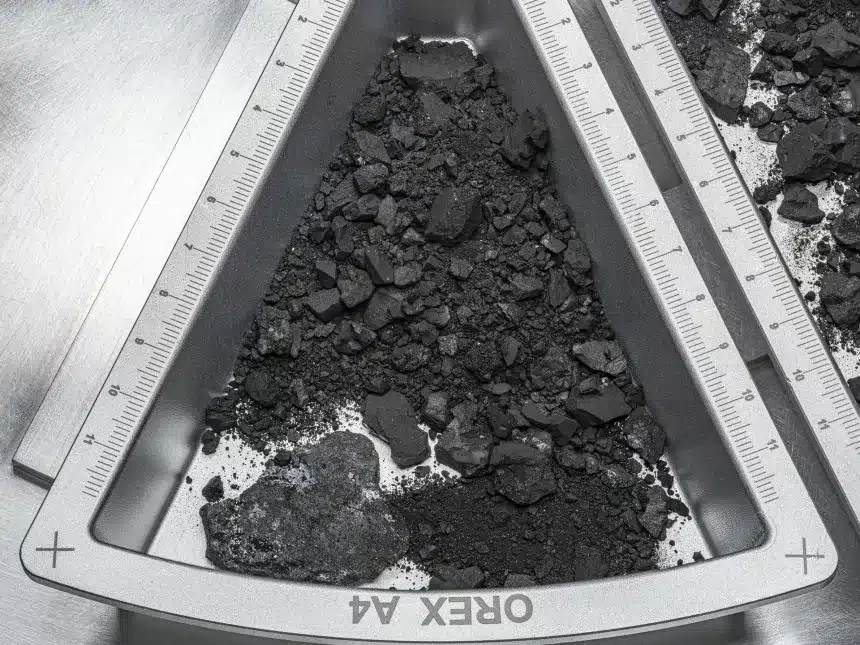 A container holding rocks and dust from asteroid Bennu. Credit: Erika Blumenfeld and Joseph Aebersold/NASA
Tryptophan belongs to the category of essential amino acids, which the human body cannot produce and must acquire through diet. It had previously never been detected in any meteorite or returned space sample, making its appearance in Bennu not only novel, but deeply significant. Its complexity had led many to assume it couldn’t form naturally in space environments. This find challenges that view.
The implications of this detection reach into the core of astrobiology: if such complex amino acids can be synthesized in space, then life’s raw ingredients might be more widespread than previously believed.
Life’s Building Blocks Born Among the Stars
For researchers, the real value of OSIRIS-REx’s mission lies in the purity of the sample. Unlike meteorites, which endure scorching atmospheric re-entry, Bennu’s material arrived on Earth untouched. “Because OSIRIS-REx returned these samples pristine, we’re finally seeing the fragile salts, minerals, and organics that meteorites lose on entry,” explained Dante Lauretta, a planetary scientist and study coauthor from the University of Arizona.
This pristineness preserves a chemical snapshot of conditions from the very beginning of the solar system—more than 4.5 billion years ago. “Bennu preserves a collection of distinct chemical systems and together they show that small bodies were dynamic, organic-rich systems long before life emerged on Earth,” Lauretta added.
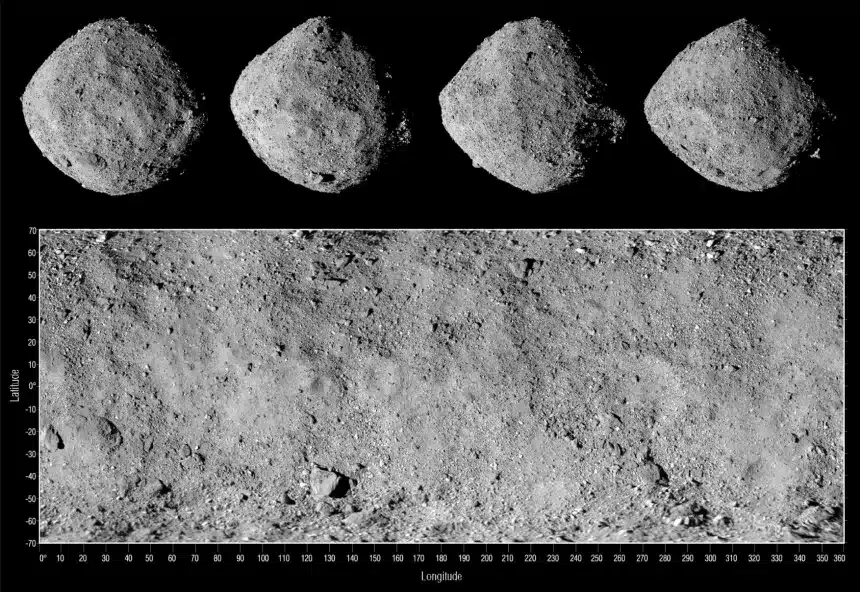 These images, taken by the OSIRIS-REx spacecraft’s PolyCam camera in 2018, show four views of asteroid Bennu along with a global mosaic.
Credit: NASA/Goddard/University of Arizona
The asteroid itself likely formed in the main belt between Mars and Jupiter, breaking away from a larger parent body up to 2 billion years ago. It has orbited near Earth for at least 1.75 million years and is now considered a “time capsule” from the birth of the planets.
The discovery adds tryptophan to the list of 15 protein-forming amino acids identified on Bennu—out of 20 known to Earth biology—hinting that asteroid chemistry may mirror early Earth conditions more closely than imagined.
Unassembled Pieces From A Prebiotic Puzzle
The presence of organic molecules on Bennu, including ammonia and other key compounds, builds a stronger case for the theory that asteroids delivered life’s ingredients to Earth during its formative period. This idea has gained support from previous missions, such as Japan’s Hayabusa2, which retrieved material from asteroid Ryugu that also contained amino acids.
“They’re like jigsaw pieces that are not yet assembled,” said Angel Mojarro, lead author of the new PNAS study and an organic geochemist at NASA Goddard. “What this is telling us is that many, many of the building blocks of life can be produced naturally within asteroids or comets, and finding tryptophan expands the alphabet of amino acids that are produced in space and could have been delivered to the Earth.”
Scientists now believe these molecules may have formed before our solar system even existed, cooked into existence in the fiery deaths of ancient stars—supernovae—then further modified through solar radiation and cosmic collisions over eons.
These insights are reshaping long-held assumptions about the origins of life. Instead of life arising from scratch on Earth, it’s increasingly possible that some of its ingredients arrived already mixed—though not yet assembled—aboard early space debris.