
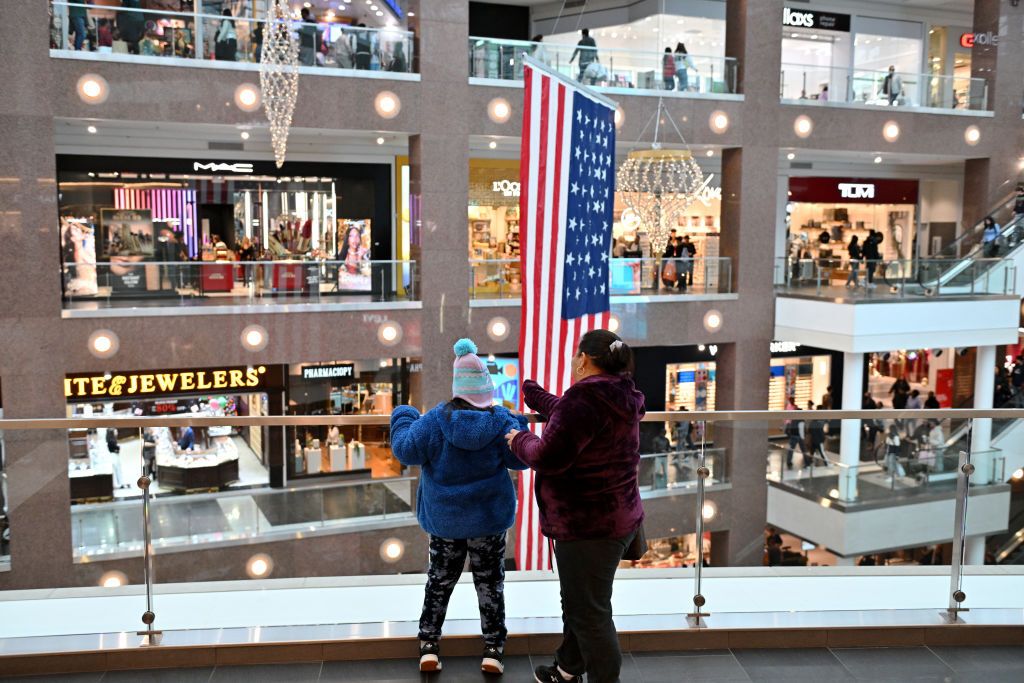
Virginians plan to dial back holiday spending this year, trimming budgets by about 5% even as the broader economy shows strong growth, according to a new Institute for Policy and Opinion Research survey at Roanoke College.
This article was reprinted with permission from Virginia Mercury.
Virginians plan to dial back holiday spending this year, trimming budgets by about 5% even as the broader economy shows strong growth, according to a new Institute for Policy and Opinion Research survey at Roanoke College.
The poll found that households expect to spend an average of $1,035 this season in Virginia — down from last year — and they’re shifting how they spend, putting more toward gifts while cutting back on personal purchases and experiences.
That pattern echoes national signals of caution. According to the latest Gallup poll, Americans expect to spend about $1,007 on holiday gifts this year, nearly unchanged from the $1,014 forecast last year.
Meanwhile, the Deloitte 2025 Holiday Retail Survey found U.S. consumers plan to spend an average of $1,595, a 10% drop from 2024, indicating restraint in spending on goods and experiences.
A shift toward “core” holiday spending
The Roanoke College survey, conducted Nov. 9–14 among 912 Virginians, shows a clear recalibration.
Planned spending on gifts is up 10.6%, while personal, non-gift purchases — such as apparel, electronics and home décor — are down 16.5%. Spending on experiences like dining out and entertainment is down 19.6%.
That shift toward essential holiday traditions mirrors national patterns: consumers preserving the emotional center of the season while scaling back discretionary extras.
Analysts attribute this to price pressure, job market concerns and tariff-driven cost increases.
“Holiday spending plans reflect a balancing act between optimism and caution,” said Dr. Alice Louise Kassens, senior analyst for IPOR and dean of Roanoke College’s School of Business, Economics, and Analytics.
“While the economy shows strong headline growth, households are tightening overall budgets, reallocating dollars toward gifts and away from non-essential purchases and experiences.”
Income brackets also shape spending expectations in Virginia.
Fewer households plan to spend between $100 and $500; instead more are at the low end (under $100) or high end (more than $1,000). Lower-income households are concentrated in lower spending tiers, while higher-income Virginians more often expect to spend above $1,000.
Strong GDP, softer labor market
The new survey arrives against a complex economic backdrop.
National GDP growth remains strong: the Federal Reserve Bank of Atlanta’s GDPNow model estimates annualized quarterly growth at 4%. That underscores consumer spending’s role — roughly 70% of the total economy.
Yet households may not feel that strength. Year-over-year inflation is at about 3%, and labor-market indicators are showing softening relative to 2024.
Those conditions align with national consumer-sentiment readings. While spending intentions remain elevated, confidence is cautious. Tariffs are adding cost pressure in import-heavy categories such as apparel and electronics — items Virginia households say they’re cutting back on.
In fact, “the continued shift to online shopping, accounting for more than half of planned holiday purchases, underscores consumers’ desire for convenience and value in a season marked by uncertainty. For small businesses, this trend highlights the importance of digital presence and competitive pricing to capture holiday demand,” Kassens said.
Digital continues its climb
Digital shopping is now the dominant channel in Virginia. The IPOR poll found that 56% of planned holiday purchases will happen online, up four points from 2024.
That mirrors national retail-industry forecasts: in the U.S., the National Retail Federation expects total holiday retail sales (excluding autos, gas and restaurants) of $1.01–$1.02 trillion this year — a 3.7%–4.2% rise over 2024.
For Virginia retailers, that means refining digital offerings and value messaging could be key. “Consumers are celebrating the season, but with sharper priorities and a watchful eye on costs,” Kassens said.
Overall, the IPOR survey paints a picture of Virginians trying to reconcile the mixed signals of the current economy. While GDP growth is robust, price levels and job-market clouds are giving households reason to pause.
Across the country, many shoppers say they plan the same or lower spending compared to last year: Gallup found 56% of Americans expect to spend about the same, 23% less.
Other national studies capture that same tension. Deloitte’s survey found 77% of respondents expect higher holiday prices and 57% anticipate a weaker economy in 2026.
Many are employing value-seeking behavior: trading down brands, waiting for deals, and making DIY or handmade gifts.
“Retailers should anticipate strong demand for early online promotions, streamlined delivery options, and competitive pricing strategies as consumers seek value and efficiency,” Kassens advised.