
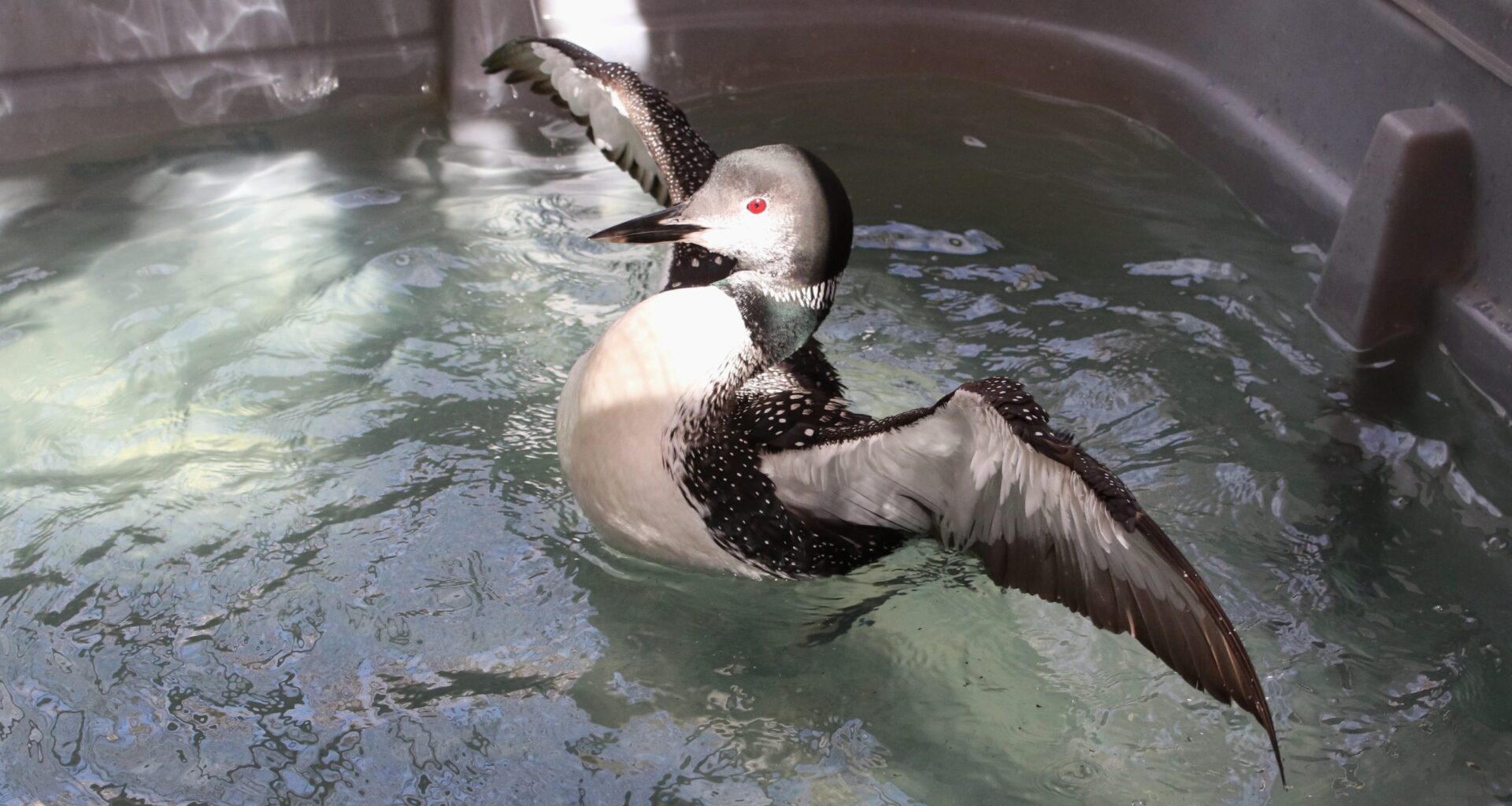
On Monday, Oct. 20, a text came in that afternoon about an adult loon that was seen on Mill Pond in Brant Lake. It was swimming mostly on its left side, indicating that something might be wrong with the bird.
In response, on Tuesday morning, Ellie George, a summer loon monitor with the Adirondack Center for Loon Conservation and year-round loon volunteer, paddled Mill Pond to check the loon. A picturesque, small shallow pond in the center of the village of Brant Lake, Mill Pond is formed by damming the outlet of Brant Lake at both the upstream and the downstream ends of the pond. Below the downstream dam, the outlet brook flows under Rt. 8. Thus, even if nothing was physically wrong with it, this loon was stuck on a pond too small for it to take flight without a very strong head wind, as loons need ~400 meters of open water to run across to get airborne.
Ellie found the loon searching for fish below the upstream dam. It was constantly peering into the water and occasionally would dive but quickly come up without a fish. It might have been catching small fish that it swallowed underwater, but it seemed to be desperately fishing. The loon swam right toward the canoe, and as it passed by, seemingly unafraid, Ellie noticed something white on its right leg. Her observations and photos quickly showed that the loon had a white fishing lure hooked to its right foot, which was preventing it from swimming with its right leg.
That afternoon, Ellie was joined by Nina Schoch, a long-time loon scientist, veterinarian and wildlife rehabilitator; Julie Harjung, a retired forest ranger; and Griffin Archambault, a biologist with the Adirondack Center for Loon Conservation. The plan was to capture the unlucky loon to remove the lure and move it to a larger lake where it could take flight to continue migrating.
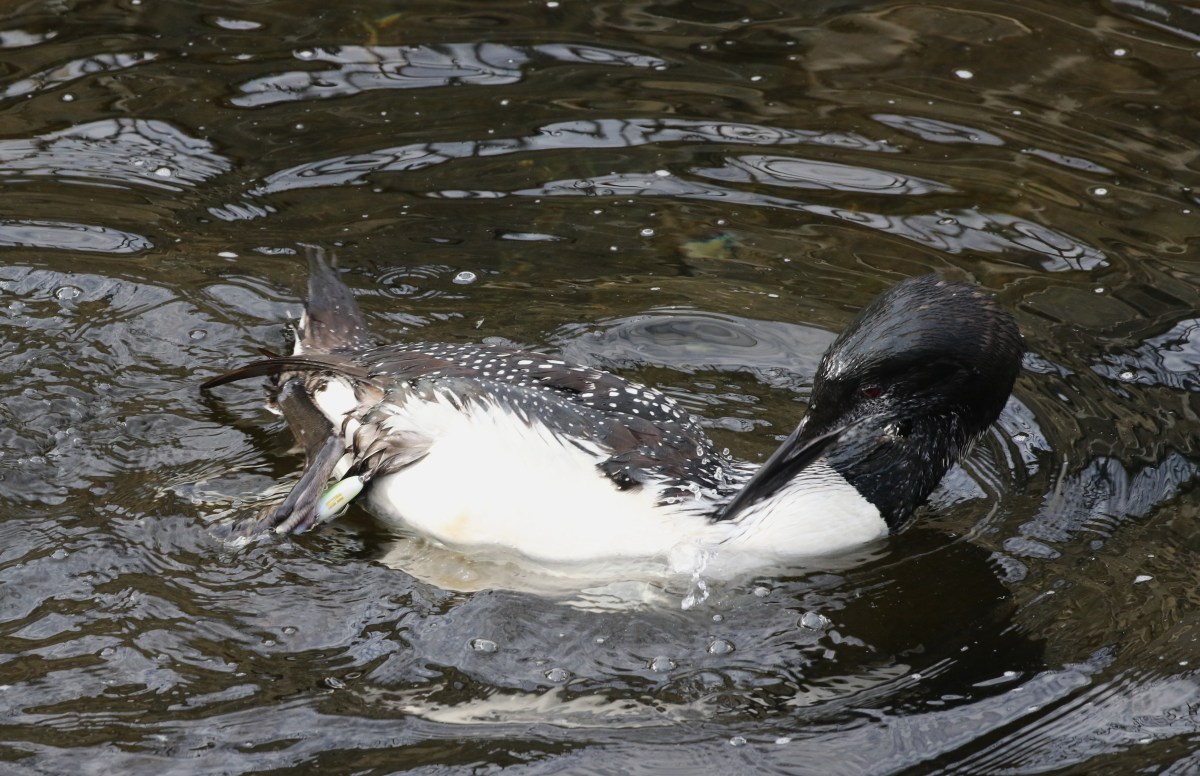 Dammit had a fishing lure stuck to her leg, making it difficult to swim and fish. Photo provided by Ellie George.
Ellie arrived back at Mill Pond first and searched for the loon from shore. However, it was nowhere to be seen! She was about to put her canoe in to search by water, when she had a thought—did the loon wash over the outlet dam?
She walked to the edge of the lower dam, peered over, and quickly spotted the loon in the plunge pool at the base of the dam preening its feathers. “Dammit!”—the loon earned her name at that moment, and her smaller size and bill depth indicated that she was a female.
The lure was easily seen from above, and Ellie realized that not only was it hooked in the loon’s right foot, but it was also hooked in the right side of the bird’s body, effectively pinning the foot to the bird’s side, and making it impossible for the loon to use its right leg and foot properly. The loon was likely starving, being unable to dive well enough to catch fish.
After Nina, Julie and Griffin arrived, two canoes were launched below the dam and everyone waded upstream toward the pool where Dammit had just caught and eaten two fish in the shallow water. She was still peering in the water and looking for fish as Griffin approached slowly with the net and the others blocked a potential exit downstream with the canoes. When he got within reach, Griffin caught the loon on the first try with a rapid scoop of the net. Julie and Griffin extracted the loon from the net and put her safely in a special net-bottom bin. Then the loon and all the equipment were carried back to the cars.
Julie held Dammit securely on her lap while Nina cut the two treble hooks off the lure and removed them from the loon. Nina then cleaned her wounds and administered antibiotics and fluids. However, in addition to the wounds from the hooks, Dammit had several other concerning signs, including diarrhea, mellow behavior, constantly peering, weight loss and poor waterproofing, indicating that she had been impaired for a while and might also have lead poisoning from accidentally swallowing a lead sinker or jig.
Thus, instead of releasing her, Nina decided to get the bird x-rayed to make sure she didn’t have a piece of lead tackle inside her stomach. Paws and Claws Mobile Veterinary Services greatly assisted by x-raying the loon the following morning, which showed a small round object in the stomach that was a concern.
Since the loon was acting reasonably well, despite all she had been through, Nina decided to take the loon to VINS, the Vermont Institute of Natural Science, where their rehabilitation team, led by Bren Lundborg, could do further testing to better assess the loon’s health and possibly rehabilitate it. Results indicated that, although she was slightly anemic and had a gastrointestinal parasite called coccidia (the cause of her diarrhea), she did not have lead poisoning—very good news.
Dammit was cared for in a large fenced outdoor pool with a haul-out net to enable her to swim, preen, feed and rest as needed. The Vermont Department of Fish and Wildlife generously donated a hefty number of live brook trout for her to eat. Dammit readily caught and gobbled up more than 80 fish during the 11 days that she spent in rehabilitation! She was treated for the coccidia infection and the wounds from the lure, which all resolved, and her bloodwork gradually improved. Her feathers became more waterproof as she fed and preened more in the pool. Amazingly, she gained over a kilogram during her stay, about a 25% increase in body weight in just 11 days.
With all these improvements in her health parameters, weight and waterproofing, Bren decided that Dammit was ready to be released back into the wild. Nina and Ellie returned to VINS on Nov. 2, excited to see Dammit restored to better health and to release her. When they arrived, Dammit had already managed to get out of her pool and was sitting on the ground right next to the door to the enclosure, ready to go. Bren put her back in the pool so she could swim one more time before release, and she dove, wing-flapped, and swam like a normal adult loon.
Her health parameters were checked one last time, and she was banded so she could be identified if she was seen again out on the water. On her legs, Nina placed a unique combination of colored bands and a metal USGS band with an identification number.
Dammit was quiet in her bin during the two-hour drive back to New York. Nina and Ellie decided to release her on Lake Champlain, a large, deep body of water between New York and Vermont that usually does not freeze over completely in the winter, in case she was not ready to migrate to the ocean. Many common loons and red-throated loons use Lake Champlain as a migratory stopover, and some loons even spend the winter there.
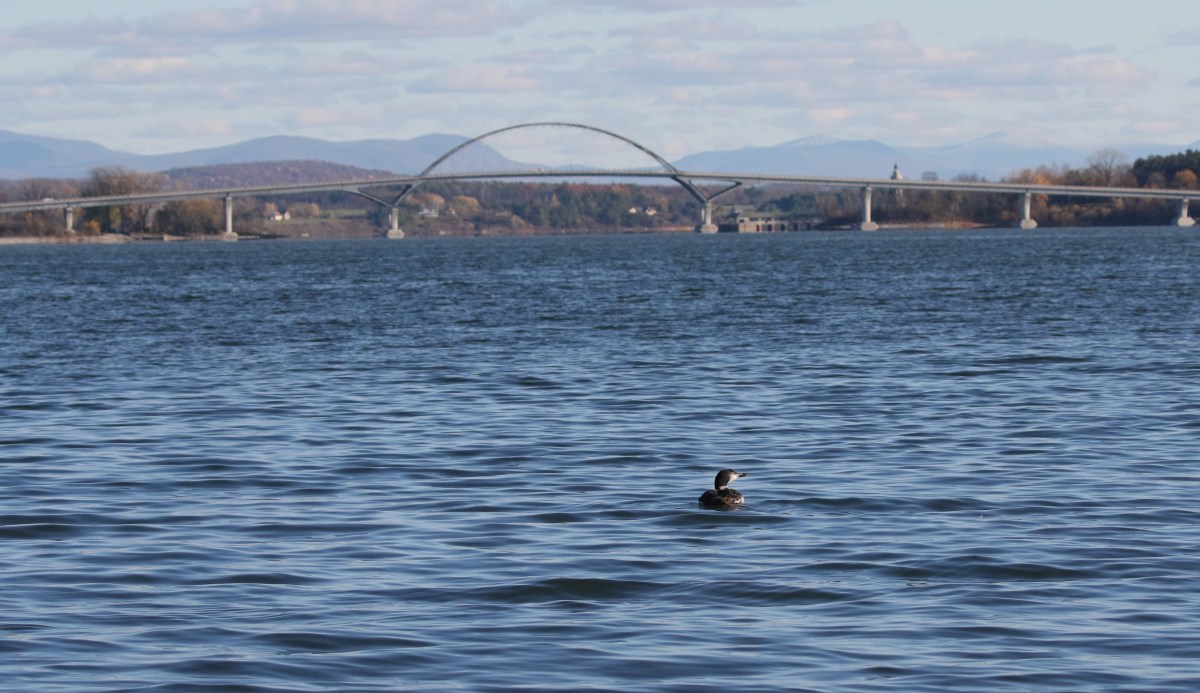 The team released Dammit in Lake Champlain, a common stopover for migrating loons. Photo provided by Ellie George.
They took her to the beach in Port Henry to release her, where they were met by another birding friend, Stacy Robinson. Nina and Ellie carried Dammit to the water’s edge and gently lowered her into the water. She slowly swam away from shore, looking around, checking out her new environment. She did a wing-flap, swam out some more, and dove. Surfacing farther out, she wing-flapped again, then turned to face them as if to say, “thank you.”
Free! Free of the fishing lure that had threatened her life, free of the coccidia infection, free from the small pond and plunge pool below its dam and free to swim out and join the other loons that Stacy had spotted out on the lake. Dammit made a wail call, swam a bit further south toward the Champlain Bridge, wailed again, and then took a long bath. Nina, Ellie and Stacy watched her swim away until she was a small, dark speck on the water.
We look forward to possibly encountering Dammit again, maybe on a breeding lake with chicks of her own. This was a complicated loon rescue and rehabilitation, and great appreciation goes out to everyone who helped her on her journey back to good health. Hopefully Dammit’s hard luck has ended, and she will have good luck and health for the rest of her life.
Note: Loons require special care during rescue and rehabilitation. Thus, loon rescues and rehabilitation are conducted with the guidance of experienced wildlife rehabilitators under special U.S. Fish and Wildlife Service and New York State permits. If you find a loon in need of rescue, in Vermont, please contact VINS at (802) 359-5000. In New York, contact North Country Wild Care at 518-964-6740 for further guidance.