
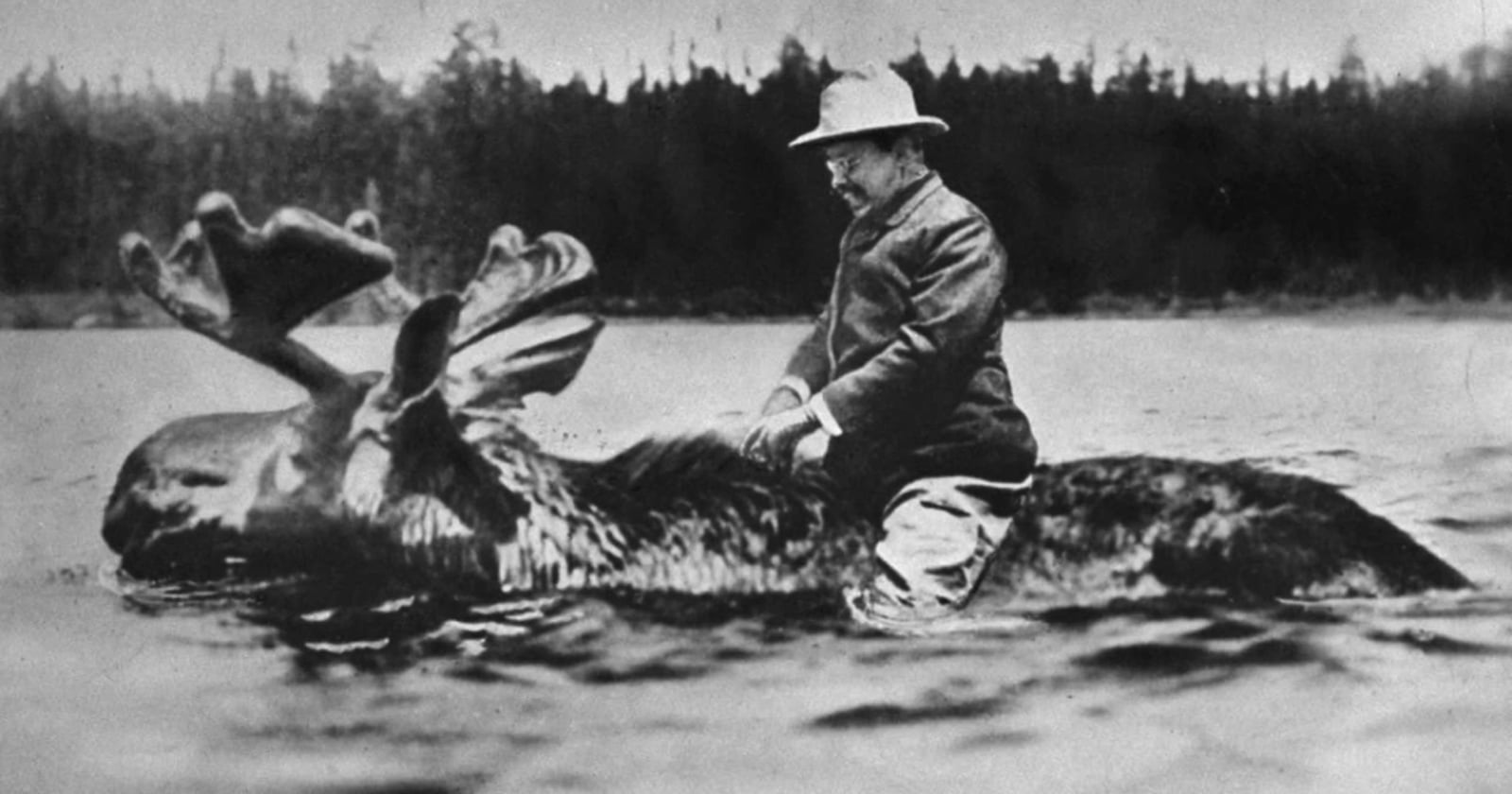
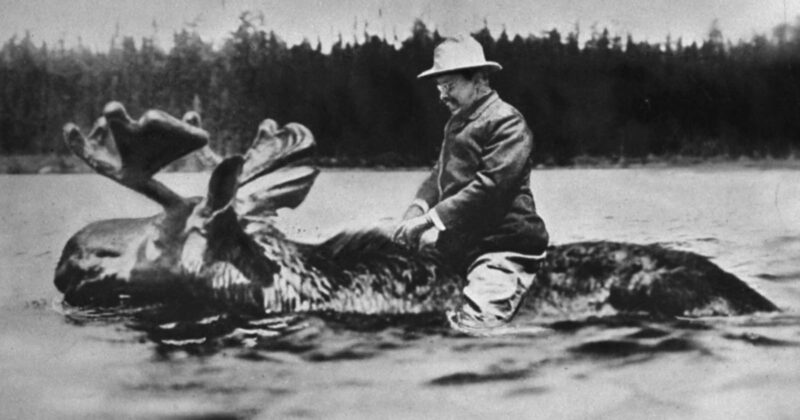
 A fake 1912 photograph of Theodore Roosevelt on a moose that was published by the New-York Tribune.
It’s easy to imagine that anxiety over manipulated images began with Photoshop or AI, but photographers have been wrestling with the problem almost since the birth of the medium. More than a century ago (113 years back to be exact), the U.S. faced a scandal over doctored images of the president, and the outrage nearly led to a national ban on fake photos.
In 1912, a U.S. senator actually introduced a bill aimed, in his words, “to prohibit the making, showing or distributing of fraudulent photograph,” according to a fascinating piece by FreeThink which first surfaced this long-forgotten legislative attempt at regulating analog image manipulation.
A Long History of ‘Fake’ Photography
Victorian photography was full of visual trickery. Headless portraits and spirit photographs created with double exposures, and other staged marvels fascinated viewers — and fooled many of them. These techniques were considered clever at the time, but they also laid the groundwork for distrust. Eventually, retouching soon became routine in portrait studios, where photographers reshaped faces or softened features by working directly on negatives or glass plates.
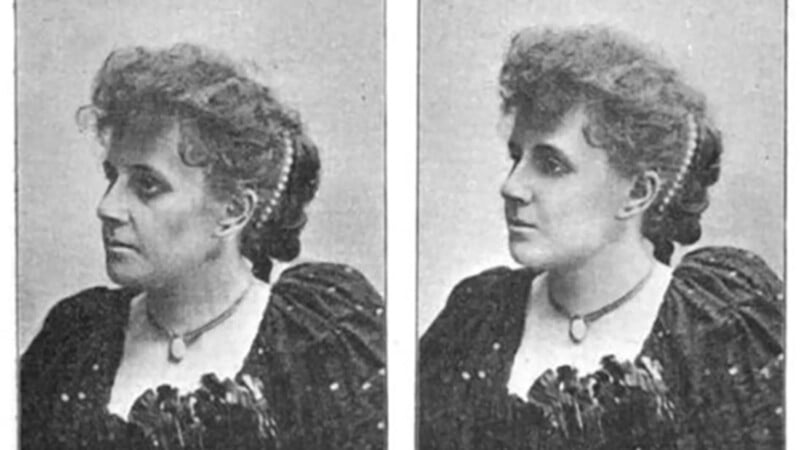 An example of retouching a photograph via negatives in the late 19th century. (Public Domain)
By the turn of the 20th century, FreeThink notes that photography was starting not to be seen as a trusted or neutral medium. In 1897, the New-York Tribune bluntly declared that the long-held idea that “Photographs Do Not Lie” had collapsed. The paper warned that the rise of retouching — via the “skillful work of the negative” — meant photography was “now made to suit the fancy of the inordinately vain.”
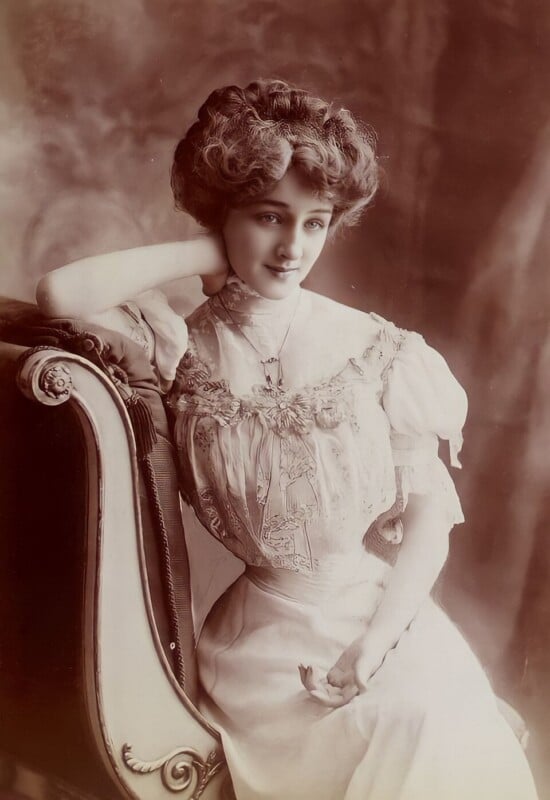 In this photograph, taken around 1900, this image was said to have been ‘edited’ by painting over the sitters waist, in hopes it makes their waist appear smaller. (Public Domain/ Wikimedia Commons)
“The old saying that ‘photographs do not lie’ must go to join the growing host of exploded notions,” the New-York Tribune wrote. “It may have been true when photography was new and undeveloped, but the fact remains that at the present time photographs may be and are made to lie with great frequency and facility. The methods by which this result is accomplished are more various and extensive than most persons suspect.”
And just like today’s AI image or deepfake-based scams, manipulated photos were already being used for blackmail. Reports from the era describe everything from the circulation of fake nude portraits of wealthy women in Chicago in 1891 to “indecent trick photographs” circulated “for the purposes of blackmail” in 1905.
When a Fake Presidential Photo Pushed Washington Too Far
However, by 1911, photo fakery had reached the nation’s capital. Small shops in Washington, D.C., began selling novelty prints that placed tourists beside the then U.S. President William Taft. The images were initially harmless souvenirs, but federal officials took notice. A U.S. attorney ordered the businesses to cease the practice, and a subsequent request to continue — submitted to the White House — was denied. But the mounting pressure ultimately forced the novelty photo operation to shut down.
The situation took a darker turn the following year. Authorities discovered a similar doctored Taft portrait in the possession of a man wanted for human trafficking. Reports said he used the manufactured presidential photo to win the confidence of his victims and suddenly, fake images became a national concern.
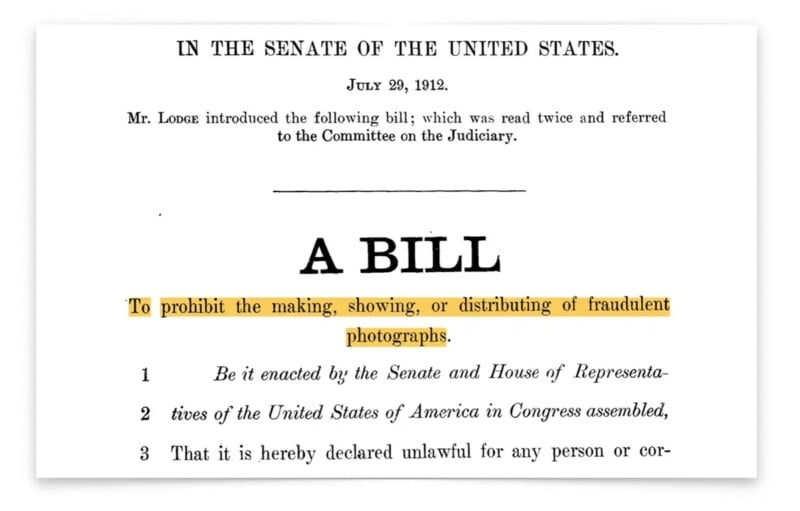 The 1912 bill to ban fake photographs (via FreeThink)
The Justice Department drafted legislation to outlaw fake photos, and Senator Henry Cabot Lodge agreed to carry it forward after allegedly seeing a doctored photo of himself with someone he had never met. On July 29, 1912, Senator Lodge introduced a bill that would make it a crime to create or distribute any “fraudulent or untrue photograph, or picture purporting to be a photograph” without the approval of the person depicted. Punishments could reach six months in jail or fines up to $1,000 — roughly $31,800 today.
Newspapers across the country paid attention. Pennsylvania’s Intelligencer Journal supported the measure and slammed the “miserable business of creating fake photographs.” The paper admired photography as a “wonderful art” but argued it was “manifestly in need of control against abuse.” Negatives “artfully combined to tell pictorial lies” were labeled “photographic crimes,” capable of being accepted as truth because they looked “apparently faithful and exhibited as the testimony of the innocent sun.”
Not everyone agreed. Some photographers felt the law was too broad and would expose professionals to endless lawsuits. In 1912, the publication American Photography reportedly dismissed the proposal as “indefensible,” warning that it would leave photographers and publishers “continually liable to blackmailing suits.”
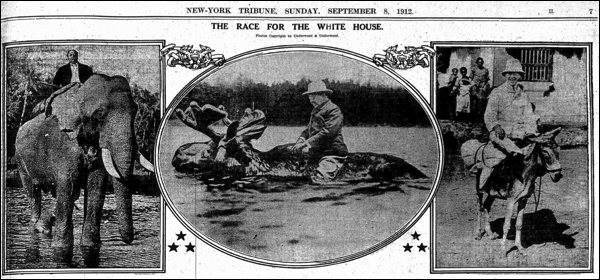 The fake photographs of the presidential candidates published by the New-York Tribune in 1912.
However, the debate over fake photographs intensified just two months before the 1912 presidential election. On September 8, the New York Tribune ran a series of humorous but entirely fabricated images under the headline “The Race For The White House.” The photographs showed the three main candidates riding the animals associated with their parties: William Howard Taft on an elephant, Woodrow Wilson on a donkey, and Theodore Roosevelt on a moose. All three images were fakes, created by the photographic firm Underwood and Underwood, highlighting to the public just how easily photographs could be manipulated.
But ultimately, the 1912 bill to ban fake photographs went nowhere and was never passed. However the proposal’s existence shows just how old and how familiar concerns around fake photographs really are.