
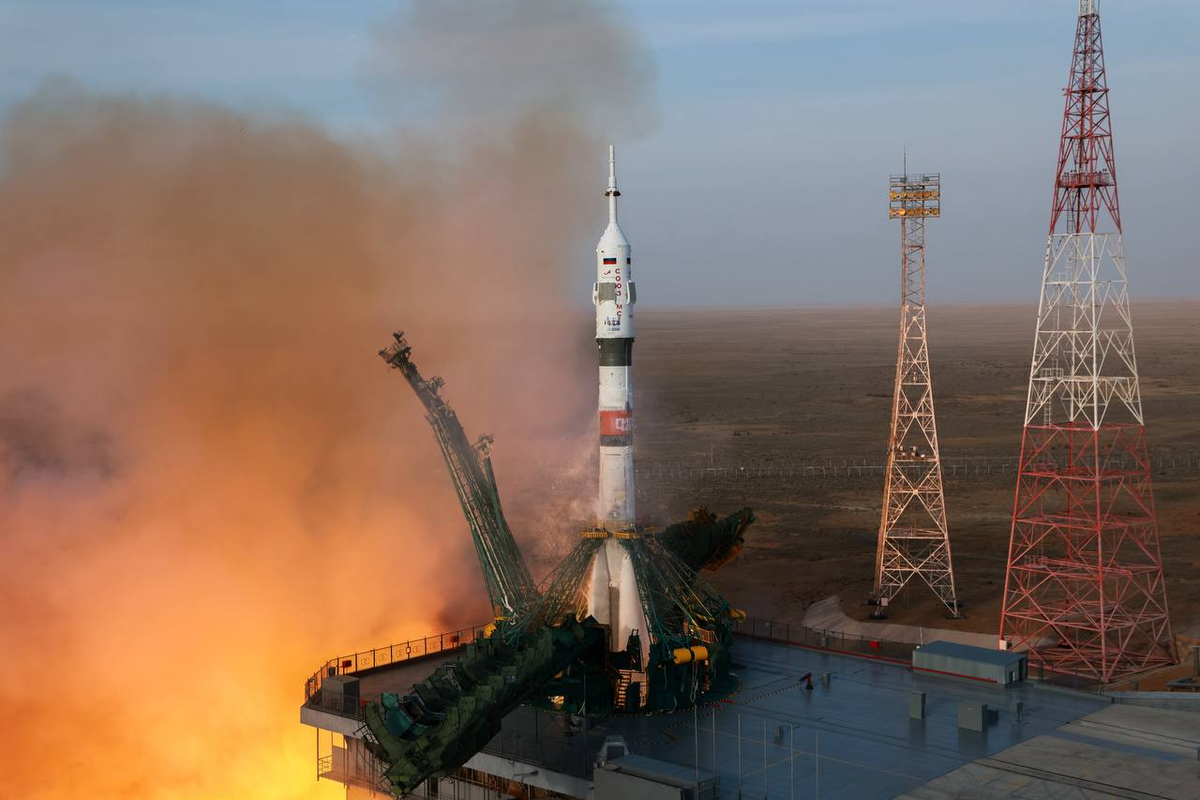
Russia damaged the launch pad at the Baikonur Cosmodrome in Kazakhstan on Thursday while sending the Soyuz MS-28 spacecraft into space.
Russia’s state space agency, Roscosmos, reported damage to the Baikonur launch pad after the rocket’s liftoff and is assessing its extent.
JOIN US ON TELEGRAM
Follow our coverage of the war on the @Kyivpost_official.
“The launch site was inspected, as is done every time after a rocket launch. Damage to a number of launch pad elements was detected. Such damage may appear after launch, so an inspection like this is mandatory in international practice,” Roscosmos wrote in a statement.
“The condition of the launch complex is currently being assessed,” it added.
Roscosmos also said the damage “will be repaired in the near future,” adding that it has access to necessary parts required.
Video of the launch shared by Roscosmos showed a large service platform collapsing into the flame trench – a mishap that, according to commentators, will require major repairs as the platform weighs 20 tons.
Newsweek, citing space experts Vitaly Egorov and Georgy Trishkin, noted that the damage could be extensive. They also highlighted the pad’s significance, as it is the only one available for crewed missions, meaning all trips to the International Space Station (ISS) depend on it.
“Since 2018, it has been the sole support facility for Russia’s International Space Station program. This means that from Russia has effectively lost the ability to launch humans into space, for the first time since 1961,” Egorov wrote in his Telegram update.

Other Topics of Interest
European Nations Mull Joint Cyber Ops Against Moscow, Reports Politico
Ideas include joint offensive cyber operations against Russia, surprise NATO-led military exercises, as well as faster and more coordinated attribution of hybrid attacks.
Other experts told tech outlet Ars Technica that the incident could reflect Moscow’s current priorities in space development and its relationship with NASA, noting that recent funding cuts suggest resources have been diverted toward the war in Ukraine.
“We are going to learn just how important the ISS is to leadership there,” Jeff Manber, a senior Voyager official, told Ars Technica.
Despite the incident, the crew of MS-28 – two Russians and one American – had successfully reached the ISS for their planned 242-day mission.
“NASA astronaut Chris Williams, accompanied by Roscosmos cosmonauts Sergey Kud-Sverchkov and Sergei Mikaev, safely arrived at the International Space Station on Thursday, expanding the orbiting laboratory’s crew to 10 for the next two weeks,” NASA wrote in its press release.
As of 2025, Baikonur is effectively the only active launch facility from which ISS crews are launched, making space cooperation one of the few ties still intact between Moscow and Washington since the 2022 invasion of Ukraine.
Russia currently leases Baikonur Cosmodrome from Kazakhstan for about $115 million per year, an agreement that runs until 2050.