
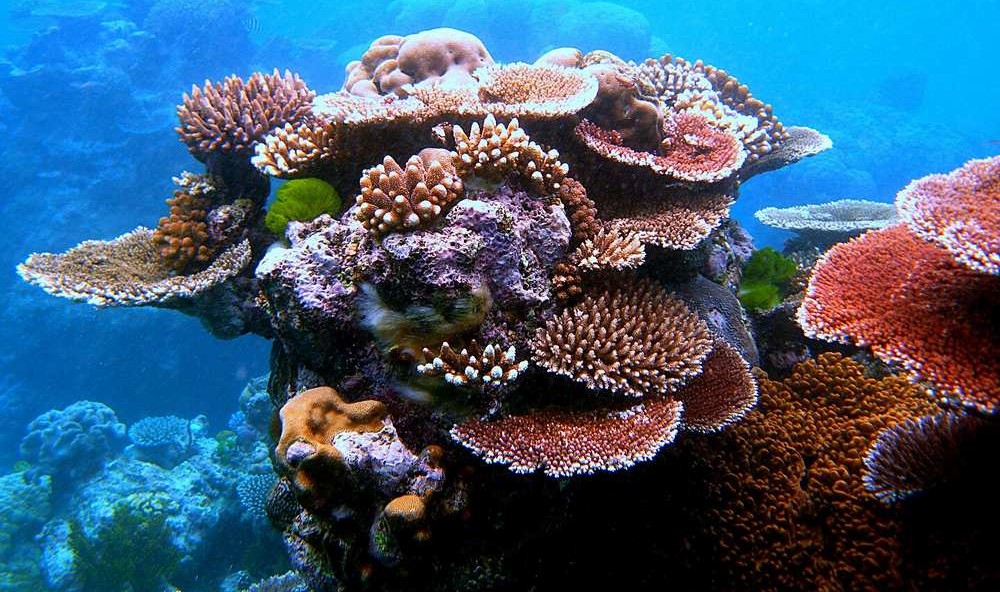
 Coral on the Great Barrier Reef – Toby Hudson CC 3.0.
At the Australian Institute of Marine Science, artificial intelligence is being leveraged to help restore coral reefs after recent bleaching events.
Following the autumn spawning season on the Great Barrier Reef, AIMS scientists are looking to give the corals a helping hand by dropping coral larvae down onto degraded reef segments.
But in an effort that would be “near impossible” to achieve with human decision making and labor alone, a robotic assistant called the Deployment Guidance System (DGS) scans the seafloor and determines the best place for a coral to spawn before dropping small ceramic coral analogues down to within 3 feet of the targeted area.
“The system is not so much one technology as many, brought together in a workflow that improves the yield for our coral seeding efforts,” explains Dr. Ben Moshirian, the project engineer behind the DGS. “The aim is to ensure coral seeding devices are accurately and safely deployed in pre-specified locations.”
Coral seeding has become an urgently targeted science-based practice around the world, with the last 20 years seeing marine scientists finally figure out how to time spawning events, capture coral larvae, and breed them in aquarium tanks.
The ceramic analogues are specially designed to offer protection to juvenile coral while they grow to adulthood, and the system releases the devices from an AIMS vessel at the optimal moment using a deep-learning algorithm informed by years of oceanographic and ecological observations by scientists.
AUSTRALIAN MARINE INNOVATION: Bite-Proof Wetsuit Fabric Almost Entirely Prevents Shark Bite Flesh Wounds
As coral seeding deployments roll out, and the understanding of it evolves, so will the decisions of the DGS to reflect the latest and best knowledge.
“This technology is not about machines replacing humans. It is about humans working with machines, to give our science impact at a scale which was difficult to achieve previously,” Dr. Moshirian said.
CORALY STORIES: Scientists Discover ‘World’s Largest’ Coral –the Size of 5 Tennis Courts
AIMS sees the eventual future of the DGS as being mounted onboard autonomous vessels that could seed coral day and night. Another potential being explored is whether the rather bulky system could make its way onto the boats piloted for tourists, divers, or by Traditional owners.
It would in effect give everyone who loves and relies on the reefs the opportunity to continuously aid in their restoration.
WATCH the system in action below…
SHARE This Use Of AI For The Good Of The Ocean With Your Friends…