
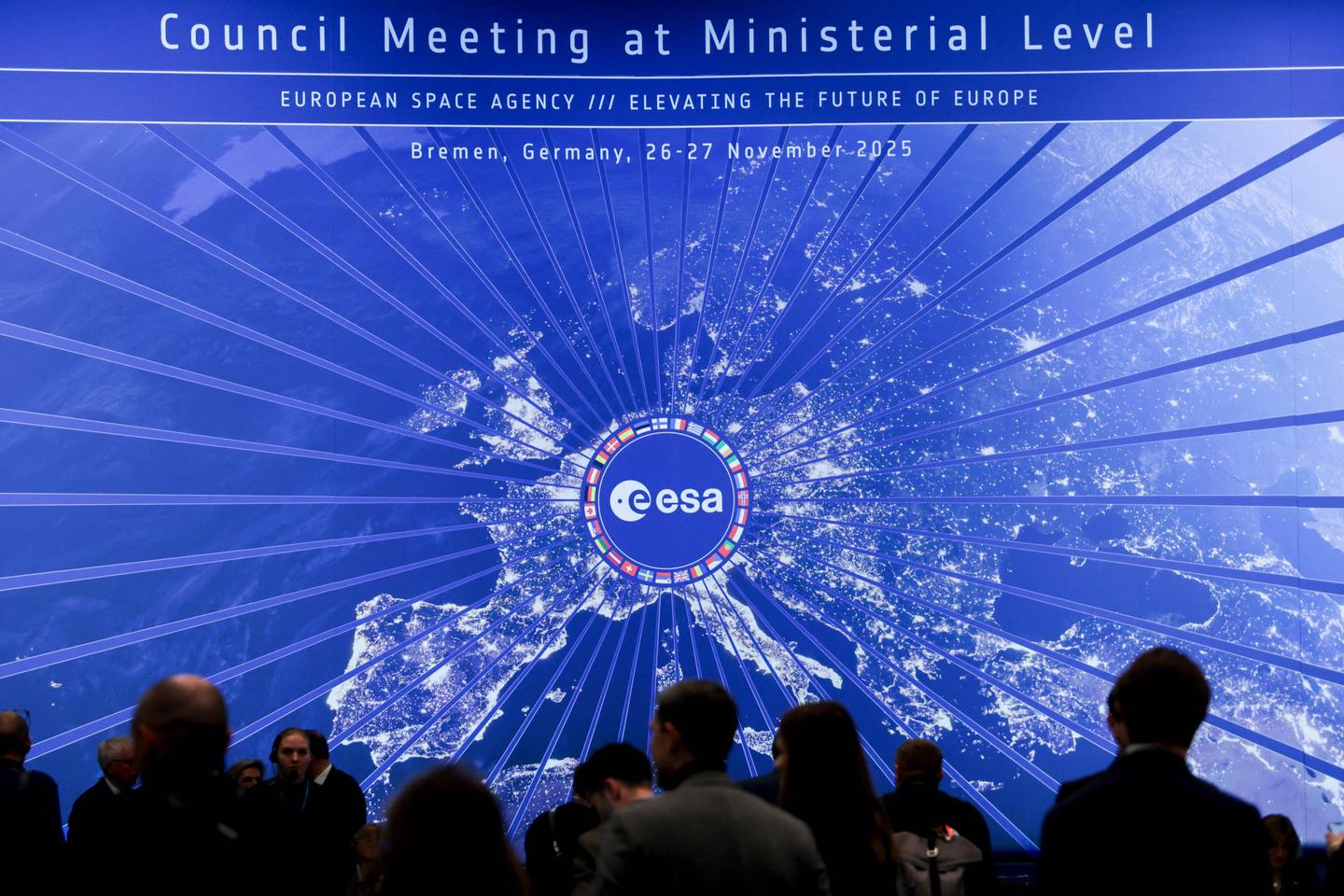
 At the ministerial meeting of the European Space Agency (ESA) member states in Bremen, Germany, on November 26, 2025. FOCKE STRANGMANN/AFP
Europe’s space community gathered on Wednesday, November 26, and Thursday, November 27 in Bremen, the northern German city-state long known for maritime trade before becoming a major aerospace hub, for a particularly crucial conference. For the first time, the event focused on European “autonomy” and “resilience” against a backdrop of profound geopolitical and security shifts. The European Space Agency (ESA) ministerial conference managed to secure a sharply increased budget for the next three years.
Read more Europe still lacks a unified vision for space
Member state contributions reached a record €22.1 billion, up from €16.9 billion in 2022, representing a 32% increase (17% excluding inflation), ESA director general Josef Aschbacher announced on Thursday. This three-year budget, still below NASA’s annual budget, has established a new hierarchy among ESA’s 23 member states.
Germany, with a €5.1 billion contribution (23% of the total), has reinforced its position as the primary funder of the European space sector, now far ahead of France (€3.6 billion), which had led for decades and remains the largest employer with nearly 40,000 jobs. “This is a tremendous blow for France, which built Europe’s space program,” said Gilles Rabin, former space adviser at the French embassy in Berlin. Paris is now neck and neck with Italy, which has raised its participation to €3.46 billion. ESA underscored this shift on Thursday when it announced that a German astronaut will travel to the Moon as part of the Artemis mission, making him the first European to leave Earth’s orbit.
You have 73.74% of this article left to read. The rest is for subscribers only.