
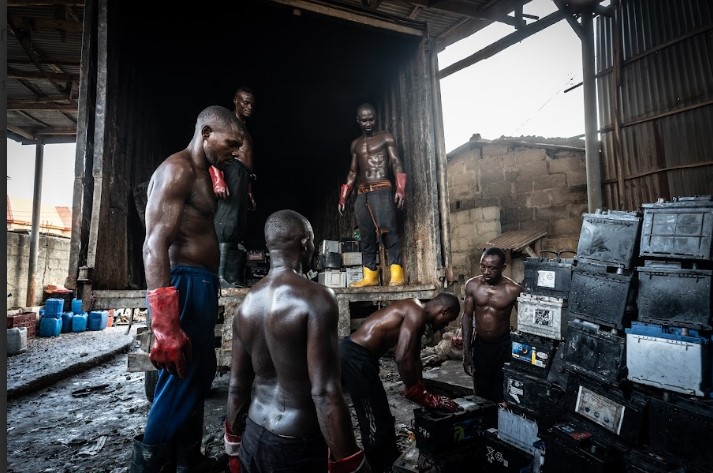
The Ogun State Government has called for an immediate suspension of lead ingot export activities in the state following growing concerns about toxic exposure in the Ogijo area of Sagamu Local Government of the state.
The government also ordered the shutdown of seven Used Lead-Acid Battery (ULAB) recycling facilities operating within the Ogijo community.


Emmanuel Ojo, the Senior Special Assistant on New Media to the Ogun state governor, Dapo Abiodun, made this known in an X post on Thursday.
PREMIUM TIMES and The Examination, a nonprofit newsroom that investigates global health threats, had published a two-part investigation that revealed unsafe working conditions and widespread lead contamination in Ogijo, a community that borders Lagos and Ogun states.
The media aide stated that the Commissioner for Environment, Ola Oresanya, visited the area on Monday with a technical team drawn from the Ministries of Environment and Health, the Ogun State Environmental Protection Agency (OGEPA), and the National Environmental Standards and Regulations Enforcement Agency (NESREA).
Following the inspection, the government ordered the shutdown of seven Used Lead-Acid Battery (ULAB) recycling facilities operating within the Ogijo axis.


Speaking with residents during the visit, Mr Oresanya said the suspension and shutdowns were precautionary measures intended to protect public health while a full investigation is conducted.
“There is no cause for panic. The state will commence a comprehensive health and process audit of the affected facilities.This will include testing for lead in humans, as well as in the air, water, and soil across the community,” he said.
He assured that updated laboratory results and findings from the audit will be made public. The state will also review the methodology behind previously circulated test results that sparked unrest in the community.
Our two-part investigative report revealed that the lead recycling factories in Ogijo have poisoned the air residents breathe and the soil where children play.
Scientists collected 70 blood samples from factory workers and residents, finding that every worker tested showed dangerous lead exposure, with some levels as high as 38 µg/dL, which is many times above the World Health Organisation’s recommended limit.
Children in the community were not spared; eight out of 14 tested children had blood-lead levels exceeding five µg/dL, a threshold that health experts say poses serious risks to cognitive development.
Soil and dust samples collected around homes, farms, and a nearby school also showed catastrophic levels of contamination. In one school playground, the soil contained more than 1,900 ppm of lead, almost five times the level of many international safety limits.
The commissioner added that industries found to be violating environmental standards will face strict penalties once the audit is concluded.
The government urged residents to remain calm as officials assess the extent of possible pollution amid long-standing worries about hazardous emissions in the Ogijo industrial belt.
OGEPA inspects ULAB facilities
Meanwhile, the Ogun State Environmental Protection Agency (OGEPA), says it led an enforcement and inspection team to six Used Lead Acid Battery (ULAB) recycling plants ahead of the mandatory 72-hour shutdown order issued to nine facilities across the state.
In a separate post on his X page, the SSA said the shutdown which commenced on 24 November, “is part of a comprehensive health and process audit initiated by OGEPA to ensure that battery recycling activities do not pose risks to workers, residents, or the environment.”
According to him, facilities inspected include African Non Ferrous Industry Limited, Vendanta Metal Industries Limited, Metal Manufacturing Nigeria Limited, Hanushi Manufacturing Limited, BPL Limited, GBMT.
According to the statement, the General Manager of OGEPA, Kehinde Bello, stressed the importance of reducing human exposure to lead and reiterated the agency’s commitment to maintaining a safe, regulated, and pollution-free environment.
“The mandate of OGEPA is to ensure a safe and healthy environment that is free from pollution. This we will ensure,” he stated.
Timeline of impact
Since the release of the two-part investigation, federal and state ministries, departments and agencies of government responsible for upholding labour and environmental laws have begun taking action after about a decade of poor regulatory oversight.
On Monday 24 November, the Minister of State for Labour and Employment,Nkeiruka Onyejeocha, led her team to seal up True Metals Nigeria Limited and Phoenix Steel Mills Limited,
During an inspection of True Metals, the battery-recycling plant at the center of the investigation, the minister said she found workers operating in what she described as “hazardous and dehumanising conditions.”
Days later on Thursday 27 November, the Commissioner for Environment, Ola Oresanya, led a combined team of experts from the Ministries of Environment and Health, OGEPA, and NESREA, to Ogijo and ordered the closure of seven lead recycling factories.
Earlier in September, NESREA announced the seal up of 9 lead recycling factories, after it received a copy of the soil and blood test results commissioned by The Examination and prepared by STRADev, a non-governmental environmental health organisation.
In addition, Chris Pruitt, executive chairman of the board of East Penn Manufacturing, a major US battery maker with ties to Nigerian companies, told The Examination and partner newsrooms that East Penn stopped buying lead from Nigeria and began to tighten its supplier code of conduct.