
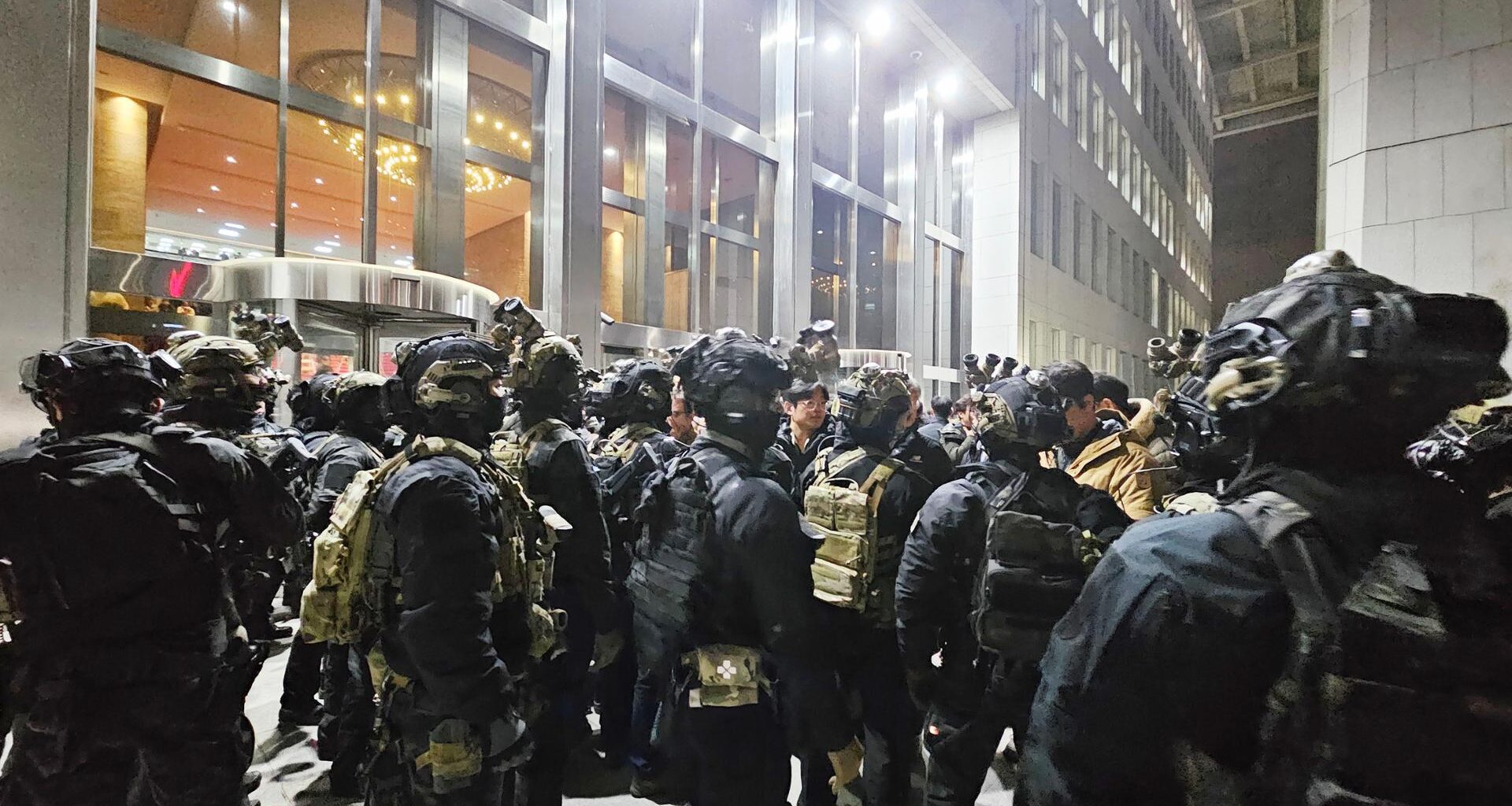
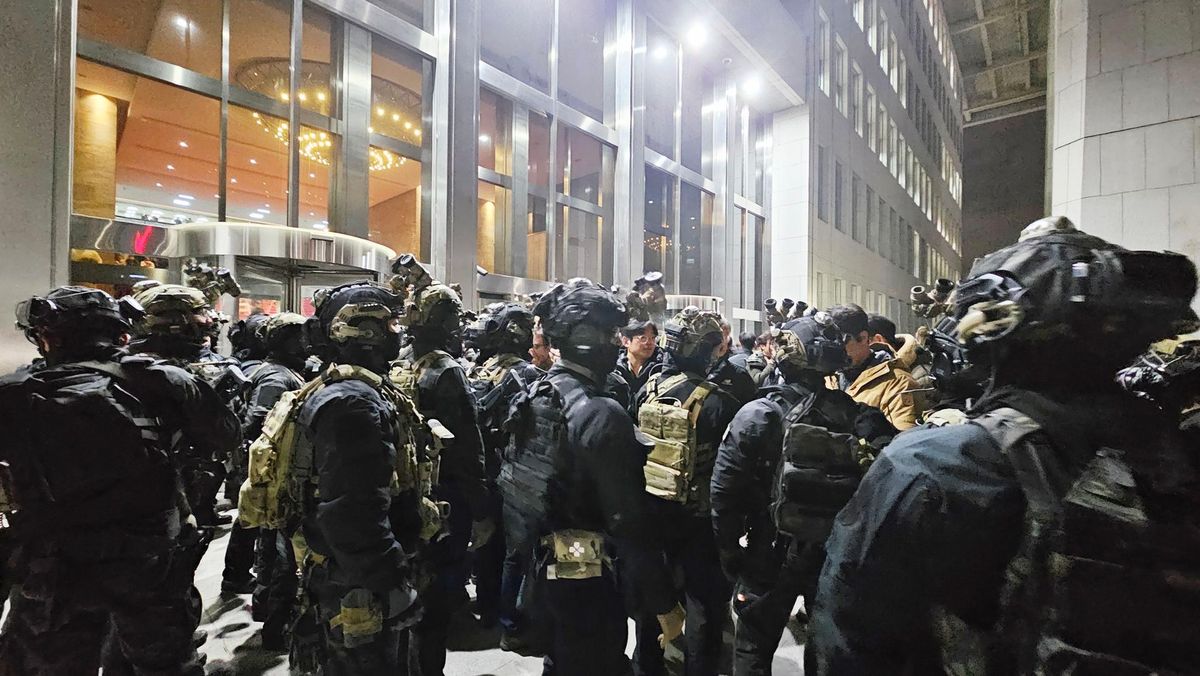
Soldiers prepare to enter the main hall of the National Assembly in Seoul, Dec. 3, 2024, following President Yoon Suk Yeol’s declaration of martial law, citing the need to root out pro-North Korean forces and uphold the constitutional order. Korea Times photo by Ko Young-kwon
Korea continues to stand at a critical economic crossroads a year after an unexpected martial law bid tarnished Asia’s fourth-largest economy that took decades to build, as emergency measures that helped navigate an ensuing crisis and changes in the global trade environment may begin to take a toll, local experts said Sunday.
After months of political turmoil triggered by former President Yoon Suk Yeol’s short-lived martial law declaration last December and his eventual removal from office in April, the country is beginning to show signs of recovery. Yet experts caution that the economic scars from the upheaval remain amid uncertainties and structural challenges.
The abrupt martial law decree on Dec. 3, 2024, sent an immediate shockwave through the financial and foreign exchange markets.
The Korean won plunged to multiyear lows against the U.S. dollar, while the benchmark Korea Composite Stock Price Index (KOSPI) tumbled toward 2,300 points.
Consumer sentiment sank, with private consumption slipping 0.1 percent in the first quarter of the year, driven largely by falling demand in service sectors, such as entertainment and hospitality.
Sweeping tariff measures introduced by U.S. President Donald Trump further strained Korea’s export-dependent economy.
Real gross domestic product (GDP), a key gauge of economic growth, contracted 0.2 percent in the first quarter, the first negative growth in nine months.
The downturn prompted major economic institutions, including the International Monetary Fund (IMF) and the Bank of Korea (BOK), to nearly halve their 2025 growth forecasts to around 0.8 percent, citing weakening consumption and persistent uncertainty surrounding U.S. trade policy.
Financial authorities have continued to reassure investors, insisting the crisis would have limited impact and that Korea’s external credibility would remain intact.
Yet, the fallout proved unavoidable, leaving lingering uncertainty that continues to weigh on the economy, even to date to some extent, experts note.
The government’s fiscal response, combined with the country’s deep strength in exports, has reignited momentum after President Lee Jae Myung took office in June.
The new administration quickly implemented a secondary supplementary budget, expanded public spending and introduced large-scale consumption-boosting measures.
Partly due to aggressive fiscal policies, GDP grew 1.2 percent in the third quarter from the previous quarter, marking the fastest expansion in roughly a year and a half.
Private consumption rose 1.3 percent during the July–September period, marking the strongest gain since late 2022.
Experts attribute much of the rebound to the government’s “consumption coupon” program, which provided direct cash handouts — 150,000 won (US$102) to all citizens in July, followed by 100,000 won to roughly 90 percent of the population in September.
Exports climbed 1.5 percent in the third quarter, driven by strong global demand for semiconductors and automobiles.
Semiconductor exports, in particular, surged amid booming demand for artificial intelligence (AI)-related chips, helping to restore investor confidence.
Financial markets also rebounded, with the KOSPI surging about 70 percent so far this year. driven by government-led market reform measures and optimism surrounding the AI boom.
Investor sentiment received another boost after Seoul and Washington finalized details of Korea’s $350 billion investment package in the United States, part of a broader trade agreement.
The deal, concluded during President Lee’s meeting with Trump at the Asia-Pacific Economic Cooperation (APEC) summit in the southern city of Gyeongju, removed a significant source of uncertainty surrounding the country’s export outlook.
“While this year’s growth may not be greatly affected, the reduction in trade uncertainty could provide upside potential for next year’s growth,” Joo Won, senior economic researcher at Hyundai Research Institute, said.
Following such developments, the IMF and the BOK revised their 2025 growth forecasts upward to 0.9 percent.
The IMF noted that the economy entered a recovery phase in the second half of the year and expects more substantial improvements in 2026, praising the government’s fiscal stimulus measures.
As Korea moves forward, the question is whether recent momentum can evolve into sustained long-term growth or whether unresolved economic vulnerabilities will resurface.
A turbulent presidential election and ongoing trials involving Yoon, along with several high-ranking soldiers and political figures, could undermine the foreign confidence returning to the markets, according to the local experts.
“While it is generally agreed that Korea is one of the most well-trusted democracies in Asia and that its political stability has mostly returned under the new administration, confidence among foreign investors cannot be guaranteed,” said a senior economics professor who requested anonymity.
The government’s aggressive stimulus measures also raise concerns about financial imbalances.
The finance ministry previously projected that the managed fiscal balance, a key gauge of fiscal health calculated on stricter terms, could widen to 4.2 percent of the GDP under the new supplementary budget.
Yang Jun-seok, an economics professor at the Catholic University of Korea, cautioned that stimulus measures must be applied with far greater care.
“Unchecked spending could further strain national finances over the long term, especially as debt continues to mount,” he said.
The Korean won, which has been among the world’s weakest-performing currencies over the past year, continues to weigh on the economy.
Structural headwinds remain significant, as demographic changes, including population aging, rigid labor market and persistently high household debt, continue to affect Korea’s long-term growth prospects, they said.
Moreover, the country’s recovery remains heavily reliant on semiconductors and AI-driven exports, raising concerns that should global demand weaken or competition intensify from rivals such as China and Taiwan, outbound shipments could quickly lose momentum.
“While financial authorities maintain that the martial law debacle had limited economic impact and would not leave lasting scars, Korea stands at a critical juncture amid ongoing uncertainties and long-standing structural challenges,” said the economics professor who asked not to be identified.