
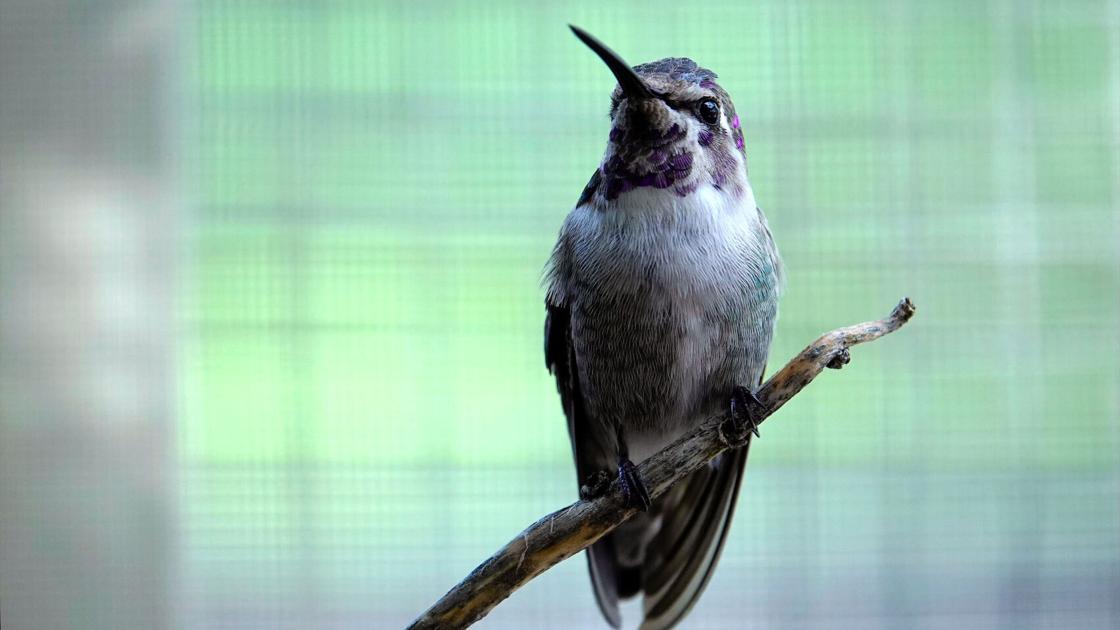
Heading south for the winter can be difficult and dangerous, especially when you’re tiny. Sometimes, hitching a ride is the safest way to go.
A wayward Costa’s hummingbird that was saved from frigid temperatures in Nebraska is now flying free in Tucson, after a long road trip from the Upper Midwest and a brief stay with a local rescue group.
“I was so outclassed by this little, 2½ gram bird,” said Lincoln, Nebraska, resident Jennifer Munson, who helped rescue the lost hummer. “It was just the craziest, wildest five-week period. It was fun.”
Costa’s hummingbirds are native to the southwestern U.S. and northwestern Mexico, where the male sports a bright purple cap and bib known as a gorget that sticks out from his chin like a long mustache.
People are also reading…
Elegant no more: Rare Southern Arizona bird gets new name
Local vendors, goods to be featured in new Tucson shop
New work rules put SNAP benefits in peril for many in AZ
Former Sweet Tomatoes building near Tucson Mall to be revived
Territorial Cup: Arizona Wildcats take down ASU to finish regular season with 9 wins
Arizona commission will sue to block political party’s name change
Driver, 72, arrested in deadly Tucson crash
More than a ride: Cyclists brave wind, turmoil in 42nd El Tour de Tucson
These local restaurants are serving up delicious turkey dinners this Thanksgiving 🍗
Longtime University of Arizona sports historian and statistician dies | Greg Hansen
With plans for Maui in 2026, Arizona basketball resisting Players Era jackpots so far
The ultimate list of Tucson holiday events: Music, ballet, festivals, food and more
Territorial Cup: Point spread, over/under for Arizona vs. ASU
28 things to do in Tucson this Thanksgiving weekend, November 28-30! 🦃🍁
Arizona Football Aftermath: Storylines, stats and quotes from the Wildcats’ win over ASU
But those markings hadn’t quite developed yet on the juvenile male that showed up in early October in Munson’s yard, more than 1,000 miles outside of the Costa’s normal range. At first, she mistook him for a native ruby-throated hummingbird — one that had maybe lost some of its colorful plumage in old age.
“He would not leave my house,” she said. “I didn’t know he was anything special.”

Bob the Costa’s hummingbird getting acclimated in a Tucson backyard after being rescued from a Nebraska winter.
Julia Lehman, Southern Arizona Hummingbird Rescue.
After watching him for a couple of weeks and seeing no other hummingbirds that looked quite like him, though, she snapped his picture and shared it with her friend, Dina Barta, a retired game warden.
Barta thought the bird might be something rare and suggested a call to the Nebraska Game and Parks Commission. That prompted a visit from the agency’s nongame-bird program manager, Joel Jorgensen, who confirmed the backyard visitor as just the fourth Costa’s hummingbird ever recorded in the Cornhusker State.
What about Bob?
Munson and her husband nicknamed him Bob, as in Bob Costa’s, a tiny, feathered version of the famous sportscaster.
Word soon spread through the region’s bird-watching community. Bob was famous.
Munson said hundreds of birders flocked to her house, including some who drove in from out of state to catch a glimpse or maybe a photo of the Costa’s. They were eager and polite and came armed with telephoto lenses and parabolic microphones to record Bob’s song.
“It looked like the press line at an NFL game,” she said. “It was all day, every day for about two weeks.”
Some of the birders were so thrilled by the experience, they left gifts for Munson — a jar of honey, some homemade jam. One group gave her a hummingbird-themed photo album filled with their best close-ups of Bob. Someone else sent her a drawing of the bird in colored pencil with a nice note on the back.
Munson said Bob was a welcome ray of light for her in an otherwise dark year, marked by the sudden death of her father in April. The hummingbird would swoop down to see her every day when she arrived home from work, she said, “and he was constantly singing.”
But Munson began to worry as the days shortened, the temperature dropped, but Bob continued to hang around.
“It got bad fast,” she said. “After that first freeze, I was convinced he was dead. The frost zapped everything that was a food source for him.”
On a particularly cold day soon after that, her retired game warden friend called her at work to tell her that her feeders had frozen and the bird was in distress. Munson rushed home to “heat up some warm Bob soup” — warm water with extra sugar in it to give him an energy boost.
“He started hitting the feeder while I was still carrying it” back outside, she said.
That’s when Munson knew that the only way to save Bob was to get him back to where he belonged. “I spent so much time agonizing over this bird. I just wanted to help him,” she said.
Finally, on Nov. 17, Munson and Barta brought Bob in from the cold and got him into the hands of a licensed rescue organization.
Rehab road trip
Nebraska Wildlife Rehab executive director Laura Stastny has been rescuing animals for the past 25 years, and she said Bob certainly fit the bill.
“He toughed out a couple of nights when I think it bottomed out at about 16 degrees,” Stastny said, but he wouldn’t have lasted much longer, especially with no nectar or insects around for him to eat.
“He doesn’t belong anywhere near Nebraska. Not even close,” she said. It’s shocking he showed up there in the first place and “even more shocking that he stayed,” as the seasons began to change.
Tucson bird rehabilitator Julia Lehman was answering the hotline for Southern Arizona Hummingbird Rescue when the call came in from Omaha. She was “just giddy with excitement” as soon as she heard about Bob, she said.
It was Stastny who ended up driving the bird to Tucson, a round trip that covered more than 3,000 miles with a few other stops along the way.
She left Nebraska on Nov. 21 with a carload of wayward wildlife. Her first stop was Fort Worth, Texas, where she handed off a pair of Mississippi kites that were headed to a raptor rehab in San Antonio. Then she continued southwest with the hummingbird and a juvenile big free-tailed bat, destined for a rescue in the Phoenix area, that Stastny said was the first of its kind ever recorded in Nebraska.
Bob was active in his carrier for much of the drive and seemed to be “having a great time,” she said, though “he didn’t like it when we hit bumps.”
The bird’s buzzing increased as they crossed from Texas into New Mexico.
Stastny rolled into Tucson on the night of Nov. 22 and dropped off Bob at Lehman’s house, along with the cage she brought him in and an expensive container of special hummingbird food.
The next morning, Lehman carried the travel cage outside so the bird could get acclimated. She said he grew very still as he listened to the sounds of other hummingbirds racing around her backyard.
Release day
No one is quite sure how Bob wound up in Nebraska.
“The animals that end up in weird predicaments are usually juveniles,” Stastny said. “I have a feeling this had to do with the weather.”
She doesn’t think it’s a coincidence that a rare hummingbird and an extremely rare bat both showed up in Nebraska at about the same time and right after a series of strong storms that swept across the Plains from west to east.
Bob the Costa’s hummingbird hangs out in an outside aviary at the home of Patricia Coghlan, of Southern Arizona Hummingbird Rescue, before he was released back into nature in Tucson on Nov. 26. Bob was found in Nebraska and brought to Tucson to escape the frigid winter temperatures.
Mamta Popat, Arizona Daily Star
According to eBird, the Cornell Lab of Ornithology’s popular online database for bird observations, there have been a handful of Costa’s sightings in such unusual places as Michigan, South Dakota, Kansas and Oklahoma in recent decades. And at about the same time Bob was hanging out in Munson’s yard last month, a female Costa’s was spotted and photographed by more than a dozen birders in Calgary, Alberta.
“To have been seen that far north is really kind of crazy,” Lehman said.
Costa’s are among the most common hummingbirds in Tucson, though Lehman said she doesn’t handle that many of them, because they tend to live on the outskirts of the community or out in the desert.
So far this year, Southern Arizona Hummingbird Rescue has cared for more than 270 injured or orphaned hummingbirds and released an impressive 70% of them back into the wild.
Bob is the latest success story. After two days at Lehman’s house, he was moved to the home of Patricia Coghlan, another rehabilitator with the group whose neighborhood near the eastern district of Saguaro National Park is buzzing with other Costa’s.
Then, when the time finally came on Nov. 26, the eager young male was set free into a sunny, 68-degree Tucson morning.
There was nothing to it, really. Coghlan simply propped open the door on the large aviary in her backyard, and the bird came zipping out less than a minute later.
It happened so fast, no one could say for sure what direction he went. And with no numbered band on his leg or other distinguishing markers, there’s really no way to track him. Bob is on his own now.
He certainly looked ready to go to Coghlan, who has been handling hummingbirds for more than 30 years. She declared him healthy, active and “robust,” with good fat reserves around his breastbone. When he flew off, she said, he seemed to do so with purpose and maybe a destination in mind.
“I think he’s migrating somewhere,” Coghlan said. “He’s on his way out of Tucson.”
Munson was delighted by the news — emotional even, especially when she saw video clips of the bird buzzing around inside the aviary and then racing through the open doorway.
“It was a really touching moment of closure,” she said by phone from chilly Nebraska. “But if he ends up back at my house, I’m going to lose my freaking mind.”