
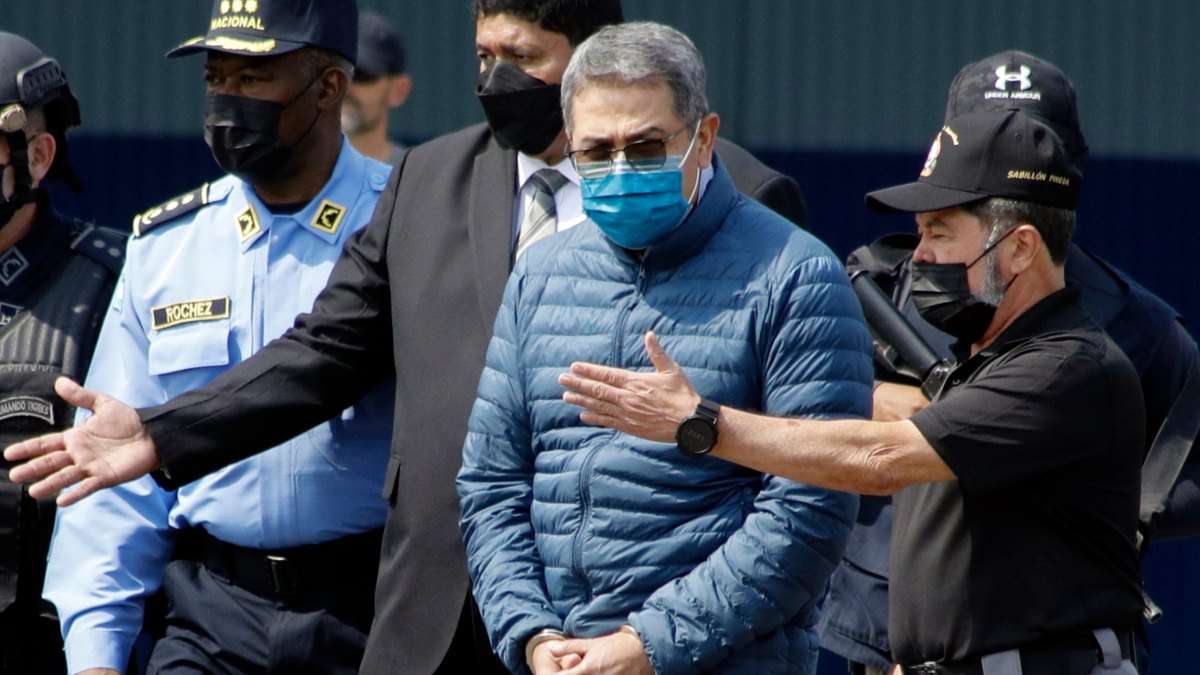
A week ago Juan Orlando Hernández, the former president of Honduras, was languishing in a federal jail in West Virginia, with decades left to serve of his 45-year prison sentence for cocaine trafficking.
“We are going to shove the drugs up the noses of the gringos,” Hernández, a supposed US ally, once allegedly said.
Now, after an extraordinary intervention from President Trump, the disgraced former leader is set to be freed less than a year after he was convicted by a Manhattan court.
On the eve of elections in Honduras, a country with a history of political violence, Trump said that Hernández had been treated “very harshly and unfairly”.
Interrupting his Thanksgiving golfing holiday in Mar-a-Lago, Trump said he would issue a “full and complete pardon” for Hernández after listening to “many people that I greatly respect”.
At the same time, Trump endorsed Nasry “Tito” Asfura in Sunday’s elections, the presidential candidate from the same conservative party as Hernández, and threatened to cut off hundreds of millions of dollars of US aid to Honduras if voters rejected him.

Campaign banners for Nasry “Tito” Asfura
ORLANDO SIERRA/AFP/GETTY IMAGES
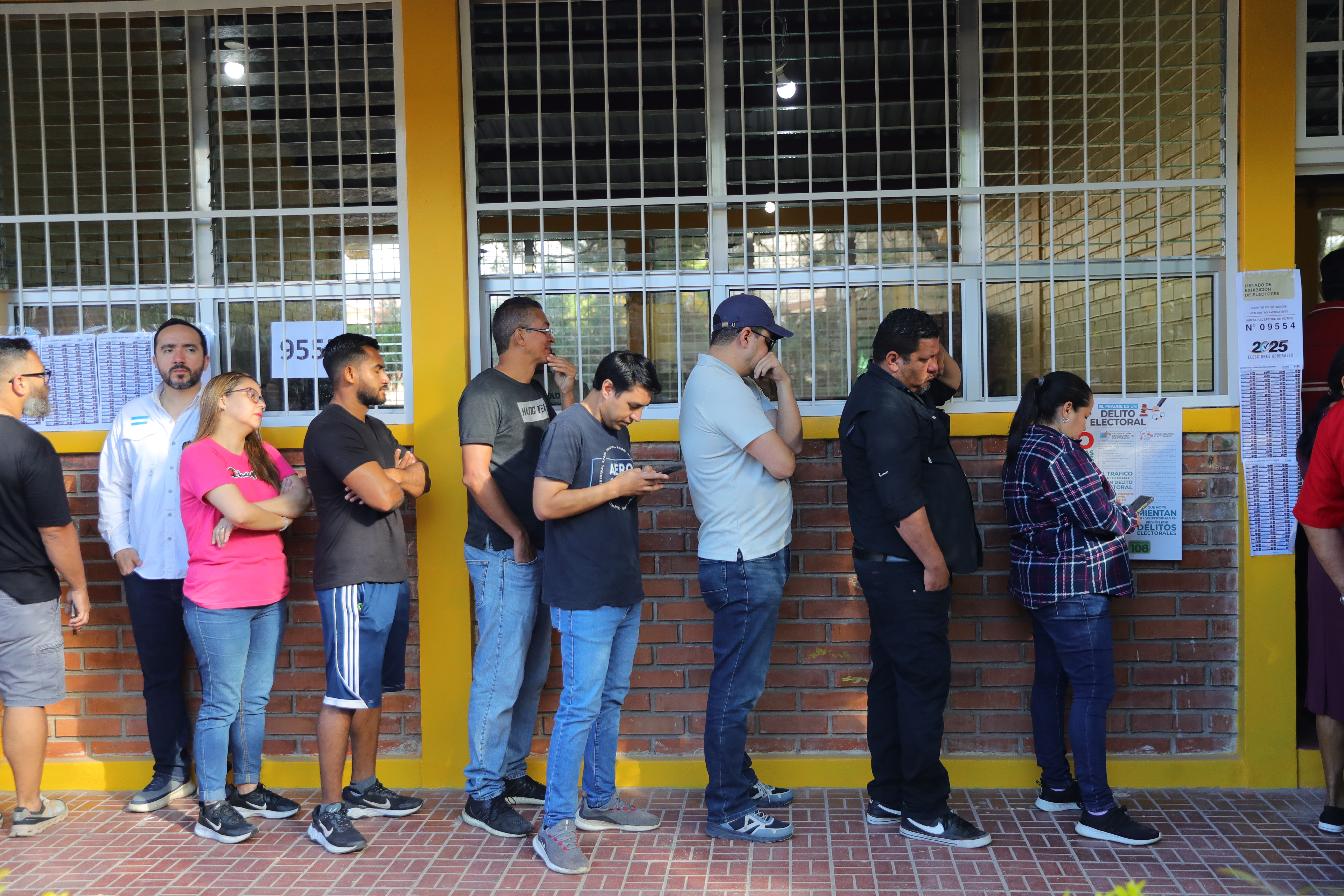
People line up to vote at a polling station in Tegucigalpa
GUSTAVO AMADOR/EPA
“If he doesn’t win, the United States will not be throwing good money after bad,” he wrote on Truth Social.
The original “banana republic”, Honduras suffered repeated invasions from its northern neighbour during the early 20th century when US marines were dispatched to protect the interests of the United Fruit Company.
Now, it is once again being closely watched by Washington.
The country’s recent tumult began when Manuel Zelaya, the country’s left-wing president, was ousted in a coup in 2009.
Seizing on the political instability, the cartels began shipping cocaine through Honduras.
Amid the chaos, Hernández, a conservative from the National Party better known by his initials “JOH”, was elected in 2013 with a promise to end the drug violence.
In fact, US prosecutors allege Hernández had already developed a close relationship with some of the most feared gang leaders in the region.
He was photographed posing with a thumbs-up beside a notorious drug dealer at the 2010 World Cup in South Africa. Before the election in 2013, his brother, Tony Hernández, accepted a hand-delivered $1 million bribe from the Mexican drug lord Joaquín “El Chapo” Guzmán, in exchange for which Honduras was expected to become a major hub for Colombian cocaine being shipped to the US.
During his eight years in power, Juan Orlando Hernández upheld his side of the bargain, it is alleged.
While presenting himself as a model ally of the US, offering to stop the migrant “caravans” heading to the US-Mexican border during Trump’s first term, he was in fact enriching himself through his dealings with the Sinaloa Cartel run by El Chapo and the MS-13 gang declared a terrorist organisation by the Trump administration earlier this year.
• Seventeen of El Chapo’s family enter US in ‘secret cartel deal’
His brother, implicated in a number of brutal killings, wielded an Uzi engraved with “Presidente de la República” on his behalf, prosecutors later alleged. The initials “JOH” were found on ledgers for drug payments.

Police near a polling station in Tegucigalpa on Sunday
GUSTAVO AMADOR/EPA
Despite the Honduran constitution banning candidates from serving multiple terms, Hernández won re-election in 2017, a result that triggered protests in which 23 people died.
However, his luck ran out when President Biden replaced Trump in 2020. Under Biden, the US decided the man claiming to be a friend of Washington was no such thing.
When Hernández left office in 2022, Kamala Harris, the vice-president, was briefed on the corruption and drug-trafficking allegations facing the former Honduran president. “Let’s go get him now,” she supposedly said.
Hernández was arrested by US authorities in Honduras with the co-operation of the country’s new president, Xiomara Castro, who is the wife of Zelaya, the leftwinger ousted in the 2009 coup.
He was brought to the US in handcuffs in 2022 and, at the end of a humiliating trial, Hernández was sentenced to 45 years on cocaine trafficking and weapons charges in June last year.
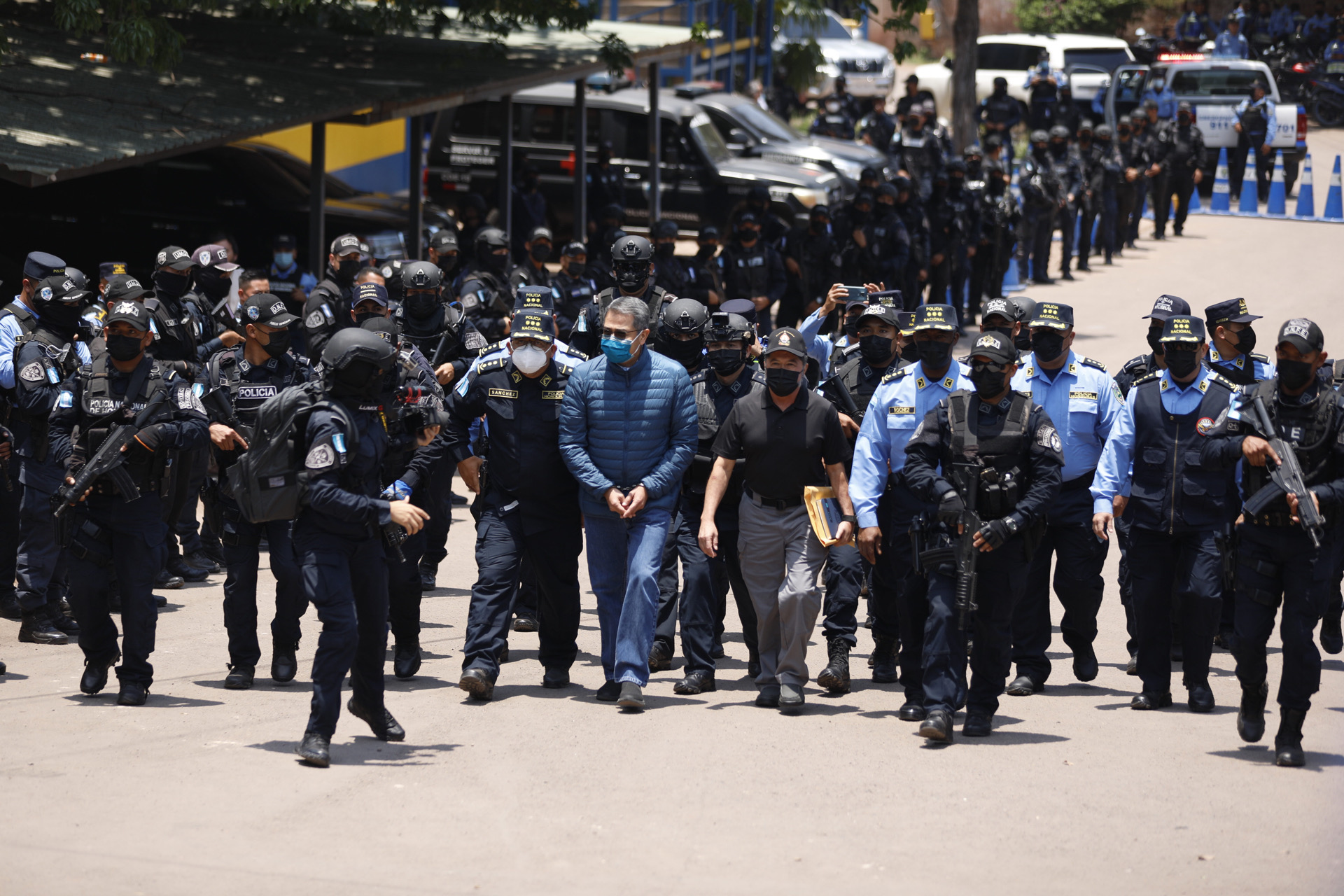
Hernández is escorted to Toncontin International Airport in 2022 after a US extradition request
TOMAS AYUSO/BLOOMBERG/GETTY IMAGES
Now, his sudden release has raised tensions in Honduras just as voters go to the polls.
In Sunday’s election, Rixi Moncada, the left-wing heir to Castro, is facing a challenge from Asfura, the National Party candidate endorsed by Trump, and Salvador Nasralla, a right-wing sports broadcaster.
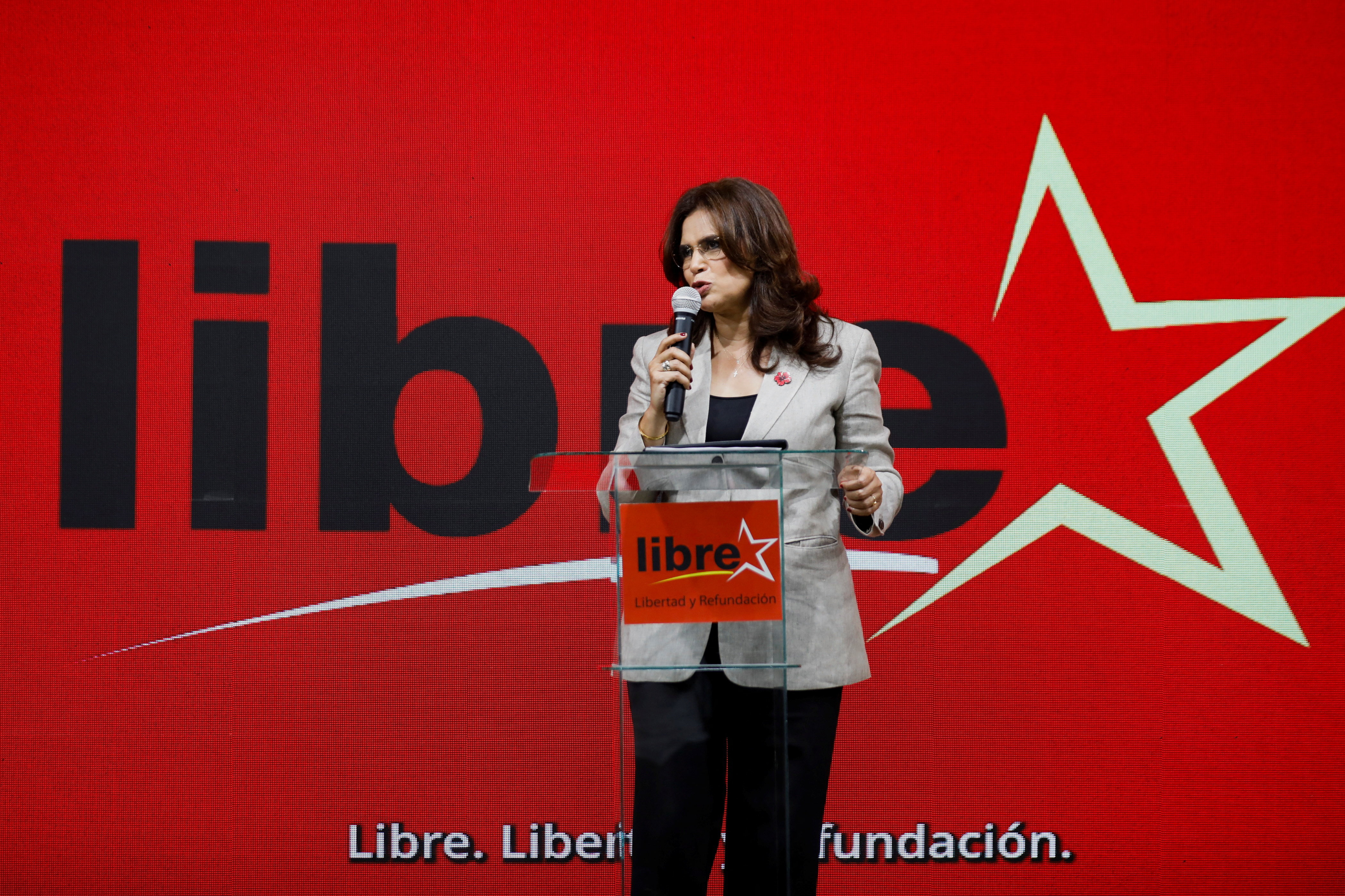
Rixi Moncada
JOSE CABEZAS/REUTERS

Posters for presidential candidates in Tegucigalpa
EMMANUEL ANDRES/AP
Trump has said that Nasralla is a stalking horse candidate put up by “communists” to divide the right-wing vote.
The president’s clemency towards Hernández contrasts with his wider approach in central and south America, where he has vowed to clamp down on “narco-terrorism”, most recently declaring the airspace above Venezuela closed as he edges towards approving airstrikes on the regime of President Maduro.
• Will Trump invade Venezuela — and what comes next?
Yet it also reflects his preference for right-wing strongmen leaders in the region — from Nayib Bukele, the self-declared “world’s coolest dictator” of El Salvador, to Javier Milei, the chainsaw-wielding president of Argentina — and his disdain for leftist governments like the one running Honduras.
“Democracy is on trial in the coming Elections in the beautiful country of Honduras on November 30th,” Trump wrote on Truth Social, shortly before posting a video of a successful chip on his Florida golf course. “Will Maduro and his Narcoterrorists take over another country like they have taken over Cuba, Nicaragua, and Venezuela?”