
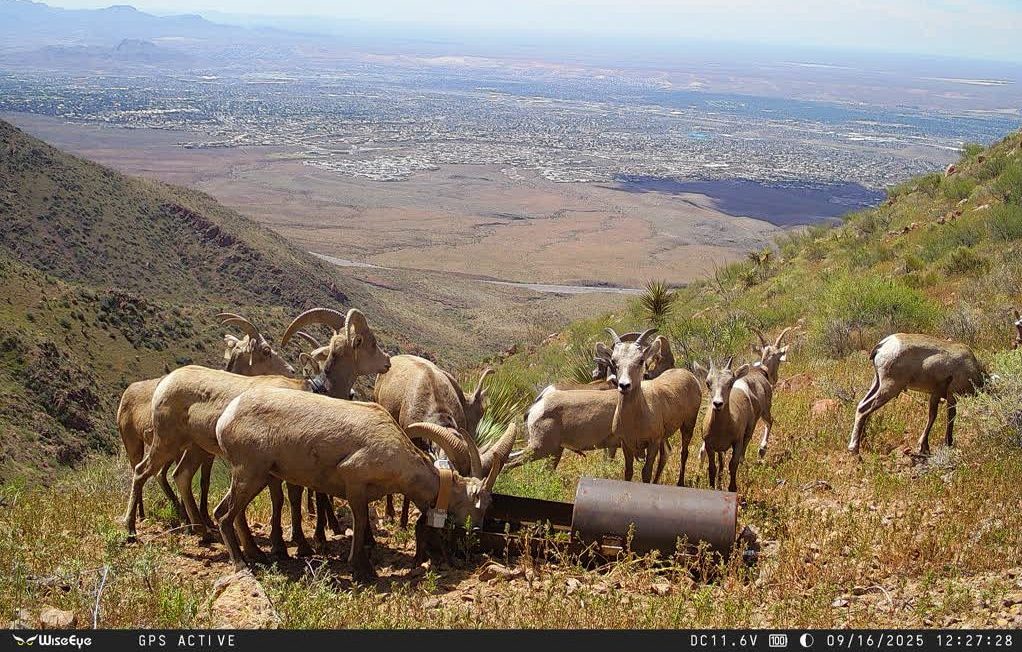
Jose Etchart spotted them from a helicopter on a mild October morning – a group of 30 or so desert bighorn sheep scaling the Franklin Mountains in El Paso, just north of Smugglers Pass. The sheep’s characteristic white rump, split by a dark brown tail, caught his eye.
Small lambs less than a year old climbed with the flock up the rocky terrain, distinguished by their short horns and lack of GPS collars. They are the first of their kind to be born in El Paso in a very long time, Etchart said with pride.
Etchart works as a senior wildlife biologist for the Texas Parks and Wildlife Department overseeing the species’ conservation efforts. The lamb sightings are encouraging news for the future of desert bighorn sheep in Texas.
Desert bighorn sheep roamed the isolated mountain ranges of Far West Texas for thousands of years before human activities wiped them out by the 1960s. In a decades-long effort to restore the animal to their native stomping grounds, the Texas Parks and Wildlife Department began translocating desert bighorn sheep from a primary herd in the Elephant Mountain Wildlife Management Area to the sheep’s original mountain ranges.
In December 2024, Texas Parks and Wildlife translocated 77 desert bighorn sheep to Franklin Mountains State Park. Six from that group have died since then, one from what appeared to be a vehicle collision and five from natural causes, said park Superintendent Cesar Mendez. That’s a high survival rate compared with other translocations, he noted.
There is now a sense of urgency to establish a new primary herd, Etchart said.
The population of aoudads, a non-native sheep species, has exploded in the Trans-Pecos region where it outcompetes the bighorns for resources and kills them off with disease. Aoudads are now found on Elephant Mountain and every range in the region except one – the Franklin Mountains.
It’s crucial for the desert bighorn sheep to take root there, Etchart said.
“We were pretty happy to see some lambs on the ground after we did this big translocation because the animals do go through a lot of stress,” Etchart said. “And we’re hoping for the next year or so, especially with the type of monsoon season that we had, with all the rains we’ve been having, it’s going to set us up for a very good lamb crop in the spring.”
El Paso monsoon season boon for desert bighorn sheep
Rain stimulates the growth of vegetation that desert bighorn sheep eat for nutrition and hydration. The state also worked with the Texas Bighorn Society to set up a water guzzler to collect rainwater, providing animals a watering hole. The sheep are more likely to have healthy lambs if they and their lambs meet their nutritional requirement, Etchart said.
The water guzzler is helpful for other animals, too. Camera footage shows more than 40 species have quenched their thirst there, Mendez said.
Texas Parks and Wildlife released a mix of rams and ewes of varying ages in El Paso. Most of the ewes, the female sheep, were pregnant.
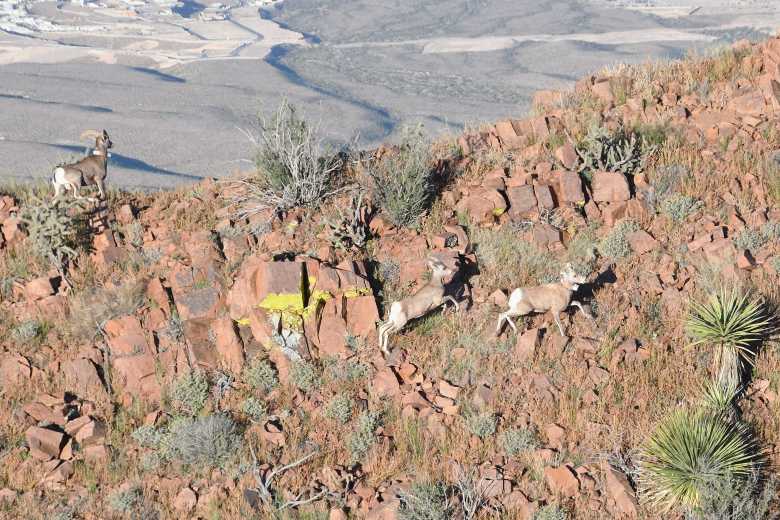 An ewe and two lambs run through the Franklin Mountains during the aerial survey of desert bighorn sheep Oct. 29, 2025. (Courtesy Cesar Mendez)
The department conducts a statewide aerial survey of desert bighorn sheep every fall, though a survey of the Franklin Mountains population also took place in the spring to count newborn lambs.
Parks staff counted 17 lambs in April and 13 surviving lambs in October. Lambs that survive the first six months of life are more likely to make it to maturity, Mendez said.
“Ewes do protect their young,” said Froylán Hernández, the former desert bighorn sheep program leader, last year. “I’ve seen if the lamb dies and the ewe is still close to where it dies, she’ll hang around hoping it’s just sleeping and will eventually come back. The ewe will be bleating for the lamb to respond and she waits and waits until eventually gives up.”
Hernández, who ran the program for more than 14 years, left Texas Parks and Wildlife in October. The state is in the process of hiring his replacement.
In preparation for the sheep’s move to El Paso, Texas Parks and Wildlife attempted to relocate “Bob the Goat,” a domestic goat turned loose in the Franklin Mountains. The possibility of the goat carrying M. ovi, the bacteria also carried by aoudads, posed a threat to the desert bighorn sheep. Records indicated Bob died from the stress of capture.
Aside from disease, causes of death for desert bighorn sheep include the stress of translocation and predation. In El Paso that would be bobcats, coyotes and golden eagles, which can snatch up lambs, Mendez said.
The sheep also need time to acclimate to their new environment, Etchart said.
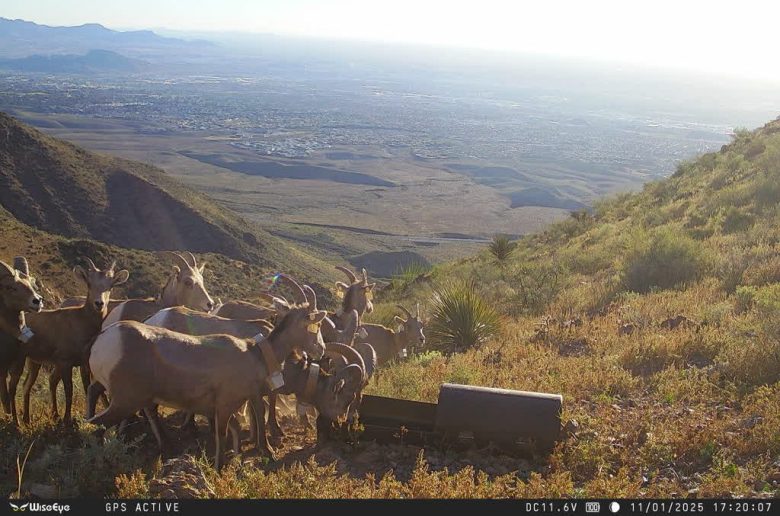 A wildlife camera captures desert bighorn sheep in the Franklin Mountains drinking from a rainwater catcher Nov. 1, 2025. (Courtesy of Franklin Mountains State Park)
“They’re coming from two different landscapes. One, an area that is kind of out in the open … compared to the state park surrounded by an urban scenario,” Etchart said. “We’re hoping the sheep are habituating and just getting used to being around the city, the cars, the sounds, the people that are in the park.”
Lois Balin, urban wildlife biologist at Texas Parks and Wildlife, advises hikers to observe the sheep from a distance and leave them alone.
“They’re in their habitat where they’re finding enough to eat, places to rest and get shade and sleep,” Balin said. “If you bother them, they may leave that area and may not find another place as good. It’s especially important during the lambing season of spring to early summer because if you disturb them enough, they will leave their lambs – which would be a disaster.”
Parks officials collect roadkill data, warn drivers to slow down
The state park’s urban surroundings have already contributed to the death of one desert bighorn sheep.
Balin said she received a phone call in June about a large, dead mammal found on Woodrow Bean Transmountain Drive, the section of state Loop 375 that winds through the Franklin Mountains. When Balin arrived on the scene she saw it was an ewe that suffered a head injury. The ewe had given birth to a lamb earlier that year, she later discovered.
In other scenarios she would report animal-vehicle collisions to the Texas Department of Transportation, which handles roadkill. But this was the first bighorn roadkill, so Etchart and a game warden came instead, she said.
Texas Parks and Wildlife told El Paso Matters there were no responsive documents for its public records request seeking an incident report on the death.
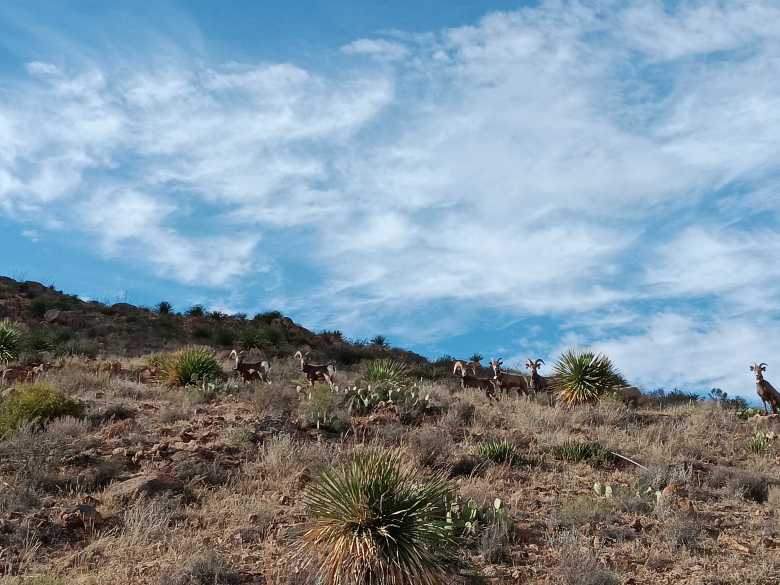 A view of desert bighorn sheep from Woodrow Bean Transmountain Drive Nov. 19, 2025. (Elida S. Perez / El Paso Matters)
Desert bighorn sheep roadkills aren’t common because the animal prefers the safety of higher, steeper terrain, Balin said. The sheep also tend to run to higher elevation when they sense danger from below, Etchart said.
But this year’s rainfall caused certain lower-elevation areas to turn green and for longer, perhaps leading the ewe to wander close to the road for food, he said.
Etchart said his department is in talks with TxDOT to put up yellow signs warning drivers to watch out for desert bighorn sheep. These signs exist in other states, but Texas hasn’t put any up yet because outside the Franklin Mountains, the sheep live in less-trafficked areas, he said.
Balin started a Franklin Mountains roadkill survey this year to identify areas with high levels of wildlife-vehicle collisions. While the sheep translocation prompted her to start it, participants can also list other species including mule deers and javelinas.
Anyone, including the public, can use the online survey.
The more robust systems for preventing wildlife-vehicle collisions usually involve more than one technique, such as a combination of fences and roadside animal detection technology. But the most effective techniques also tend to also be the most expensive, Balin said. One sheep death is not enough to spend resources and it could take many years of data collection, Balin continued.
Related
LISTEN: EL PASO MATTERS PODCAST